Italy
East of the MountainsItaly is the setting where Ben Givens encounters the physical wreckage of war, retreats from combat after a killing, and marries Rachel Lake. The narrative traces his passage through damaged southern cities and northern battlefields before bringing him back to Livorno, where the end of fighting makes possible a private commitment amid a devastated landscape.
Arrival and the southern staging ground
After a nine-day passage, Ben’s unit entered the Bay of Naples in dismal weather. From the harbor, the soldiers saw sunken German ships and bomb-damaged buildings. Their arrival offered none of the ceremony that had accompanied their departure from Virginia: instead, beggars, Red Cross workers distributing stale doughnuts, and waiting army trucks marked the transition from ship to war zone. The Empress of Australia lay so close that it blocked their view, leaving them with only the curve of its hull.
Ben came ashore on Christmas Eve, 1944, among newly arrived soldiers crowding the damaged docks. Bailey bridges spanned gaps in the pier, and a catwalk crossed a capsized ship. In a converted quartermaster truck, he passed through Naples, where bomb-loosened streetcar tracks twisted across the streets and apartment facades had fallen away. The journey brought the war into view not as a distant front but as damage woven into the city’s everyday routes.
The company spent Christmas Eve in Bagnoli, in a bombed-out orphanage that the Germans had previously occupied. Its school building was cold, dark, and unfurnished. Rain came through broken windows, and Ben, wearing layers under his trench coat and wrapped in blankets, tried to sleep sitting upright. The position recalled fruit pickers he had seen resting against tree trunks when the ground was too cold or damp. His thoughts turned to home and Rachel Lake. At noon, the soldiers ate turkey and potatoes from their mess kits for Christmas; the next day they boarded the SS Sestriere and landed at Livorno in darkness.
The campaign and its aftermath
From Livorno, the troops traveled northeast to Pisa and camped in the Tenuta di San Rossore, once a royal hunting and picnic ground. Artillery sounded in the distance, its flashes visible at night, while soldiers played cards beneath the poplars. The juxtaposition of a former aristocratic landscape and a military encampment situates ordinary routines inside a country being traversed and remade by war.
As the regiment advanced across the Po plain, it moved through Bomporto, San Benedetto Po, Villafranca, and Verona. Ben made no pretense of fighting. He was involved in the fighting to liberate Torbole, but remained behind a wall and did not participate. His withdrawal from combat is part of Italy’s significance in his story: the country is not merely the backdrop to a campaign, but the place where his relation to violence changes.
After the surrender, Ben was sent to Bolzano. Men from his company took shotguns and pistols from the Beretta factory and guarded a warehouse holding paintings the Germans had plundered from Florence. The collection of stolen art, guarded in a northern Italian warehouse beneath the distant Dolomites, gives the postwar setting its own unsettled character: the fighting had ended, but its spoils and consequences remained present.
Livorno, reunion, and marriage
On the train back to Livorno, other soldiers celebrated their expected return home, drinking wine and waving to people in the fields. Ben remained silent as the train passed shelled towns, shattered farmhouses, and burned tanks. Against this landscape of ruin, he wrote to Rachel in Marseilles. She came to Livorno aboard a hospital ship, taking twenty days of leave to see him.
Ben searched for her near an encampment of army tents beside the Ligurian Sea. He found her after being told she had gone swimming. Their reunion joined recognition with change: each seemed harder and darker than before, but Rachel held him and comforted him. They spent the night in a room above a bakery, in uncomfortable conditions that did not prevent their closeness. The next morning, an army chaplain married them, waiving the usual regulations despite Rachel’s being an officer and Ben’s being enlisted. The chaplain connected the end of the fighting and the deaths it had brought with the possibility of marriage; the ceremony turned Livorno into the place where their wartime separation became a shared future.
A journey north and a promise about death
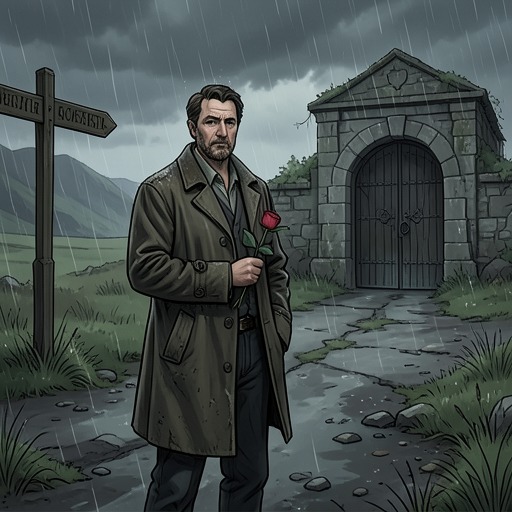
After the wedding, Ben and Rachel took the chaplain’s jeep, bought chianti, and traveled toward Florence, stopping in Pontedera. They left the jeep near the Palazzo Strozzi and continued north by train through forested valleys. On the train to Bressanone, Rachel proposed that their ashes be placed side by side: his associated with a red rose, hers with a white one, with the hope that the colors might eventually merge into pink. The couple recognized that the outcome could not be guaranteed and left it to fate.
From there they rode west in a supply truck and set out on foot into the mountains. During the journey, Ben told Rachel about the German soldier he had killed in Italy and admitted that he had not thought at the time. Her response—that the situation had been difficult—did not erase his belief that events need not have turned out as they did. Italy thus holds both the memory of violence that Ben cannot simply put aside and the marriage through which he begins to tell it. Its route from ruined harbor to mountain passage gives the narrative a geography of movement, but not of easy release.