Jimmy Perez
East of the MountainsJimmy Perez appears in the account of Doris’s difficult labor as her partner and the father of their child. He helps care for Doris, identifies himself to Ben Givens, and remains present as Ben delivers their daughter. His questions and actions place him not at the edge of the emergency but within its immediate circle of responsibility: he attends to Doris, worries aloud about the baby, and agrees to seek further medical care afterward.
Identity and Relationships
When Ben asks for the laboring girl’s name, Jimmy supplies it: she is Doris. He tells Ben that she is fifteen and confirms that he is the father. When Ben asks for his own name, he identifies himself as Jimmy Perez. These exchanges establish the central relationships in the scene: Doris is Jimmy’s partner, and the baby Ben is trying to deliver is Jimmy’s child.
The account gives no further background about Jimmy or the couple. His role is defined through what happens in the confined room: he stays close to Doris, responds to questions, and faces the uncertainty surrounding the birth with her. The scene’s focus remains on the immediate family and the decisions required to protect them.
Supporting Doris During Labor
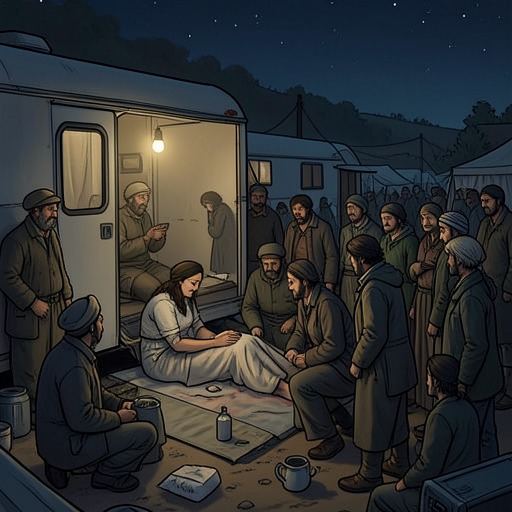
Jimmy drapes a blanket over Doris and later puts a hand on her back, leaning close to her while Ben tries to help. These gestures are small and practical, but they show him participating in her care rather than leaving the crisis entirely to the older physician. Doris is in labor in a trailer, and Ben determines that the baby is already beginning to emerge; the option of reaching a hospital before delivery has passed.
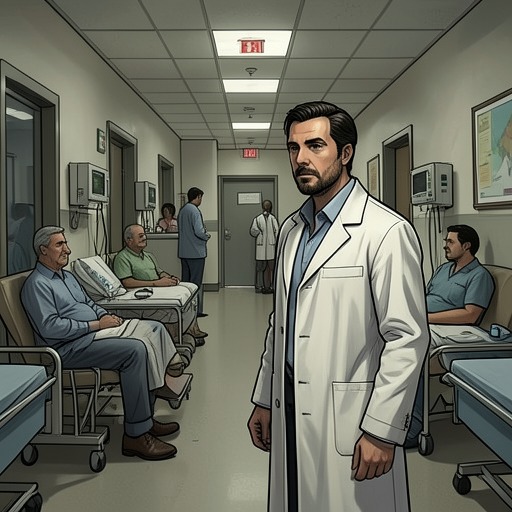
Ben has not attended a birth since his obstetrics internship decades earlier and initially says that Doris needs a hospital. As events progress, however, he recognizes that there is no longer time to transfer her. Jimmy remains beside Doris through this change in plan. His presence does not resolve the medical danger, but it gives Doris immediate support while Ben takes responsibility for the delivery.
The Birth and Jimmy’s Response
During the delivery, Jimmy asks whether the baby is dead. The question makes the uncertainty of the moment explicit: the child’s condition is not yet known, and Ben has to continue working to free her. Ben answers that they will get the baby out. Once the girl is delivered, he stimulates her until she begins moving, makes small sounds, and gradually turns pink. Jimmy’s fear gives way to the recognition that his daughter is alive.
The glass-eyed woman who has been present calls the birth a miracle. Jimmy’s response is more restrained: he thanks Ben. That brief acknowledgment marks the importance of Ben’s intervention without displacing the couple at the center of the scene. Ben places the cleaned, covered baby on Doris’s belly, and Jimmy lies down to look at his daughter, covering his mouth in disbelief. The account thus moves from a question about whether the child has survived to Jimmy’s direct encounter with her.
Aftercare and Narrative Significance
After the delivery, Ben checks Doris and advises Jimmy to take both mother and child to a doctor as soon as possible, suggesting a clinic in Wenatchee, Washington. Doris may need stitches, and Ben wants a clinician to check the newborn as well. Jimmy agrees and thanks him. The birth is therefore not presented as the end of the emergency: the immediate crisis has passed, but the family still needs professional follow-up.
Jimmy’s significance in the episode lies in this sequence of concrete responsibilities. He names Doris, confirms his relationship to her and the baby, supports her during labor, voices his fear for the child, and accepts the next steps in their care. His limited speech does not make him incidental; the questions he asks and the decision he makes register the stakes of the birth from a father’s position. The scene places him within an improvised network of care, alongside Ben and the others in the trailer, and ends with the new family facing the need for continued medical attention.