Lenora Givens
East of the MountainsLenora Givens is Ben Givens’s mother, a forceful advocate for the family orchard and a skilled worker whose religious conviction makes labor a form of love and a way of discovering one’s purpose. She is neither confined to domestic life nor separated from it: the same woman who keeps the orchard books, argues agricultural policy, and outworks her husband in the packing shed also teaches her sons that their future should follow the particular gift they have to give. Her final illness puts that faith under pressure, and her death becomes a defining loss for Ben and the family.
Identity and Background
Lenora, born Lenora Chandler, came west with her parents and two sisters in what the narrative describes as an adventure. Her sisters later returned east; she stayed, married Wright Givens, and made her life in the orchard country. She had attended boarding school near Boston and learned decorum there, but her composed manner accompanies considerable practical authority. In Wenatchee, people ask her about irrigation work and apple prices; she answers confidently without arrogance. At home, she keeps the orchard accounts and tells her husband when to plow new land and plant new trees.
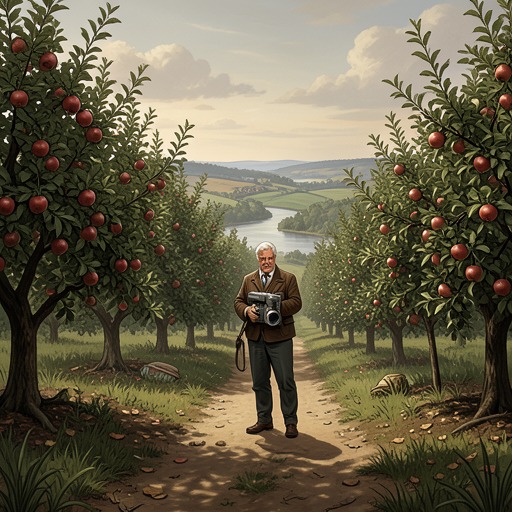
Her connection to the fruit industry is familial as well as professional. At a growers’ conference, she introduces herself as the wife of Wright Givens, whose grandfather brought the first fruit stock across the plains, and as the daughter of the founder of the Rainier Delicious apple. The details place her within an agricultural inheritance, but her public authority comes from her own judgment and command of the business at hand.
Work and Public Judgment
At the 1932 Grade and Pack Conference, Lenora speaks from the floor after sitting for two hours beside her sons and husband while men argue. Dressed in black, tall and direct, she objects to allowing even C-grade apples to be shipped worm-stung, discolored, or hail-pocked. Culls, she argues, should go to vinegar plants rather than be sold into a market already flooded by brokers in Spokane and Portland with higher-grade culls. That glut depresses prices, while Winter Bananas at $1.25 a box do not cover picking, packing, freight, and auction costs.
Her argument connects the quality of the fruit to the financial survival of the people who grow and ship it. She warns that the 1929 stock market crash has left many shippers bankrupt and that orchardists depend on shipping contracts as collateral for bank loans covering growing costs. Her proposed responses are specific: lobby through the shippers for a Great Northern freight rate of $1.25 per hundred pounds, use sea shipment from Puget Sound rail points to counterbalance the railroads, and consider the Crop Production Loan Office plan for spray and fertilizer purchases. She also sets out what she considers sustainable labor costs: picking wages near 15 cents and box construction at no more than 75 cents per hundred. She predicts that orchards could be out of business within two seasons without action, but insists that growers can endure a tightening of belts and that conditions may eventually improve.
The response gives the scene its measure of her presence: the gathering is silent while she speaks and remains so afterward. She sits with her eyes fixed ahead, fanning herself with a Yakima newspaper, and Wright reaches across her lap to take her right hand. Her authority is grounded not only in family lineage but in detailed economic reasoning and years spent managing the orchard.
Labor, Faith, and Her Sons
Lenora’s work is visible in the repeated routines of family life. Once a month she takes Ben Givens and Aidan Givens to Wenatchee for errands at the bank, courthouse, post office, utility office, market, apothecary, fabric shop, and library. In summer, she works alongside her sons in the packing shed. The family buys box shook from a mill in Malaga and ferries it across the river; with a box hatchet, she drives nails with either hand and can make sixty-five boxes in an hour, five more than Wright. She holds ten nails at once as if they were sewing needles. During picking season she wraps apples in oiled tissue, packs them tightly, nails down the lids, loads the wagon, and attaches a label she designed, showing the orchard beside the river.
Her faith gives this labor a meaning beyond necessity. A dyed-in-the-wool Presbyterian, she takes her sons to church and revises the minister’s teaching for them: work is not merely a curse to be endured, but an expression of love for God and a path toward knowing Him. When Ben says he does not know what he would do besides apples, she answers that he will do whatever is in the spirit of who he is, and that he will have some kind of gift to give. Her counsel links identity to action: people come to know themselves through the work they do. She does not prescribe Ben’s occupation; she trusts that his particular design will disclose itself through purposeful work.
Illness and Death
When Dr. Williams tells the family that Lenora has an incurable pancreatic tumor, Ben protests that a doctor should be able to cure her. The doctor answers that he is not a magician. The diagnosis brings the limits of work and effort into sharp relief: the woman who has managed practical problems with confidence cannot make her own illness yield to competence or persistence.
Lenora tells Ben that she is afraid of the pain and says, “This isn't any way to live,” adding, “I miss the world, Ben.” When he proposes putting her bed outside, she explains that the problem is not simply where she lies: “It's more that my work on earth isn't finished. Raising you, I'm not done with that. You and Aidan both.” Her words make motherhood part of the vocation she has taught Ben to understand. She later tells him to “Do something fine” and “Do something grand and wonderful. Whatever your heart desires.” He promises to try.
Later that week, on June 28, 1938, Lenora dies at 6:35 in the morning. Ben, Aidan, and Wright sit on kitchen chairs brought into her room. As her wheezing stops, Wright lowers his cheek to her heart and says her name twice: “Lenora,” he said. “Lenora.” She is buried on a knoll above the river, with relatives and neighbors gathered there; that evening, a thunderstorm brings rain across her grave.
Legacy and Narrative Significance
The summer after Lenora’s death, the family works the apples with a hollow feeling, and the orchard falls into decline. The change makes her absence material: the orchard is not only the setting of her life but the work she organized, interpreted, and performed beside her family. Her business judgment had addressed the conditions that might keep orchards solvent; her daily labor had turned harvest into boxes of carefully wrapped fruit; her faith had given labor a moral and spiritual meaning.
For Ben, her influence also takes the form of an unfinished charge. She tells him that a life’s work is particular to the person who does it, and that he should give his gift to the world. Her own account of motherhood remains unfinished at her death, but the instruction survives her: labor can express love, and a person’s identity is not exhausted by the work already familiar to him. The contrast between that hopeful counsel and her final helplessness over pain does not erase her convictions; it gives them the weight of a life lived within both meaningful work and limits that work cannot overcome.