Medical duty and professional identity
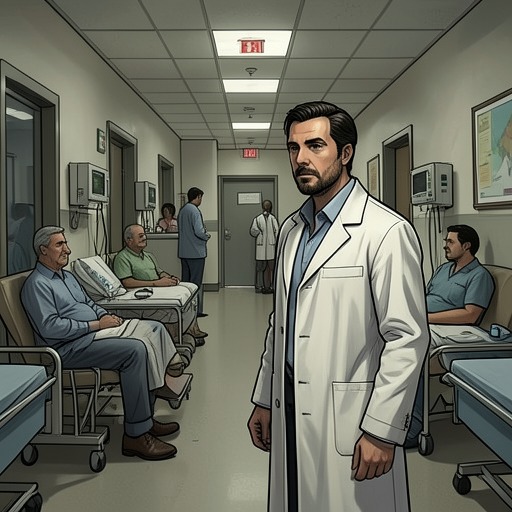
East of the MountainsMedical duty and professional identity are tested whenever Ben Givens confronts suffering he cannot simply cure. A physician accustomed to intervention, he must face both the limits of medicine in his own terminal illness and the persistent demands of care in others: an injured dog, a wounded comrade, a seriously ill stranger, and a woman in labor. The novel makes his professional identity practical rather than ceremonial. It survives through attention, judgment, and work, even when he is frightened, out of his usual setting, or unable to promise a cure.
Identity and the Limits of Medicine
For years, Ben practiced as a physician with confidence in his hands and in medicine’s power to intervene. He had treated patients’ hearts as problems to be met tactically, and had tried to keep emotional distance from deaths he could not prevent. That distance had never meant an absence of tenderness: he understood both the physician’s capacity to act and the helplessness that accompanies it. His own diagnosis collapses the distance he had maintained. As a doctor, he regards his cancer as incurable and anticipates a course of suffering that he believes medicine cannot stop. Expertise gives him a clear understanding of his prognosis, but not control over it.
This reversal makes professional knowledge a source of distress as well as authority. Ben has heard people describe gradual dying as a time when love and ordinary experience become more vivid, but he doubts that such consolations capture the pain he expects. His reasoning about ending his life grows from a physician’s knowledge of what disease can do and from his conviction that suffering may overwhelm any argument for endurance. The contrast is central to the concept: medicine has taught him to recognize what may happen, while his own illness forces him to inhabit the vulnerability he once encountered in patients. His professional identity cannot protect him from being a patient, and his knowledge cannot supply the intervention he wants for himself.
Care for Rex in the Field
The clearest instance of Ben’s duty persisting under pressure comes when Rex is injured in the desert. Ben is exhausted and in pain, and he has reasoned that he will soon die; nevertheless, he continues after the dogs because his conscience will not let him abandon them. The obligation is tied to the person he understands himself to be: a doctor who attends to details and a man who does not casually neglect responsibilities. His decision to keep moving is therefore not simply a response to danger. It is a refusal to let his expectation of death erase the habits and commitments by which he has lived.
When he reaches Rex, Ben shifts from desperate search to clinical assessment. He uses his medical kit and headlamp, cleans his hands, and applies gauze to keep the dog still while he examines him. The careful examination identifies several serious wounds, and Ben recognizes that they must be closed before Rex can continue across the desert. He has experience treating people in the field, including stitching cuts and managing other injuries, but has never stitched a dog. That difference does not make him abandon the task; it marks the limit he must cross through adaptation. He builds a fire from willow to provide warmth and light, while hoping Tristan will find it too.
Ben’s care for Rex also persists when the encounter with the armed rider could have pulled his attention toward retaliation. The rider leaves with the wolfhounds and Ben’s shotgun, but Ben turns away from him and kneels beside Rex. The decisive action defines duty as a choice of where attention belongs: not toward the challenge to his authority or possession, but toward the dependent creature who needs treatment. His apology and soothing manner accompany the practical work, joining technical care to an awareness of Rex’s distress.
Physician and Assistant
At the veterinary clinic, Ben does not treat his field work as a reason to displace the veterinarian. He offers to stay and help, accepts the consent and cost arrangements, and assists Dr. Ilse Peterson with Rex’s procedure. The change of role is striking: nineteen months earlier his surgery had involved a human heart; now he is assisting a veterinarian with a dog. Yet the familiar sequence of preparation and focused work draws him back into a professional practice he had expected to leave behind. Dr. Peterson uses anesthesia and intravenous support, while Ben helps hold Rex and administers an antibiotic at her direction. She also recognizes that his field stitches, despite the difficult circumstances in which he placed them, helped keep dirt out of the wounds.
This is not a return to mastery without limits. Ben contributes his skills, but the veterinarian directs the procedure and provides the specialized care Rex needs. The scene presents professional identity as collaborative: competence includes knowing how to assist, following another clinician’s lead, and applying one’s own experience where it is useful. For Ben, the work is also a reversal of his intended end. At a time when he had expected to be dead in the sage country, he finds himself preparing for surgery as he has done many times before. The obligation to care reappears not as an abstract belief but as a set of familiar actions.
Triage, Judgment, and Referral
Ben’s response to Angel, a seriously ill young man traveling on a Greyhound bus, illustrates a different boundary: recognizing urgency without pretending to provide care he cannot deliver. When asked about the symptoms, he considers tuberculosis and pneumonia among the possibilities, while acknowledging that other infections could also account for them. He does not turn a provisional judgment into a definitive diagnosis. He explains that he has no medical equipment with him and cannot offer treatment, and urges that Angel reach a clinic or hospital.
When Angel collapses at the bus station, Ben calls the emergency operator and identifies himself as a doctor. He describes the situation as an emergency, reports that Angel has coughed up blood, gives the station location, and answers questions about the patient and his own credentials. When the ambulance arrives, he directs the technicians to Angel and communicates his concern that the young man needs immediate assessment and hospital care. The sequence makes duty include advocacy and handover: Ben uses his authority to bring help to someone in danger, while being candid about what he cannot do. His judgment matters not because he resolves the illness, but because he recognizes the need for more capable and properly equipped care.
Emergency Care and Professional Continuity
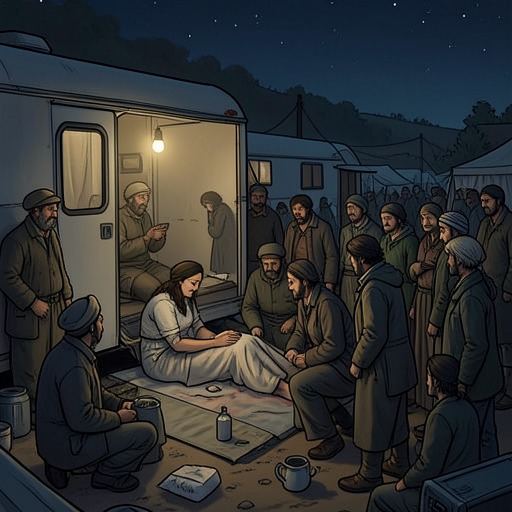
Ben’s response to Doris’s labor brings his medical identity into a situation for which he is poorly prepared. He has not attended a woman in labor since an obstetrics internship forty-four years earlier. His first judgment is that she should be taken to a hospital and that an ambulance should be called. As labor advances, however, he recognizes that transfer is no longer feasible. He observes the baby’s position, explains what it means, and turns to the practical preparations needed for delivery.
When the baby’s arm is caught, Ben makes a difficult intervention to free the shoulder and assist the birth. The scene acknowledges the limits of his experience and the distress of the situation without presenting him as an obstetric specialist. His action is an emergency response shaped by immediate observation: he pauses, assesses what is happening, and acts because the option he initially preferred is no longer available. Afterward, he receives the newborn and tells the others that the baby is a girl. The event carries the same pattern as his care for Rex and Angel: professional duty does not guarantee certainty or ideal conditions, but it requires a response to the need actually present.
Significance
Across these episodes, the novel distinguishes medical responsibility from the fantasy of complete control. Ben cannot cure his cancer, cannot make a field setting equivalent to a clinic, and cannot substitute for every specialist. But those limits do not make his knowledge useless or his responsibilities disappear. He assesses, treats, assists, refers, and calls for help according to the circumstances, adjusting his role as those circumstances change.
The recurrence of care also unsettles Ben’s expectation that his approaching death will make ordinary obligations irrelevant. His own reasoning about suffering remains serious, but his conduct repeatedly binds him to the living needs before him. The doctor who once tried to distance himself from the mystery of death is now both patient and caregiver; his hands cannot save him from cancer, yet they still matter to Rex, Angel, and Doris. Professional identity, in this account, is neither a guarantee of rescue nor a defense against mortality. It is a durable practice of attending to another’s vulnerability while acknowledging what cannot be done.