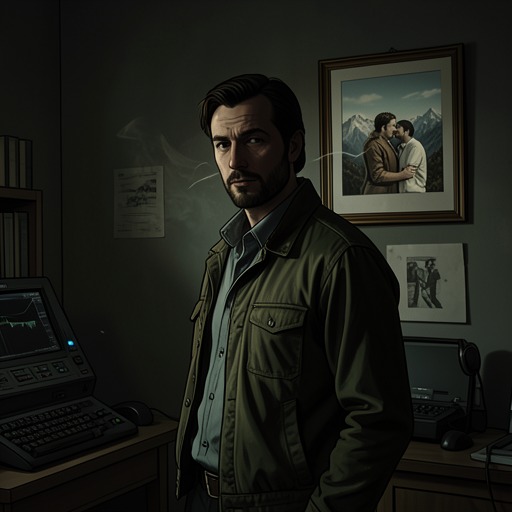
Memory and the Story of Love
East of the MountainsMemory and the Story of Love is the pattern through which Ben Givens revisits his life with Rachel: physical keepsakes summon the past, present encounters open onto remembered scenes, and the act of remembering becomes inseparable from the fear of losing the story. His memories preserve a marriage and its particular details, yet Ben knows they are selective and fears that, when he dies, no one will be able to carry them forward.
Keepsakes and the Work of Remembering
The night before leaving, Ben pages through photograph albums and correspondence, holds the earrings and lockets Rachel wore, and searches among the objects she left behind. The collection is deliberately various: a jar of sewing buttons, a lavender wand, a pair of shoes, foxglove seeds, and a sketch pad containing unfinished drawings of trees. He opens her garment bag and searches among her dresses for a trace of her. These things do not amount to a complete record of Rachel; their small, separate particulars give his attention somewhere to rest as he tries to recall her.
The archive reaches beyond his marriage. In books he finds his mother’s handwritten signatures, and in a cedar box his father’s pocket watch, still missing its face glass after fifty years. Near the bottom of a box are photographs of his daughter, Renee; other pictures show Ben among apple orchards and on mountain summits, in uniform and on leave in the mountains of northern Italy. Remembering Rachel therefore takes place amid several generations of family history and images of Ben’s own earlier selves. The keepsakes make the past tangible, but they cannot make it whole.
The Present as a Trigger for the Past
During the journey east with Kevin Lamont and Christine Reilly, Ben accepts water and roasted pumpkin seeds from Christine. The offered food creates a small present-tense exchange, and the seeds recur later as something he can eat while alone. The journey also sets present conversation against memory: after a remark from Kevin about reality, Ben does not answer, but remembers traveling with Rachel in the Dolomites. He recalls their route through the mountains, their newly married days, and the places they visited, including the Refugio Scotoni and the Hotel Monte Sella. The remembered trip is not presented as a neutral itinerary; its landscapes, meals, and shared time gather into Ben’s account of what life with Rachel meant to him.
The movement between present and past is not simply escape into a happier time. Ben sits with pain from his recent ordeal, fingers the bandage at his temple, and watches the road, while memory offers scenes that are both consoling and difficult to bear. Later, after the young travelers have gone, the pumpkin seeds, Italian carabiner, and ring-angle piton remain with him. Touching these objects recalls different parts of his life: Christine’s kindness, his climbing history, and Rachel in Italy. A present object can hold more than one association, allowing the narrative to pass between episodes without treating the past as finished or separate from the journey.
Italy as a Shared Story
Ben’s recollections of Italy return in distinct scenes rather than as a single continuous account. He remembers Rachel and himself taking a mountain trail to see the evening light on the Torre di Vaiolet, staying at a hotel by Lago di Carezza, and traveling onward through places including Falzarego and Lagazuoi. Another memory fixes their marriage as only ten days old. Ben recalls the hotel in San Vigilio de Marebbe, its decorated interiors and meals, and the ordinary time they spent together there. The accumulation of such details gives their relationship a shared setting and a history made from particular journeys, places, and routines.
A later recollection shifts to the plain of the Po, where the newlyweds slip between rows of apple trees and kiss. Ben understands the tenderness of that moment alongside the knowledge that time can undo what people most want to preserve. The scene therefore carries its own contrast: their good fortune is present, but already shadowed by its vulnerability. The memory is not merely proof that the marriage was happy; it preserves Ben’s awareness, even within happiness, that time changes and eventually removes what matters.
In another Italian memory, Ben and Rachel travel by train from Mantua. He remembers the light in the sleeper-car window, the landscape passing outside, and the two of them sitting quietly as the train settles into a steady rhythm. The scene narrows from travel to shared presence and then to the roses Rachel imagines: red and white varieties becoming a single bush of pink roses. Ben agrees to her vision. Recalled alongside the journey and the orchard, the promise becomes one of the story’s compact images of their life together: two distinct colors imagined as a shared future.
Mortality and the Limits of Memory
Ben does not treat memory as a perfect record. Sitting in the van, he mistrusts it because it makes what was beautiful unusually vivid while allowing the rest to recede. That imbalance brings pain rather than uncomplicated comfort: remembering can sharpen loss precisely by preserving the scenes that seem most worth keeping. The narrative’s returns to Italy enact this selectivity. Each recollection offers a carefully held fragment, but none can restore the whole past.
His deeper fear is that Rachel’s story will disappear with him. Ben imagines that his death will end the narrative of their time together, leaving no one to explain what their love was or preserve its particular meaning. This concern makes the act of remembering more than private reminiscence: as the novel presents it, memory is also a form of witnessing, though Ben doubts that it can survive its witness. The keepsakes, photographs, and repeated Italian scenes resist erasure for a time. Their survival in the narrative gives readers access to the story Ben fears will otherwise leave the earth with him.