Quincy, Washington
East of the MountainsQuincy, Washington, is both a waypoint on Ben Givens’s journey toward the Columbia River and the place where an emergency forces that journey into a different kind of work. Its after-hours veterinary clinic becomes a setting for Rex’s treatment and for Ben’s unexpected return to surgery, while the town’s roads and bus connections link his private crisis to the wider basin and its inhabitants.
Setting and Place in the Journey
Ben’s intended destination lies beyond Quincy, not in the town itself. From Quincy, it is six miles to the Columbia River: his route crosses Babcock Ridge and the mouth of Lynch Coulee, passes the trading post at Trinidad, and continues upriver toward Rock Island. The surrounding points of reference—northwest of Baird and Willow Springs, southwest of Moses Coulee, and beyond the Burlington Northern Line and the road to Palisades—place his planned end within a specific working landscape. He has set out for a place where he hopes to die, seeking an uncomplicated end in the country where his life began.
The approach to Quincy is therefore charged by what Ben intends to do after passing through it. Yet the town interrupts the clean conclusion he imagines. Just before dusk, Ben and Stu Robinson reach the junction of Highway 28, the Ephrata-Wenatchee Road. A boy at a gas station directs them to a veterinarian, and Robinson drives west until they reach the Quincy Veterinary Clinic, near the cemetery and a cavernous cold-storage warehouse. The clinic is closed on that Sunday evening, but its window displays an after-hours number. Quincy is introduced through practical landmarks—road junction, warehouse, cemetery, clinic—rather than as an abstract refuge from the journey.
The Veterinary Clinic and Rex’s Treatment
After the clinic’s recorded message directs Ben to another number, he reaches Ilse Peterson at home. He explains that Rex is severely wounded and that they have traveled on foot from Vantage to George, Washington. Peterson tells him to wait outside her office while she comes in. Her response turns the closed clinic into an available place of care: she arrives, examines Rex in the parking lot, and opens the building so Ben can bring the dog inside.
Peterson’s professional manner makes a strong impression on Ben. He sees a young veterinarian whose directness and practical confidence suggest experience, and he trusts her with Rex. The narrative also frames her as part of the region around the river basin, imagining her among the families associated with its farms, orchards, and dams. Those details connect the clinic’s work to a locally rooted culture of labor and land, while her competence remains grounded in the immediate demands of treatment.
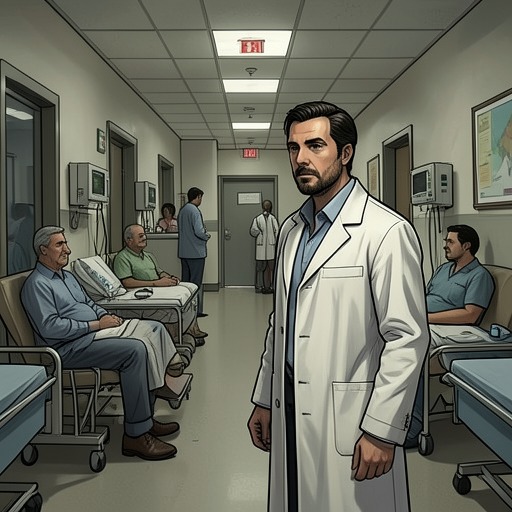
The clinic becomes the scene of an unexpected professional partnership. Peterson prepares Rex for surgery, and Ben assists: he helps hold the dog, administers an antibiotic through the intravenous line, and watches as she evaluates and treats the wounds. Ben has not performed surgery for nineteen months; his earlier work was repairing human hearts, not assisting a veterinarian. Nevertheless, he feels excitement as he removes his field jacket, rolls up his sleeves, and washes his hands. The contrast is stark: he had expected to be dead in the sage country, but in Quincy he is preparing to help save a life.
Peterson recognizes that Ben’s field stitches have kept much of the dirt out and calls them well done. Her assessment gives his improvised care a measure of professional acknowledgment, even as she takes charge of the operation. The scene does not erase the distinction between their roles: she is Rex’s veterinarian, while Ben contributes his medical training where it can help. Afterward, she tells him to sleep at a nearby motel and return when he wakes. The treatment will cost two hundred and fifty dollars, payable without a credit card. Her remark that two minutes of open-heart surgery can take two hours in dog surgery neatly registers the difference between Ben’s former specialty and the work he has just undertaken.
A Waystation Between Despair and Responsibility
Quincy’s significance extends beyond the clinic. During this stage of the journey, Ben calls Greyhound for the schedule of a bus upriver and contacts a Wenatchee company to reserve a rental car. He plans to go to Malaga, find William Harden’s Wolfhound Orchard, and recover his shotgun before returning to the Colockum country. The plan still ends in suicide, but it now requires a sequence of practical decisions and confrontations. Quincy is a staging point from which Ben tries to organize that remaining journey; its roads and services make movement possible without resolving his purpose.
The bus connection also carries Ben onward to Wenatchee, where a separate emergency tests his medical identity again. On the bus, he assesses a seriously ill young man and urges that he receive hospital care; at the station at First and Chelan, he calls emergency services after the young man coughs up blood. The emergency happens in Wenatchee, not Quincy, but the operator’s questions about the Quincy bus ride mark the town as the preceding link in that passage. Ben’s medical knowledge, first put to use in Quincy for Rex, continues to shape what he does after leaving.
Return and Narrative Significance
After the intervening events of the journey, Ben returns to Quincy to collect Rex from the clinic. Ilse Peterson is occupied, so a woman at reception brings the dog out and promises to pass along Ben’s gratitude. He checks Rex’s staples, strokes his coat, and settles him on a blanket across the back seat before whispering that they are going home. The pickup completes the clinic episode: Quincy has been the place where Rex received treatment, but it is also where Ben can resume the journey with his companion beside him.
The road from Quincy toward George, Washington, opens onto sunlit fields, large irrigators, and the sharp boundary between cultivation and steppe. Ben recognizes the fertility as precarious, dependent on water, and sees the arid plateau beneath the fields. This view links the town’s human arrangements to the altered Columbia Basin landscape, where cultivated ground presses against desert. As Bea drives, Ben tells her the story of how he came to this point, beginning with Rachel’s death and including his daughter and grandson, his lost shotgun, Rex’s wound, and his blackened eye. Quincy thus sits within a larger passage from intended solitude toward contact: at the clinic Ben accepts help and offers it, and on the road away he begins to tell his story to a stranger.