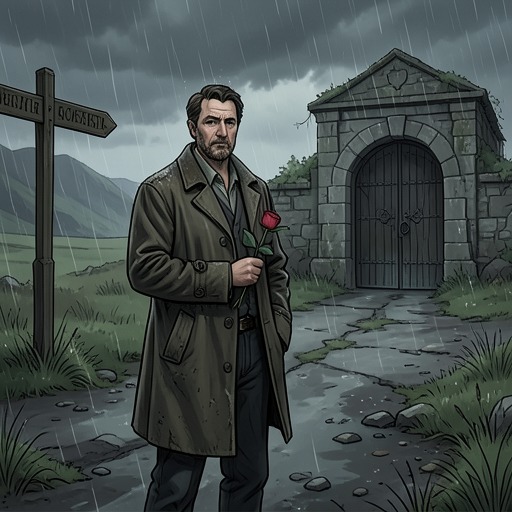
Rachel Givens's death
East of the MountainsRachel Givens’s death is the loss that reshapes Ben Givens’s life and gives their promise about roses its lasting force. The novel approaches the event through memory rather than a detailed account of the death itself: it establishes that Rachel has been dead for nineteen months, recalls the couple’s vow to have their ashes nourish red and white roses, and returns to their final conversation before her surgery. The circumstances of her death are not specified, but its consequences are visible in Ben’s altered work, habits, and hopes.
Loss and Its Aftermath
By the time of the novel’s present, nineteen months have passed since Rachel Givens died. Ben Givens has turned away from his work as a surgeon and has too much idle time; after Rachel’s death, he takes up hunting birds to shoot on the wing, a pursuit he had not followed since he was a teenager. The change is more than a new pastime: the loss interrupts a life organized around medical work and gives his days a different, haunting occupation.
The novel does not narrate the death as a completed medical scene or state its cause. Instead, it places the reader near its approach through Ben’s recollection of Rachel’s final hours before surgery. That boundary matters: the remembered exchange shows what the couple said and feared, while the death itself remains beyond the scene’s account.
The Promise of the Roses
The promise reaches back to a train journey from Mantua to Bressanone. Rachel and Ben imagined their ashes becoming the bed for two roses, his red and hers white, growing together and eventually intertwining. As they grew older, they were amused by the youthful, romantic idea but did not abandon it. After Rachel’s death, Ben preserves her ashes in the hope that their vow can still be fulfilled.
The image joins bereavement to a future imagined as shared. Rachel’s death has separated the couple, but the promised roses make that separation neither simple nor final in Ben’s understanding: he continues to hold open the possibility that their remains will nourish a single living growth. His recollection of the vow is also a measure of what he stands to lose if he chooses a death that would prevent its fulfillment.
Rachel’s Final Reminder
The promise returns in Rachel’s last conversation with Ben, the day before she died and two hours before her surgery. She reminds him of their colors—Ben as red, Rachel as white—and asks him to remember the roses and her love if she dies, while making clear that she is not planning to die. The words hold hope and contingency together: Rachel faces the possibility of death without presenting it as her expectation.
Ben answers her fear with professional certainty, telling her that the mortality rate for a mitral-valve replacement in someone in her condition is approximately one in a billion and assuring her that she will be fine. The exchange brings his identities as husband and heart surgeon into direct contact. He offers the confident prognosis of a doctor, while Rachel asks him to carry forward a private promise that no prognosis can guarantee.
Significance in Ben’s Life
Rachel’s death is present through recurring consequences rather than a full account of its circumstances. It marks the beginning of Ben’s withdrawal from surgical work, precedes his return to bird hunting, and leaves him guarding Rachel’s ashes for the sake of their shared plan. The roses give that grief a concrete form: a remembered vow that joins love, death, and the possibility of growth after loss.
The scene before surgery also places the limits of Ben’s medical confidence beside the intimacy of the couple’s promise. He can state a mortality estimate and try to reassure Rachel, but the narrative’s later confirmation of her death makes clear that reassurance did not prevent the loss. What remains is the request she entrusted to him: remember the roses, and remember her love.