Rex’s injuries and recovery
East of the MountainsRex’s injuries and recovery turn Ben Givens’s desert journey from a hunting expedition into an extended act of emergency care. After a pack of hounds attacks Rex, Ben intervenes, treats him with the equipment he carries, and later assists veterinarian Ilse Peterson in surgery. Rex survives the immediate crisis, but the treatment plan makes clear that survival is only the beginning: his wounds require follow-up care, restricted activity, and time before he may hunt again.
The attack and immediate care
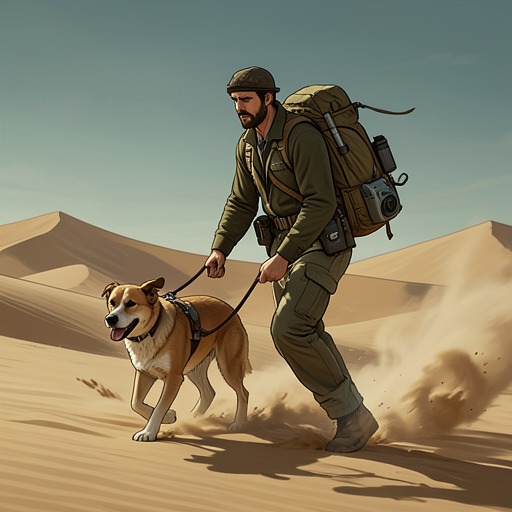
The crisis unfolds after the hounds, having finished with a coyote, turn on Rex. Several dogs bring him down and hold him, while Ben rushes into the pack. His warning shot stops most of the hounds, but one continues to attack Rex. Ben tries to pull it away with the butt of his shotgun and kicks it, then uses the weapon when he judges that Rex’s life is in immediate danger. The moment is a severe reversal in a journey organized around hunting: Ben must use his gun not to pursue game, but to protect his dog.
Rex is left badly hurt and unable to rise. Ben initially fears that his spine may be broken. He apologizes, but avoids touching him when Rex’s pain makes him writhe. After the rider on the dirt bike leaves with the hounds, Ben turns back to his dog. Rex has stopped struggling and appears to contain his distress; Ben nevertheless examines him closely rather than mistaking his stillness for recovery.
Using his headlamp and medical kit, Ben assesses injuries to Rex’s leg, shoulder area, and throat. The wounds are serious enough to require closure before the dog can continue the desert journey. Ben has extensive experience giving emergency care to people in the field, including stitching cuts and treating fractures and dislocations, but he has never stitched a dog. He cuts willow for shavings, builds a fire with a paraffin starter, and sits beside Rex, brushing his coat while hoping Tristan will find the blaze and arrive unharmed. Ben’s skill makes immediate treatment possible, but the unfamiliar patient and the severity of the injuries leave him needing veterinary care.
Field treatment and veterinary surgery
Ben later explains that he had to place the field stitches one-handed. Veterinarian Ilse Peterson examines them and says they are effective: they have kept most of the dirt out. Their value is practical rather than final. The wounds need to be assessed, cleaned, and repaired under veterinary supervision, and Peterson plans to anesthetize Rex, provide intravenous support, and spend two or three hours resuturing him. Ben agrees to stay and help.
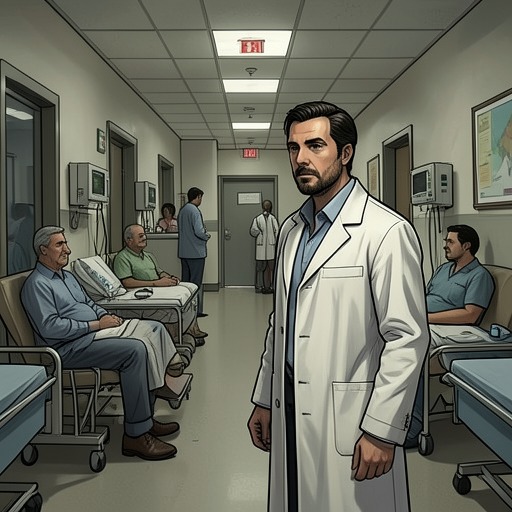
The work brings Ben back into a medical role he had not expected to occupy. Nineteen months have passed since his last operation, which was on a human heart; now he is assisting a veterinarian with his dog. Peterson asks him to help restrain Rex while she gives medication and establishes intravenous access. Once Rex is anesthetized, Ben administers an antibiotic as Peterson evaluates the wounds and removes the field stitches. His temporary repair has helped protect Rex, but Peterson’s examination and surgical work are needed to complete the treatment.
Peterson closes the wounds in stages, attending to the tissue beneath the skin as well as the skin itself, and treats the affected areas with cleaning and irrigation. She then gives Rex additional medication and monitors his return from anesthesia. Ben watches the careful procedure and rubs his own side. The sequence shifts the burden of care between them: Ben’s field experience has carried Rex through the immediate emergency, while Peterson’s veterinary expertise provides the operation and recovery plan.
Recovery and restrictions
Rex stays overnight with Peterson. She gives Ben a ten-day supply of antibiotics and five days’ worth of pain medication, and explains the practical work still ahead: the leg needs thorough rest, the staples should be removed by Rex’s veterinarian in Seattle after Ben gets home, and exercise should remain limited for ten days. The drains are due to come out in forty-eight hours, either under Ben’s care or at the veterinarian’s office. He must complete the antibiotic course rather than stopping early, and Rex may eat and drink normally while resting.
Peterson’s instructions establish recovery as a sequence of supervised steps rather than a single successful operation. The overnight stay allows further observation; medication and drain care continue after discharge; and Rex’s return to ordinary activity depends on rest and follow-up. Peterson allows that, with luck, he may hunt birds again around Thanksgiving, while estimating that he will need about six weeks before he can resume hunting. The cautiously framed forecast offers hope without presenting the outcome as certain.
Hunting, dependence, and significance
Ben tells Peterson that Rex lives to hunt and that hunting is all he wants. She replies that perhaps Ben is attributing his own desires to the dog. The exchange leaves open whether hunting is Rex’s defining purpose or Ben’s interpretation of their shared life, but it makes clear that recovery matters to Ben not only as a medical outcome: he wants Rex to regain the activity that has bound them together on the journey.
The injury also changes the immediate priorities of that journey. Rex cannot simply be treated as a companion who will keep pace; his wounds require Ben to stop, improvise, seek a veterinarian, and accept a period in which hunting is prohibited. The narrative does not confirm that Rex completes this recovery or returns to the field. Instead, it follows him from the attack through emergency care and surgery to a detailed, conditional plan for convalescence. That limit preserves the distinction between a successful intervention and a guaranteed cure.