Stemilt Hills
East of the MountainsStemilt Hills is an orchard country above Malaga where cultivated slopes, seasonal labor, and Ben Givens’s memories of the Columbia River valley converge. As Ben drives through it with Emilio, the abundance of the apple harvest draws him toward a new purpose, while the pain of his cancer forces him to stop and recognize that he still wants to live. The hills are more than a backdrop: their working orchards recall the world that formed Ben and bring him into contact with the people who sustain the harvest.
Setting and Agricultural Landscape
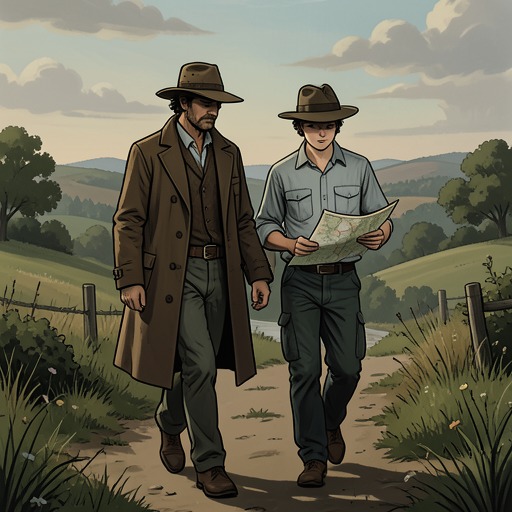
The route into Stemilt Hills passes through a landscape shaped by fruit growing. From the Stemilt Creek–West Malaga cutoff, Ben sees orchards extending toward Jump-Off Ridge, with roads winding through canyons and draws. A shaded pond lies where Stemilt Creek comes out of the mountains; farther uphill, the road gains about a thousand feet through tight switchbacks and turns among orchards cut into the slopes. Some hills had once been planted with grapes, English walnuts, and pears. From the crest of Stemilt Hill, the view opens eastward over the trees and across the river toward a wheat plateau.
The cultivated slopes invite comparison with distant agricultural country: Ben sees the manicured orchards as graceful as the plain of the Po and undulating like the vineyards of the Apennines. Yet the view is emphatically local and worked. Pickers stand on ladders among the apple trees, and the route passes camps, cabins, and packing sheds. The hills’ visual order depends on the repeated labor visible below it.
Ben’s Return to Orchard Country
The drive brings Ben back into terrain linked to his childhood. Pointing across the river, he tells Emilio that his parents’ farm was on the other side. That family orchard was not the same place as Stemilt Hills, but its work and landscape give the new journey a personal history. Ben had grown up among orchards where the seasons organized both the trees’ care and the household’s days: he and his family cleaned irrigation ditches, planted and pruned trees, thinned fruit, propped laden branches, and harvested apples and other crops.
The memory of harvest is especially concrete. In the summer when Ben first met Rachel Lake, the cherry picking began on June 11, with his father assigning workers trees, buckets, and ladders. Ben cleared leaves from his bucket and carefully gathered cherries with their stems intact; the season ahead seemed to stretch across thousands of trees and months of fruit. That earlier orchard scene helps explain why the working hills matter to him now: fruit growing is not an abstract view but a world of skilled, repeated tasks that he knows from the inside.
Harvest and Migrant Labor
In the present-day orchards, harvest transforms the hills into a busy work landscape. On Joe Miller Road, bins wait at the sidings as tractors move fruit, pickers fill their bags from ladders, and workers ease apples into bins to avoid bruising them. Coats, hats, canteens, and bottles hang among the branches; dogs rest in the grass while children sprawl in the sunlight. The usual quiet of the orchards is overtaken by the voices of workers. Their patient, dogged pace gives the harvest its own measure of time and effort.
The workers’ presence also connects the hills to a wider circuit of seasonal migration. In Ben’s childhood, pickers had traveled north through successive fruit crops, arriving at the Givens family place for cherries and peaches before later harvests, including apples. In Stemilt Hills, the camps and work sites make that labor visible as part of the orchard landscape itself. A camp sits in a hollow among pines, cottonwoods, and poplars; nearby are plywood cabins, a cinder-block washhouse, a creek, worn trailers, and a large, dilapidated equipment shed. The harvest’s abundance is inseparable from the workers’ temporary housing and arduous work.
Work at Wolfhound Orchard
Ben and Emilio travel through the hills toward Wolfhound Orchard, where a contractor, Lyle Parmenter, checks employment documents. He examines Emilio’s worn employment card, which bears the name Raul Ramirez, and Ben’s driver’s license and social security card. Parmenter questions whether Ben has picked apples and warns that the work is for a younger man. Ben insists that he can still do it and that his age has taught him how to pick properly. Their exchange makes the orchard a prospective workplace rather than merely a remembered or picturesque landscape.
The employment encounter leads Ben and Emilio into the workers’ camp. Sanchez shows them its washhouse, including a hot-water tank, two shower stalls, a wall heater, a washing machine, and a line for drying clothes. The practical details establish the basic facilities serving the pickers, while the camp’s worn buildings and equipment convey the conditions around the harvest. The place is part of the orchard’s working organization, not a separate pastoral retreat.
A Place Where Ben Chooses Life
Before reaching the work site, Ben stops near the community church because he is too ill to continue. His side feels as if it might burst, and even sitting upright hurts. He stumbles among the cherry trees behind the church, lies in the grass, and tries to endure his nausea. As he attends to his breathing and the rhythm of his heart, the orchard becomes the setting for a decisive recognition: he wants to live and to have the world of a cherry orchard in midautumn in river country.
The moment binds the hills’ harvest imagery to Ben’s changing purpose. The trees and fruit do not erase the physical reality of his cancer; on the road, he still vomits and struggles with pain. But this orchard country gives his desire a particular shape: not an abstract wish to continue, but a wish to remain among the landscapes and ordinary forms of life he knows. Stemilt Hills thus joins memory, labor, and bodily vulnerability in the turn that leads Ben toward work and away from his earlier intention to die.