The Apple Orchard and Its Fruit
East of the MountainsThe apple orchard and its fruit form a recurring image of the world Ben Givens comes from and, eventually, the world he decides he still wants. Orchards join the Columbia River country of his birth to family labor, his memories of Rachel Givens, and the harvest landscapes he encounters as an old man. Their fruit suggests abundance, but never abundance outside time: it must be tended and gathered, can be bruised or left to rot, and is bound to seasons that continue as individual lives approach their end.
The Orchard as Home and Working Landscape
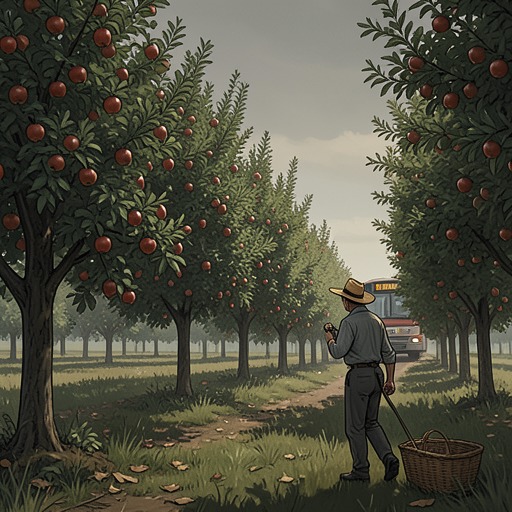
The orchard enters first as part of an autumn landscape that lies east of the mountains. Under October moonlight, apple orchards share the dry country with hay fields, vineyards, and sagelands; frost gathers on fallen fruit while apples still hang heavily from fragrant trees along the Columbia River, where Ben was born. This picture holds two conditions at once: the trees are laden, yet fruit already lies on the ground, beginning to rot. The land is beautiful without being exempt from decay.
Ben's parents' farm gives this landscape its concrete history. On the east bank of the river, Lombardy poplars sheltered the orchard as its rows descended toward the water. The planting included thirteen acres of Golden Delicious apples, two of Winesaps, and two of Rome Beauties, alongside eight acres of cherries and apricots. Irrigation ditches ran among the trees, with quack grass growing thickly and branch props leaning against forked limbs. A weathered shed served for making boxes and packing apples in oiled tissue; the farmhouse stood on a knoll among shade elms and willows, with the western hills visible from its front window. The orchard is not an abstract pastoral retreat but a worked place, built out of varieties, structures, water, and care.
That work shaped Ben's childhood through repeated tasks rather than a single harvest scene. He made apple boxes from pine shook, tended the kitchen garden, split firewood, and milked cows twice each day. With his father and brother, he put out pollinating hives in spring; when rain clogged the sluice gates with weeds, he and Aidan Givens cleaned them by hand from the ditches. The yearly cycle continued through planting and pulling trees, disking between rows in early summer, supporting young branches in July, thinning fruit, and propping limbs under the weight of apples. August brought picking, while pruning and burning water sprouts occupied fall and winter. Fruit here is the visible yield of sustained, seasonal labor.
Harvest, Memory, and Love
The harvest calendar also brings other workers into the family orchard. In June, when the cherries ripened early, Wright Givens set the eleventh as the first day of picking. At first light, the pickers assembled by the siding: Ben, his father, migrant workers including the Emery family and their children, and Rachel Lake, Mrs. Emery's niece, who had come from Waterville, Maine to stay for the harvest. Rachel wore borrowed work clothes that were much too large. The fruit orchard is thus a place where family life meets seasonal labor and where Ben's future relationship begins within the practical rhythms of picking.
The work itself is measured in buckets, ladders, crates, and the fruit gathered from the trees. Ben cleared leaves from his bucket and took the cherries with their stems intact, while the harvest ahead seemed to stretch through ten thousand trees and months of picking. He noticed Rachel high in a ladder, her borrowed denim pants cinched with Manila twine, then later saw her emerge from the shade to drink from a water jug. The details keep the abundance grounded in bodies at work: fruit must be reached, handled, and gathered before heat softens it. When the cherries grew soft in the afternoon, Wright called off the day's picking; the family and workers loaded the fruit and prepared the boxes for pickup.
After Ben and Rachel are together, the orchard becomes a setting for intimacy and shared attention. In late summer, they take a picnic basket deep among apple trees heavy with fruit. Their meal includes tomato sandwiches, spearmint tea, celery stuffed with peanut butter, cherries in syrup, and walnuts. As the sun lowers, light filters between the branches; they lie on a blanket and watch dusk become night, with the apples hanging dark and still above them. The fruit-filled trees shape a temporary shelter for their time together, while the changing light makes that closeness part of a season that is already passing.
The orchard also holds a more painful form of memory. Ben recalls that he and Rachel, newly married in Italy, slipped between apple trees on the plain of the Po and kissed in the cool darkness. In the memory, their tenderness is inseparable from the knowledge that time can undo what people most desire. The orchard does not preserve love from loss; it gives Ben a particular place through which to remember both the happiness of their marriage and its vulnerability.
Fruit, Mortality, and the Choice to Live
On his later journey, Ben again connects home with orchard country. After his crash, he tells two young travelers that he was born near Rock Island and is going home. When one remarks on the beauty of all the apple orchards, he agrees. This exchange makes the orchards more than scenery along a route: they identify the homeward direction Ben is trying to recover, a region known through its trees and fruit.
The motif acquires its sharpest force as Ben's intention to die gives way to his wish to remain in the world. In a cherry orchard in midautumn, he becomes aware of his breathing and the steady rhythm of his heart, and recognizes that he wants to live and to possess ordinary things such as an orchard. Cherries, rather than apples, furnish this decisive moment, but the orchard's meaning gathers together the book's recurring fruit landscape: the seasons, the work of cultivation, and the particular beauty of a lived place. The desire to live is expressed not as an escape from mortality but as renewed attachment to the world that mortality threatens to take away.
Later, driving slowly along Joe Miller Road, Ben passes a busy apple harvest. Ladders disappear among the leaves; bins wait in shaded rows; tractors carry fruit to the sidings. Pickers rest in small groups or work high in the trees, easing full bags of apples into bins to avoid bruising them. Coats, hats, canteens, and bottles hang or lean among the branches, while dogs lie in the grass and children sprawl in the sun. The scene places harvest abundance alongside the effort and care required to gather it, and it recalls the family work that formed Ben. Yet he is not returning simply to a remembered orchard: he is trying to find William Harden, the man he suspects of taking his shotgun. The working harvest continues around a journey shaped by conflict and grief.
Recurrence and Significance
Across these scenes, fruit links distinct stages of Ben's life without making them identical. Apples mark his childhood home and its demanding annual routines; cherries bring Rachel into that working landscape and recall their later intimacy; autumn fruit becomes part of Ben's recognition that he wants to live. The repeated return to orchards makes memory physical: rows, ladders, props, crates, and fruit give his attachments specific forms.
The motif also resists a purely idyllic reading. Fruit is abundant, but it depends on labor, water, tools, and seasonal timing. It can be bruised during harvest or left rotting beneath the trees; the orchard's beauty does not cancel either condition. That tension gives the image its emotional force. For Ben, orchards represent a world he has loved and worked in, one that continues beyond any single life. Their fruit can be gathered and cherished, but not held apart from change, loss, and the passing of time.