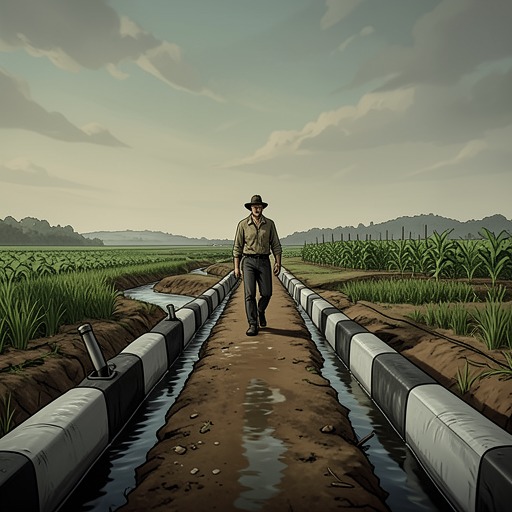
The transformation of the Columbia Basin landscape
East of the MountainsThe transformation of the Columbia Basin landscape is both the material history of the region and a conflict in Ben Givens’s understanding of home. Irrigation turns sagebrush country into orchards and fields, making fruit harvests possible far from the river, while dams and diverted water alter the river itself. The resulting landscape is productive and familiar, yet Ben recognizes that its abundance has been secured by changing the country he remembers.
River Country and the Family Orchard
Ben’s childhood landscape joined the Columbia River, orchard ground, and the desert beyond the cultivated land. His parents planted their orchards on the river’s east bank, sheltered by Lombardy poplars. The property contained thirteen acres of Golden Delicious apples, two of Winesaps, two of Rome Beauties, and eight acres of cherries and apricots. The farmhouse stood on a knoll among shade elms and willows; nearby were a packing shed, barn, stable, chicken house, outhouse, icehouse, and pump house. Irrigation ditches crossed the orchard, where props supported fruit-laden branches.
This was a working landscape, maintained through a year-round cycle rather than produced by harvest alone. Ben Givens made apple boxes, tended the kitchen garden, split cordwood, and milked cows. In spring, he and Aidan Givens helped their father set out pollinating hives and clear weeds by hand from the irrigation ditches. They planted young trees, removed older ones, controlled mice between the rows, tied back branches, thinned fruit, and propped limbs against the weight of apples. Picking came in August; pruning and burning water sprouts occupied the colder seasons. Agriculture appears as both an inheritance and a sustained bodily practice, shaped by waterworks, weather, and the timing of trees.
The orchard had a sharp boundary. Beyond it began a dry country of buttes, coulees, canyons, and sagebrush. Ben and Aidan took their dogs into that country to hunt birds, sometimes riding horseback or camping overnight. The contrast between orchard rows and open desert was part of the place’s character: cultivated ground offered a managed abundance, while the surrounding steppe remained expansive and comparatively unaltered.
Harvest, Migration, and Agricultural Abundance
The harvest scenes show how the orchard landscape draws in seasonal labor. In one early cherry season, Wright Givens set June 11 as the starting date after the fruit ripened ahead of schedule. At first light, Ben, his father, and nine migrant workers assembled, including the Emery family and its four young children. Rachel Lake, Mrs. Emery’s niece, had come from Waterville, Maine to stay for the harvest. The workers were assigned trees, ladders, and picking buckets; the cherries filled the buckets and were packed for shipment by the Consolidated Cherry Packing Company.
Harvest is described through repetition and scale. Ben sees ten thousand cherry trees and imagines the weeks and months of fruit still to come; the work continues until hands, leaves, and fruit seem to occupy even his dreams. The process depends on careful handling as well as volume: he strips the branches, gathers cherries in clusters, and takes care not to leave their stems behind. The fruit is an agricultural yield, but the narrative makes its production legible as coordinated, skilled labor.
Later views of the region extend that picture beyond the family orchard. On the road to Wenatchee, Washington, apple pickers fill canvas bags while tractors haul bins and loaded trucks carry fruit along the highway. In the orchards, workers rest in small groups or climb ladders among the trees; coats, hats, canteens, and bottles hang from branches, while children sit or lie in the grass. Their work fills what had been the orchards’ silence with voices. At the same time, the landscape includes makeshift camps beside the river and children near the water, details that place the human cost and conditions of agricultural labor alongside the visible prosperity of the harvest.
Irrigation and the Reordered Basin
The change is clearest to Ben when he returns across country that once held sagebrush, coulees, and willow draws. It has become fields of seed peas, potatoes, alfalfa, peppermint, and wheat, as well as orchards. The river that shaped his youth has been diverted and spread across the land to feed crops. Ben recognizes that the transformation is not simply an increase in cultivated acreage: water that once ran in its own channel is made to seep through the soil toward agricultural roots. As he puts it, "The river was no longer a river, and the desert was no longer a desert."
The altered scenery is not confined to farmland. Near Rock Island Dam, the river appears as a broad, choppy lake, while the road passes a silicon plant and an aluminum smelter. The region’s working landscape includes dams, industry, orchards, and transport as well as fields. In Wenatchee, Washington, orchards climb the edges of a prosperous town, and bridges and dams interrupt the river’s course. The older railroad freight yard across the water, once busy with apples, has become skeletal and little used. The basin’s agricultural transformation thus changes both land and infrastructure: it creates new routes and forms of production while leaving some earlier systems diminished.
Memory, Responsibility, and Ecological Limits
Ben’s response to the changed basin is divided by his own history. He knows what happened to the sagebrush lands because he helped burn them; he also sees that farmers like his father took control of the river believing it belonged to them, without intending evil. That recognition does not erase the consequence. Ben’s life spans both the fast river of his memory and the orchards made possible by its diversion, and he cannot simply choose one version of the landscape without confronting what the other has cost.
The novel connects this ecological contradiction to Ben’s inherited habits. He sees a likeness between loving the river while helping to diminish it and loving small birds while shooting them over pointing dogs. In both cases, affection coexists with practices that damage what is loved. The tension is not resolved by declaring the past wholly innocent or the present wholly corrupt: Ben understands the farmers as products of their time, yet remains unable to reconcile river and orchard. His attachment to old ways is bound up with his attachment to his own name and origins.
Near the end of his journey, the fields’ apparent fertility also looks precarious. On the road to George, Washington, irrigators stand in cultivated fields, but Ben sees a stark line between the crops and the steppe. The sage has been removed, and he judges the land’s fertility false because it depends on water reaching places that are naturally dry. If that water stops, the crops will die of thirst. The landscape’s transformation is therefore both a record of human work and a condition with limits: cultivated abundance has not abolished the desert but laid fields over it.
Narrative Significance
The basin’s changing geography gives Ben’s memories a physical measure. He was born upriver before the dams, grew up among orchards bordered by desert, and later travels through a country where irrigation has redrawn the relation between river and land. The October sunlight on the distant breaks and the contemporary orchards laden with fruit do not cancel one another; they hold the older and newer landscapes in view at once.
That double vision prevents the agricultural landscape from becoming either a simple pastoral ideal or a mere sign of loss. The orchard offers labor, family history, and the fruit that marks the seasons; the diverted river and disappearing sagebrush reveal the environmental price embedded in that history. Through Ben’s divided attachment, the Columbia Basin becomes a place where memory and productivity depend on the same altered ground, and where the visible harvest cannot conceal the water and wild country on which it has drawn.