Undocumented status of the orchard pickers
East of the MountainsThe undocumented status of the orchard pickers shapes an emergency that is at once medical, financial, and legal: Angel needs prompt care, while the people around him fear that seeking it may expose them to deportation. The scene does not establish what ultimately happens to the group. Instead, it shows how uncertain status and competing claims about payment constrain the choices available to sick workers and their companions.
Identity and Immediate Circumstances
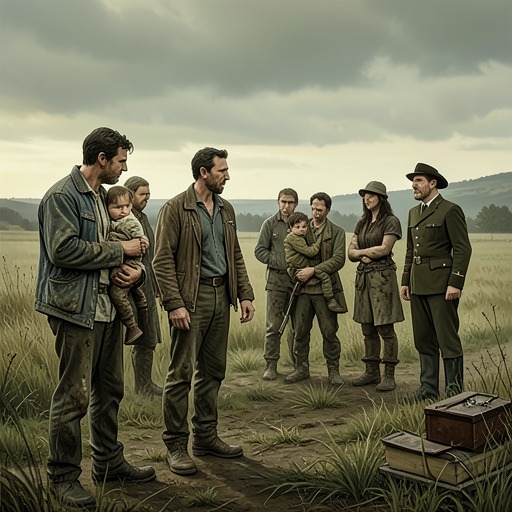
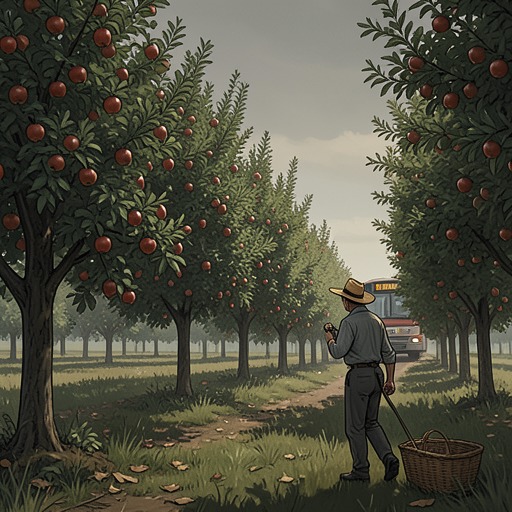
On the bus, Ben Givens encounters a group of orchard pickers traveling together. Catherine Donnelly introduces Ben as a doctor who wants to help. At close range, the pickers appear to him to be younger than seventeen, though the passage does not establish their ages. One is seriously ill; another, identified as his brother, accompanies him. A picker explains that the illness is only a cold, while Ben considers more serious possibilities and says the sick man needs medical attention.
The group’s vulnerability becomes clearer when Ben identifies the pickers as being without green cards and afraid of deportation. This is the information he asks Catherine to convey; the scene does not independently establish each worker’s immigration history or legal circumstances. Their apprehension nevertheless shapes what they are willing to do. The possibility that contact with a hospital could lead to questions about identification or a visa is enough to make medical care feel risky.
Care, Translation, and Fear of Deportation
Catherine acts as an intermediary between Ben and the workers. She tells them in Spanish that Ben is a doctor and wants to help, and later assures them that he and the others are not the police and will not turn them in. Her role is practical as well as interpretive: Ben depends on her to communicate his concern, while the pickers’ responses determine whether assistance can proceed.
Ben explains that he cannot diagnose or treat the sick man on the bus. He has no medical equipment with him, not even a stethoscope, and urges that the man be taken to a clinic or hospital when they reach Wenatchee. Catherine immediately identifies a competing danger: a hospital may ask for papers, and the sick picker might be deported. The exchange makes clear that the barrier is not simply a lack of medical advice. The workers’ fear of official scrutiny complicates the very step Ben considers necessary for treatment.
The disagreement is sharpened by a promise already made. Catherine reminds Ben that they assured the workers they would not be deported. Ben responds by emphasizing the seriousness of the illness and the possibility that it could worsen without care. Neither concern cancels the other: the promise offers reassurance, but it cannot guarantee what questions an institution might ask or what consequences might follow.
Emergency Response and the Cost Dispute
At the bus station at First and Chelan, Angel collapses onto a bench and continues coughing. Ben calls the emergency operator, identifies himself as a doctor traveling on Greyhound, and explains that a young man is seriously ill and needs immediate assistance. He gives his professional perspective as a thoracic surgeon and answers the operator’s questions about his identity, the patient’s symptoms, his credentials, and the bus journey. An ambulance arrives within three minutes, and Ben directs the emergency technicians to Angel, explaining that he suspects tuberculosis and that the patient needs an urgent assessment and hospital care.
The workers’ fear is joined by a financial obstacle. Catherine reports that Angel’s brother will not let him go because he feels responsible for him and believes they cannot pay for a hospital. Ben insists that payment should not prevent treatment and tells Catherine to reassure the group that they will not have to pay. The exchange places immediate care against a concrete worry about cost, while showing that Ben’s assurance is not shared by everyone present.
One technician, Coleman, disputes Ben’s claim that assistance will cover the expense and argues that undocumented workers are not eligible. Odle counters that the hospital may be able to apply for welfare assistance through the Emergency Medical Office. Coleman rejects that possibility for this group. The passage therefore presents no settled answer about coverage: the professionals disagree, and the workers’ financial concern remains unresolved in the evidence provided.
Significance and Unresolved Outcome
The scene treats immigration status not as background information but as a force that changes the choices surrounding illness. A hospital appears to the pickers as both a potential source of care and a place where identity documents may be demanded. Cost adds another restraint, and even the emergency personnel offer conflicting accounts of what help might be available. The medical need is urgent, but access to treatment is mediated by fears and institutional uncertainty.
Ben’s actions move the encounter from the bus toward emergency assistance: he explains the need for care, calls for an ambulance, and gives the technicians his assessment. Catherine works to preserve the workers’ trust by communicating their fears and repeating the assurance that they are not dealing with the police. Yet the supplied passage ends amid disagreement over payment and the group’s hesitation. It does not confirm whether Angel enters the ambulance, receives treatment, or whether any picker faces immigration consequences. That unresolved boundary is central to the episode: help is sought, but the scene cannot promise that seeking it will be free of risk.