Wenatchee, Washington
East of the MountainsWenatchee, Washington, is both the prosperous center of the apple country and a place where the labor behind its abundance is plainly visible. Its orchards and river landscape anchor Ben Givens’s memories of family work, while the town later becomes a bus-station stop where illness, language barriers, and seasonal employment bring him into contact with migrant workers and Emilio. The movement between these settings makes Wenatchee more than a regional landmark: it joins Ben’s remembered agricultural world to the people who sustain its present harvest.
Setting and Regional Character
The novel presents Wenatchee as a city of more than twenty thousand people, set in a bowl between the Columbia River and hills rising roughly a thousand feet above it. The eastern heights, colored in auburn and tan, form the rim of a broad wheat plateau; to the north, shadowed draws descend steeply toward the river. Orchards climb the arid outskirts, while basalt summits—including Castle Rock, Squaw Saddle, and Old Butte—recall the country Ben scaled as a boy. Bridges and the Rock Island and Rocky Reach dams interrupt the sunlit, winding river.
The town’s built environment combines quiet residential edges with a busy commercial center. Tidy homes with deep porches and sheltering willows give way downtown to stoplights, restaurants, crowded parking lots, and strip malls. Trucks outnumber passenger cars; tractor-trailers and high-riding pickups move through streets wide enough for two lanes in each direction. The ranchers Ben remembers from childhood remain visible in the men walking the sidewalks in cowboy hats, pearl-button shirts, and boots. The city is modern and active, but its traffic and familiar figures keep it tied to the agricultural basin around it.
Orchards, Family Labor, and the Harvest
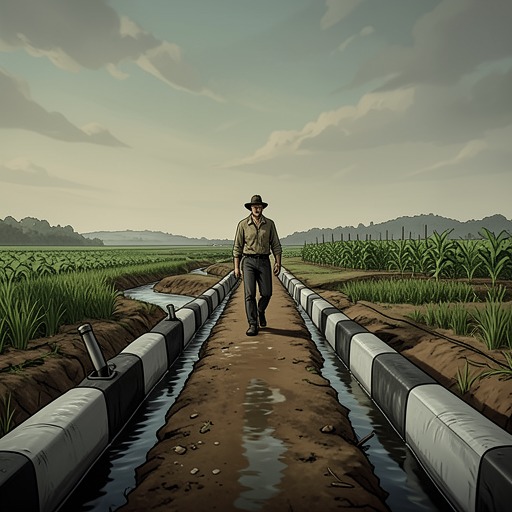
Ben’s parents planted their orchard on the east bank of the Columbia River. The family farm was a working landscape of fruit trees, irrigation ditches, and supporting buildings: thirteen acres of Golden Delicious apples, two acres each of Winesaps and Rome Beauties, and eight acres of cherries and apricots. Picker shanties, a packing shed, a hay-filled barn, a horse stable, and a pump house stood among the facilities needed to keep the operation going. The farmhouse occupied a knoll among elms and willows, with sage-scented air and western hills visible from its front window.
That abundance depended on repetitive, skilled work through every season. Ben made apple boxes, tended the kitchen garden, split wood, and milked cows. With his father and brother Aidan, he helped set out pollinating hives; after rains, he and Aidan cleared weeds by hand from clogged irrigation ditches. They planted windbreak and pollinating trees, removed old trees, disced between orchard rows, and secured the branches of young trees. As fruit grew, they thinned it and propped limbs to keep them from breaking. Picking came in August; pruning and burning water sprouts followed in fall and winter. The orchard’s beauty is inseparable from this calendar of maintenance and bodily labor.
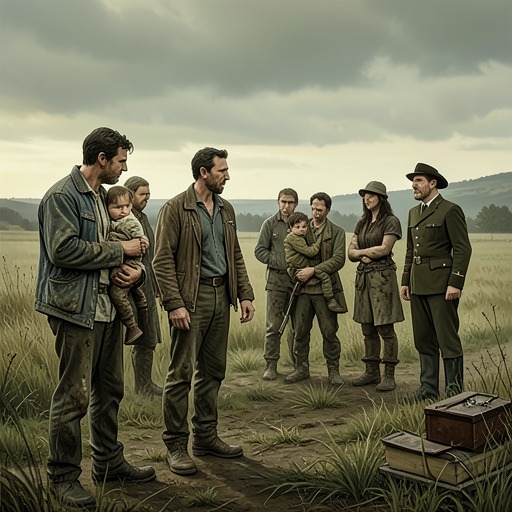
The harvest also brings workers from beyond the family. On June 11, when the cherries ripened early, Ben’s father lined out Ben and nine migrant workers, including the Emery family and its four young children. Rachel Lake, Mrs. Emery’s niece, had arrived from Waterville, Maine, to stay for the harvest. Wearing borrowed work clothes too large for her, she joined the pickers among the trees. Ben filled his bucket carefully, removing leaves and gathering cherries with their stems intact, while fruit struck the buckets and voices carried between the branches. The harvest stretches ahead as a vast undertaking: thousands of trees and weeks of fruit-picking labor.
Arrival and the Working City
Years later, the bus journey brings the labor economy into view before Ben reaches the city. Along the river, laden orchards, full haul trucks, and pickers filling canvas bags contrast with an old freight yard that is now skeletal and little used. Makeshift camps occupy the edges of the landscape; children sit by the river, and one worker tends a small fire in the wind. The route presents abundance and precariousness side by side rather than treating the harvest as a pastoral scene alone.
After crossing the Columbia River bridge to Mission Street, the bus enters Wenatchee and pulls into a covered loading bay on First Street. During the fifteen-minute stop, passengers gather their belongings. The apple pickers speak rapidly in Spanish, and Angel, sick and sweating beneath a blanket, waits with his mouth open while his brother adjusts a cap to shade his eyes. The station makes Wenatchee a practical point of passage, but the pause also exposes the vulnerability of workers moving through the region: Angel’s illness is immediate, while the group’s onward journey remains part of the scene.
Ben’s Search for Work for Emilio
Wenatchee becomes a place of exchange when Ben tries to help Emilio find apple-picking work. At a bookstore on Wenatchee Avenue, Ben buys Spanish for Travelers and an English-Spanish dictionary. His injured eye makes the print waver, but he works through the books to ask whether Emilio wants to harvest apples. Emilio answers that he does. Their exchange is halting, yet specific: the town’s commercial street supplies the tools for a limited but useful conversation.
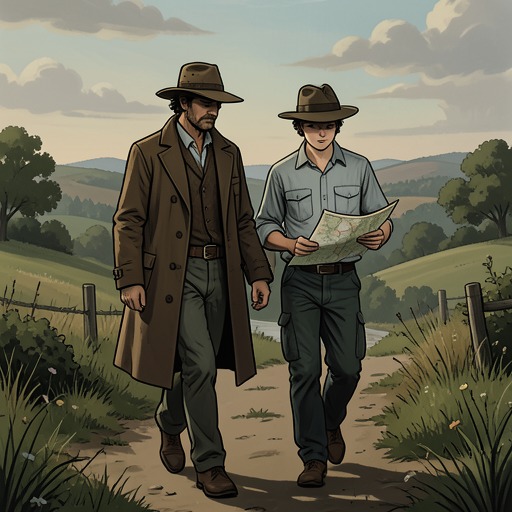
Ben then calls the Job Services Office and speaks with job specialist Hector Martinez. Agricultural jobs are available, Martinez explains, but the apple harvest is nearly over and the work may last only days. Ben persists in asking where Emilio can go. After the call, he returns to Emilio and explains that there is work in Malaga, tracing the route down the west side of the Columbia on a county map. Wenatchee thus functions as a labor-information hub, though the short season sharply limits what that help can promise.
The search continues on foot. Ben and Emilio walk up Wenatchee Avenue, and Ben has to stop twice to lean against streetlamps while Emilio waits. Outside a pawn shop, Ben’s nausea rises and subsides as he braces himself over a newspaper vending machine; Emilio reaches for the rucksack when Ben lifts it, then helps carry both their bags. At an auto-rental counter, the clerk regards the injured older man and dust-covered picker with suspicion but rents them a half-ton Ford for thirty-seven dollars a day. These encounters make the town’s streets a stage for both assistance and social judgment: Ben can arrange transport, but he and Emilio are not received as customers without prejudice.
Narrative Significance
Wenatchee links the novel’s recurring images of fruit to the conditions of agricultural work. In Ben’s childhood recollections, the orchard is family, place, and a demanding cycle of skilled tasks; in the bus journey, the same regional economy appears through migrant camps, crowded harvest roads, and a worker who is too ill to travel comfortably. The change in viewpoint does not erase the orchard’s beauty, but it complicates any easy equation between a fruitful landscape and an idyllic one.
The city also marks a shift in Ben’s attention. He arrives burdened by his own injuries, yet he uses a dictionary, a map, a phone call, and ultimately a rented truck to help Emilio pursue work. Wenatchee is where the large agricultural system becomes a chain of immediate choices: whether a harvest still has days of work to offer, how to explain a route across a language gap, and whether a stranger will share the load. Its significance rests in that conjunction of memory and action, prosperity and insecurity, productive landscape and human need.