Work as a Sacred Calling
East of the MountainsWork as a Sacred Calling is the belief Lenora Givens gives her sons as both a theology and a way of understanding a life: people are meant to undertake worthy tasks suited to their particular design, and through work they may express love for God and come to know themselves. The novel gives this conviction material weight in the labor of an apple orchard, then tests its promise against illness and loss. Work can shape a life and serve another person, but it cannot guarantee that suffering has an explanation or a cure.
A theology learned at home
Lenora’s teaching begins with Ben Givens’s assumption that he will always stay on the family farm. When she urges him to develop the habit of reading before he leaves, he protests that he does not know what he could do besides apples. She answers not with a profession or a plan, but with the idea that he will find work in the spirit of who he is and have some gift to give. Her confidence makes departure compatible with belonging: Ben need not remain in the orchard to remain faithful to the capacities his upbringing has formed.
The belief is especially pointed because Lenora is a committed Presbyterian who takes Ben and Aidan Givens to church. There they hear the minister describe human labor through the biblical curse of toil after the expulsion from Eden. On the ride home, Lenora revises that account. Work, in her interpretation of the Westminster Shorter Catechism, is not only the burden of fallen life; it is an expression of love for God, a path toward knowledge of God, and a means of doing God’s work. The sermon’s language of sweat and hardship remains present, but she gives labor a purpose beyond punishment.
Her ethic also joins vocation to self-knowledge. People know themselves through the work they do, she insists, because a life contains tasks worthy of completion in keeping with a person’s particular design. That claim makes work more than employment or production: it is a form of answerability, in which the worker’s abilities are put to use. Lenora’s hope for her sons is correspondingly generous rather than specific. She wants them to become men who do something fine and wonderful, whatever their hearts desire.
The orchard as a working world
The family’s religious language grows out of an exacting agricultural routine. Ben’s parents’ orchard occupies the east bank of the Columbia River, with thirteen acres of Golden Delicious apples, two acres each of Winesaps and Rome Beauties, and eight acres of cherries and apricots. Irrigation ditches cross the rows; props support laden branches; sheds, barns, a stable, and a pump house make up the working landscape. The orchard’s ordered beauty depends on continuing labor rather than on scenery alone.
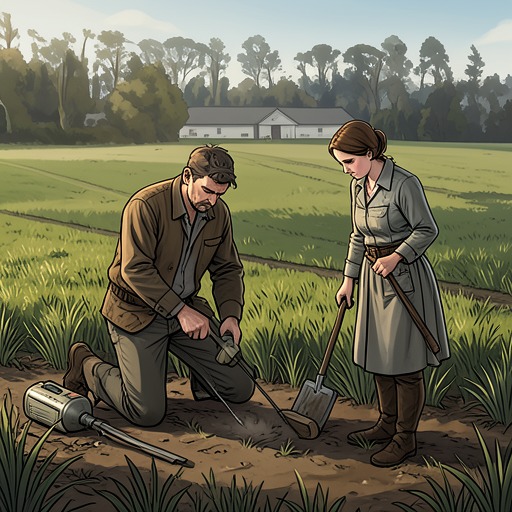
Ben learns that labor through repeated, practical tasks. He makes apple boxes from pine shook, weeds the kitchen garden, splits cordwood, and milks cows twice each day. In spring, he helps his father and Aidan put out pollinating hives, clear clogged sluice gates by hand, plant windbreaks and young trees, and remove finished trees. As the season advances, the brothers disc between the rows to deter mice, spread and strap the branches of young trees, thin fruit, and prop limbs against the weight of apples. Picking comes in August; pruning and burning water sprouts fill the colder months. The work is seasonal, but it does not end with harvest: each task prepares the ground and trees for what follows.
The orchard’s abundance is therefore inseparable from maintenance and skill. Fruit must be thinned; a branch must be supported before it cracks; irrigation must be kept clear. The labor ethic does not treat the harvest as effortless bounty. Its value lies partly in the knowledge of when and how to act, and in the accumulated attention that lets the trees bear fruit. Ben’s childhood gives him a working understanding of that relation between care, time, and yield.
Labor shared, labor tested
The orchard is also an employer and a meeting place for migrant workers. Pickers travel north through a seasonal circuit: strawberries in California in April, then plums and pears, then cherries and peaches in June, followed by more fruit and finally apples. They arrive from Oklahoma, Arkansas, Missouri, and Texas, as individuals and families, by truck, freight train, or on foot. Their work brings them into the same rows as the Givens family, but the workers’ itinerant lives and stories make visible a world beyond the farm’s settled household.
The seasonal work requires coordination and technique. On June 11, when cherries ripen early, Wright Givens assigns workers trees, buckets, and ladders. Ben picks carefully, removing leaves from his bucket and taking the cherries in stemmed clusters. The scale of the task is measured not simply in crates but in the thousands of trees and the weeks and months of fruit ahead. The scene sets individual dexterity inside a larger collective effort: the crop is gathered by many hands, each moving through assigned rows while the harvest advances across the orchard.
Years later, Ben’s knowledge of picking becomes a claim about skill and dignity. At Wolfhound Orchard, the contractor doubts that an older man can handle the work, calling it a young man’s job. Ben acknowledges his age but argues that experience has taught him how to do it properly. His answer does not deny the physical demands; it distinguishes endurance from competence. The pickers’ camp, with its weathered plywood cabins, washhouse, and trailers in a dusty field, also keeps the labor from becoming an idealized pastoral image. Work can be organized and skilled while the workers’ living conditions remain plain and makeshift.
Where work cannot repair loss
Lenora’s own illness exposes the limit of her theology without erasing its importance. When she develops jaundice and is eventually diagnosed with incurable pancreatic cancer, work cannot restore her health. As her condition worsens, she tells Ben that she misses the world and that her work on earth—raising her sons—is unfinished. Her sense of vocation is at once religious and intimate: motherhood is not an abstract duty but a task she wants to see through by watching Ben and Aidan become adults and learn what they will do in the world.
The family’s encounter with her pain makes the limits of human service explicit. When Wright Givens asks Dr. Williams how much opium is too much, the doctor leaves the decision to the family, framing it as a question of how much pain Lenora can bear and when enough is enough. He cannot convert medical knowledge into a cure or a clear moral instruction. The scene places care in the space between what people can do and what they cannot change; loving attention matters, but it does not make suffering legible or controllable.
Lenora dies on June 28, 1938, with Ben, Aidan, and Wright beside her. Her death follows her insistence that she has not finished raising her sons, a desire the event cannot fulfill in the way she hoped. The contrast complicates any simple claim that worthy work guarantees a satisfying result. The ethic gives labor direction and meaning, but the novel does not present it as a bargain through which devotion earns protection from death.
The ethic beyond the farm
The question of whether suffering can be reconciled with divine purpose returns when Ben reads the Book of Job. He is troubled by the apparent indifference with which God and Satan conduct their test, and by the punishment of Job’s friends for trying to comfort him. Job’s restored health and extraordinary prosperity seem too complete a happy ending to Ben; the book’s final reminder that Job dies resists the idea that restoration cancels mortality. This reading places Lenora’s faith in meaningful labor beside a harder religious question: whether a life’s suffering can be justified by a plan that those who suffer cannot see.
Yet the novel also shows practical care continuing where explanation fails. At a difficult birth, Ben catches the newborn girl, checks her mouth, stimulates her by turning and flicking her feet, and slaps her back until she cries and turns pink. The baby’s father calls the event a miracle, but the scene also makes the work of care concrete: Ben acts on the vulnerable body before him, one attentive step at a time. This moment does not settle the theological problem raised by Lenora’s illness or Job’s suffering. Instead, it brings the ethic back to its human scale. Work may be sacred not because it masters outcomes, but because a particular task, performed with attention, can answer another person’s immediate need.