Wright Givens
East of the MountainsWright Givens, Ben Givens’s father, is both the working head of a Columbia River orchard and the keeper of the family’s stories. He teaches through daily labor, outdoor experience, and inherited memory: his sons learn how to cultivate the land, hunt and prepare game, and understand the histories that bind their family to the region. His authority is practical rather than remote, but it does not make him invulnerable. When Ben is accepted into the 10th Mountain Division, Wright’s wish that his son stay exposes the personal loss beneath the language of duty.
Orchardist and family patriarch
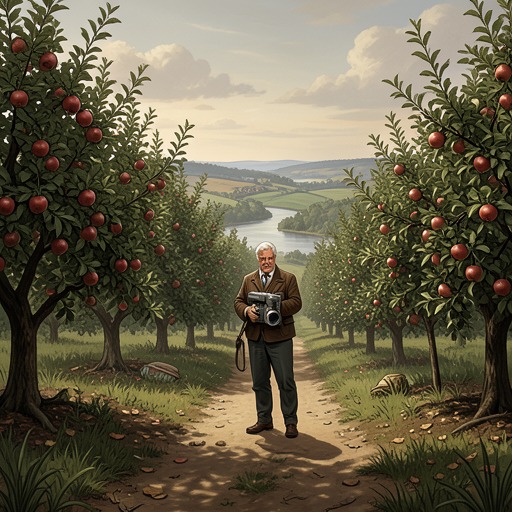
Wright’s family farm occupies a carefully worked landscape on the east bank of the Columbia River. The orchards include thirteen acres of Golden Delicious apples, two acres each of Winesaps and Rome Beauties, and eight acres of cherries and apricots. Lombardy poplars shelter the rows, while irrigation ditches, branch props, and outbuildings mark the labor required to maintain them. The farmhouse stands on a knoll among elms and willows, with the scent of sage and the wind in the trees part of the family’s year-round surroundings. This is not simply a pastoral inheritance: it is a working farm whose order depends on recurring, physical effort.
Wright’s authority over that work is visible in the seasonal routine he shares with Ben and Aidan. The boys make apple boxes from pine shook, milk cows twice daily, plant windbreaks and young trees, and clear weeds from irrigation ditches. They thin fruit, prop and strap branches against the weight of apples, and take part in pruning and burning water sprouts. Their labor follows the orchard calendar, from spring planting to August picking and the work of fall and winter. Wright’s household passes agricultural knowledge on by involving the boys in the tasks themselves.
That family operation is also part of a larger harvest economy. When the cherries ripen early, Wright sets June 11 as the beginning of picking and lines out the workers, assigning each a set of trees, a bucket, and a ladder. Ben works alongside migrant pickers, including the Emery family and Rachel Lake, who has come from Waterville, Maine, for the harvest. Later, the apple harvest fills the roadsides with bins, ladders, tractors, and workers reaching into the trees. The narrative’s attention to this labor makes the orchard’s abundance inseparable from the people and repeated effort that produce it.
Teacher in the hills and keeper of family history
Wright’s teaching extends beyond the farm. When Ben is ten, Wright takes him and Aidan deer hunting on horseback, crossing the river at Coleman’s Landing and following the Colockum Stagecoach Road through new snow. The party camps above the river under a brilliant night sky. Wright explains the habits of deer and the possibilities of approaching them from above, connecting observation of the land with the practical knowledge needed for a hunt. His instruction also reaches into local history: the road once demanded that wagons be lowered by rope, with trees dragged behind their axles to help brake them, and a schoolhouse was moved from farm to farm so the burden of heating it and housing its teacher could be shared.
Around the campfire, Wright recounts the family’s westward migration. In 1879, his grandfather John Hale Givens led a wagon train west with two wagons converted into mobile soil beds for grafted fruit trees and bushes. The plants were covered against the weather, then exposed to sunlight on favorable days as the wagons crossed the plains. Wright also tells the boys about their maternal grandfather James Chandler, who acquired and promoted the apple that became known as Rainier Delicious. Chandler protected his original tree with an iron cage, received the Wilder Medal from the American Pomological Society in 1921, and sent a carload of apples to the St. Louis Cardinals after their 1926 World Series victory. The account ends with a family caution: Chandler had once been wealthy but invested too confidently before the 1929 stock market crash.
Ben is eager to hear these stories even when Aidan falls asleep. Wright notices that his younger son is no longer listening and says he is not interested; Ben answers that he is and urges his father to continue. Wright instead declares it time to sleep. The exchange gives the storytelling a familial intimacy: these histories are not presented as a formal lesson but as something Ben actively wants from his father, even when the evening’s talk must end.
Hunting, instruction, and the limits of authority
Wright’s hunting lessons join competence to a sense of obligation. When the family finds a buck, he explains the bullet’s path through its shoulder, spine, and other shoulder, and shows the boys where to make the cut that will drain the blood. He then steps back, removes his hat, and asks his sons to kneel with him. Wright says he had promised their mother, and the three place a hand on the deer while he gives thanks for the meat. Afterward, he explains the practical work of dressing the animal, including removing scent glands and preventing urine from tainting the meat. The scene places skilled killing and gratitude side by side: Wright teaches the boys how to take an animal’s life and how to acknowledge what the hunt provides.
This instruction helps establish the formative world from which Ben’s later hunting life emerges. It also shows Wright’s characteristic way of teaching: he demonstrates, explains the reasons for each action, and includes his sons in the physical and ethical consequences of what they have done. The prayer does not erase the violence of the kill; it gives the act a language of dependence and thanks.
Ben’s departure and Wright’s expressed need
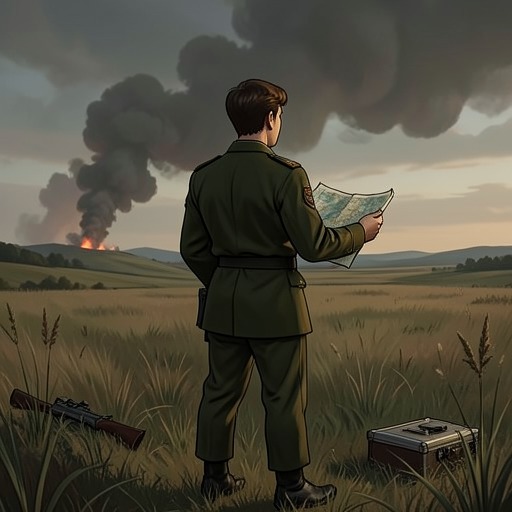
Wright’s attachment to Ben becomes clearest when military service threatens to remove him from the farm. After the attack on Pearl Harbor, a letter from the president of the Leavenworth Ski Club urges Ben to join the mountain troops, and Ben’s father acknowledges that if he must go, he may as well go as a mountain trooper. But Wright also tells him plainly that he wishes he would not go and that he needs him. Ben replies that his father will get along; Wright answers that he will not. The exchange resists any easy equation between stoicism and consent: Wright can recognize the reality of the call to service and still say what his son’s departure will cost him.
When Ben later receives orders to report for active service in the 10th Mountain Division, he reads the letter twice before finding Wright in the south orchard, laying new irrigation pipe. Wright shuts off the idling Farmall, reads the order, and responds with a single word. Ben tells him that he has been accepted. Set amid the familiar work of the orchard, the news turns a routine afternoon into a threshold between the family’s agricultural life and the war beyond it. Wright neither argues nor celebrates in this moment; his restrained response follows the earlier admission that he wants Ben to stay.
Narrative significance
Wright’s characterization rests on the continuity between care and work. He organizes the harvest, teaches the boys to read terrain and animal behavior, and preserves family history by telling it aloud. His lessons are concrete—how to clear a ditch, approach a deer, or prepare its meat—but they also transmit a way of understanding obligation: land and food demand labor, family stories deserve attention, and a kill calls for acknowledgment. The narrative’s later return to the busy orchards, where pickers fill bins through the long harvest, enlarges the world Wright has helped shape without turning that world into an effortless pastoral ideal.
His most revealing contrast is between the authority of the father who directs farm work and the vulnerability of the father who admits he needs his son. Ben’s departure is presented not as an abstract patriotic choice but as a separation felt within a household and a working landscape. Wright’s importance lies in the inheritance he gives Ben—skills, stories, and an intimate knowledge of home—as well as in the plainspoken grief that appears when that inheritance must be carried away.