Benito Avellaneda
Elena KnowsBenito Avellaneda is the police officer assigned to deal with Elena after Rita’s death, although his superiors tell him to present himself as an inspector. The distinction defines his role: he becomes a recurring listener for a mother who believes the death has not been properly investigated, but he has neither the rank nor the authority his title suggests. His meetings give Elena a place to press her questions, while repeatedly exposing the distance between being heard and receiving an answer.
Identity and Background
Benito works for the Buenos Aires Provincial Police and is placed on office duty after a serious breach of conduct in the vault of the Provincia Bank, where he had been assigned to guard cash transfers. The incident ends his prospects for advancement and leaves him handling routine administrative matters: address changes, noise complaints, car theft reports, minor violations, and background checks. His reassignment to Elena’s case is therefore not the arrival of a skilled investigator but an additional duty given to a demoted officer.
His superior’s instructions make the limits of the arrangement explicit. Benito is to meet the deceased woman’s mother and make clear that, for the police and the courts, the case is closed as suicide. If necessary, he may offer to arrange psychological assistance. His superior describes the meetings as a humanitarian accommodation rather than an investigative obligation, and authorizes him to call himself an inspector so Elena will believe her case matters to the police. The false title lends the encounters an authority they do not possess.
Benito does not carry out every part of this directive as intended. The suggestion that he offer Elena psychological assistance is never acted upon; he cannot bring himself to brush her off, because he regards a mother as sacred. This sympathy does not alter the official conclusion or reopen the case. It instead produces a compromised middle ground: he continues meeting her, but within a role designed to reassure her without promising action.
Assignment and Meetings with Elena
The meetings take place on Mondays, Wednesdays, and Fridays. Elena arrives at the station at ten o’clock and waits for Benito. She teases him about being too relaxed to arrive on time, while he responds with embarrassment. His blue police blazer, bearing the Buenos Aires Provincial Police shield, no longer buttons over his middle, and his shirt collars are frayed. These ordinary details make him an unheroic, visibly worn presence in Elena’s search for official attention.
Their physical arrangement also changes as the visits continue. Elena’s limited field of vision means she cannot see above the level of his second unbuttoned shirt button when they sit across the desk. At first, Benito assumes her gaze at his belly is personal; once he understands that she cannot see much higher, he adjusts his posture. He sucks in his stomach, holds his breath, or sinks down in his chair until their faces are level, sometimes remaining in that position long enough for his back to ache. His body makes a small accommodation to hers, a practical gesture of attention that contrasts with the institution’s refusal to revisit the case.
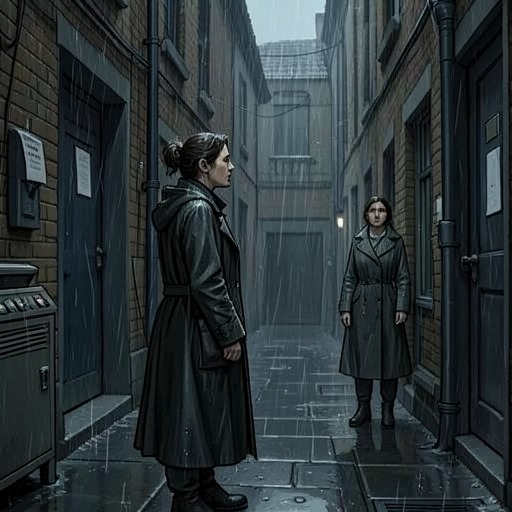
At first, Elena demands explanations and investigative leads, insisting that Rita did not go to the belfry intending to die. Benito answers from the official position: the police and courts consider the death a suicide. Elena returns to the fact that it was raining, which she regards as incompatible with Rita’s habits. Initially, he nods along without really listening. Over time, he learns to acknowledge the rain rather than deny it, but acknowledgment does not lead him to investigate its significance. For the authorities, it remains irrelevant; for Elena, it is evidence that the accepted account cannot be right.
Reports, Clues, and the Limits of His Help
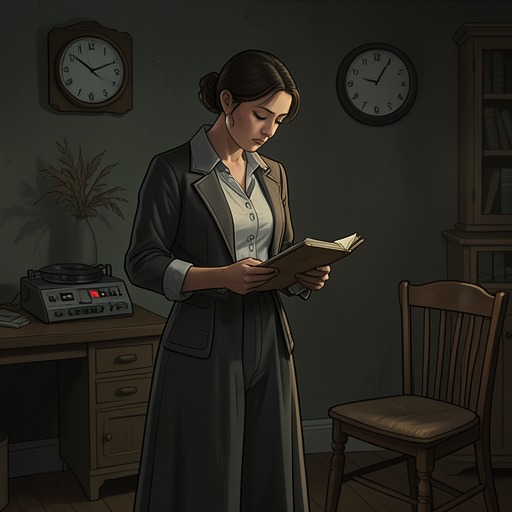
To fill the interviews, Benito reads Elena pages from the report, sometimes repeating material they have already argued over. She comes to understand that the absence of leads reflects the absence of an investigation, not a failure to find answers. Her meetings with him thus become less a channel for police findings than the setting in which she assembles and presents her own material.
Elena brings Rita’s diary, her address book, and a handwritten list of people who knew her daughter. The illness that distorts Elena’s movements also marks the writing on the page, but she asks Benito to tell her if any names are unreadable. He says he can read them and wonders how long it took her to form the blue letters on the lined paper. The exchange reveals both the labor behind her attempt to investigate and the limits of his response: he can receive her evidence, but the evidence does not by itself move the police to act.
She also prepares a list of the places Rita visited in the days before her death: Roberto Almada’s home, the Catholic school, a supermarket, Roberto’s mother’s hair salon, and the health insurance office. At that office, Rita had again sought reimbursement for a renal examination Elena had undergone two months earlier and which had still not been authorized. Benito adds another stop: Dr Benegas’s office, which Rita visited two days before she died, not for her own illness but to speak about Elena. Elena had not known of the visit and immediately asks whether Benito suspects the doctor. He denies that he does, presenting the information as a matter of completing the list rather than as a lead he intends to pursue.
When Benito hesitates over whether to include the doctor’s office, Elena takes the page, reaches for a pen, and adds it herself at the bottom of her list. She then returns the document to him and tells him to do his job properly. The moment condenses their unequal roles: he has access to a police desk and the report, but she is the one insisting on what must be recorded. His presence enables the clue to enter the conversation; her insistence is what puts it on the page.
Narrative Role and Significance
Benito is neither simply a hostile official nor the investigator Elena needs. His discomfort with dismissing her, his continuing appointments, and his adjustments to meet her gaze show a limited, personal responsiveness. Yet he accepts the closed-case framework, lets Elena believe he is an inspector, and offers no indication that he will pursue the details she supplies. His willingness to listen is real but institutionally contained.
That contradiction sharpens the novel’s distinction between apparent attention and effective listening. Elena can speak to Benito repeatedly, and he can acknowledge the rain, read the report, and hold her list; none of those acts, by itself, challenges the official conclusion. The most consequential clue in their meetings—the visit to Dr Benegas—reaches the list because Elena writes it there. Benito’s role is therefore a narrow opening in a closed process: he gives her a recurring audience, while the investigation she asks for remains, in practice, her own.