Dr Benegas
Elena KnowsDr Benegas is the long-standing neighborhood doctor who names and explains Elena’s illness, then tells Elena and Rita how much worse it is likely to become. Across decades he appears as a familiar medical authority in their family, but familiarity does not make his knowledge comforting: he can identify the disease and forecast its effects, yet cannot stop them. His consultations bring the bodily facts of Parkinson’s into the mother-daughter relationship, where prognosis becomes not only a matter of Elena’s future but a demand placed on Rita.
Identity and Background
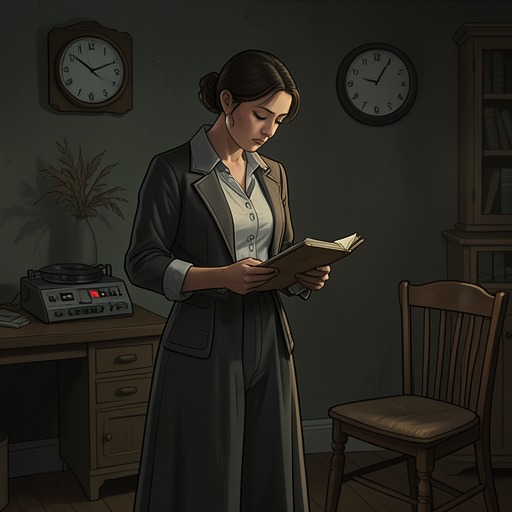
Dr Benegas has treated several generations of Elena’s family. He was Elena’s doctor, as well as the doctor of her mother and aunts, and was known to see almost everyone in the neighborhood. His longstanding presence means that Elena and Rita do not encounter him as an unfamiliar specialist: they return to someone whose authority has been established through years of local practice. He later teaches them about levodopa, the substantia nigra, the sternocleidomastoid muscle, and Parkinson’s disease, words that Elena gradually attaches to changes she experiences in her own body.
His earlier care of Rita also reveals the assumptions that could accompany that authority. When Rita was around twenty, Elena brought her to him because she suspected her daughter might be infertile. Dr Benegas suggested a test to establish whether Rita had a uterus, presenting the question in terms of whether she could fulfil her expected purpose in the world. The procedure involved fasting and a device that inflated Rita’s abdomen; afterward, the bed was tilted until her feet pointed toward the ceiling. Rita cried, but Dr Benegas dismissed the possibility that the test could hurt and joked with Elena while Rita lay at an angle. He asked Elena to leave because the mother and daughter’s fighting was putting the procedure at risk. The episode shows his medical authority operating within, rather than outside, the family’s conflicts and prevailing expectations about women’s fertility.
Explaining Elena’s Illness
When Dr Benegas first explains Parkinson’s to Elena and Rita, he describes it as a degradation of cells in the nervous system that stops them producing dopamine. The word degradation troubles both women, and he quickly recasts the explanation in several terms, saying that the cells may degrade, mutate, change, or be modified. Elena understands the disease most firmly through its presence in her body: when her brain orders her feet to move, the order depends on dopamine reaching them. She imagines dopamine as a messenger, an image that lets her make a personal vocabulary out of medical information even when the doctor’s terminology remains difficult to follow.
That gap between explanation and lived experience persists. Dr Benegas can supply the name of the disease and the account of how nerve cells work, but Elena’s knowledge comes from the failures of movement themselves: feet that will not obey, a left arm that cannot find a jacket sleeve, and the growing dependence on medication. She remembers that Rita was present at the first explanation. The diagnosis therefore enters the story as shared knowledge between mother and daughter, before Rita’s death makes that shared history irretrievable.
Assessment and Diagnosis
Two weeks before Rita’s final visit to him, Dr Benegas recommends admitting Elena to hospital for a couple of days of tests, to avoid repeated trips. Elena arrives with two new nightgowns, although she wears only one. The assessment includes blood tests, an MRI, reflex checks, examination of her eyes, observation of her walking and arm movements, and questions about how quickly levodopa takes effect and how long its effects last. A specialist and a team of ten residents examine her, sometimes returning to repeat questions or mistakenly entering the wrong room or consulting the wrong chart. Elena remains polite, hoping that the many doctors might help, but the scale of the examination does not produce a cure or a simple definitive test.
At the end of the admission, Dr Benegas explains that Parkinson’s and its progression must be assessed clinically: no single test can establish with certainty that a person has it or determine how far it has advanced. He nevertheless reports that the team has reached a firm conclusion about Elena’s form of the disease: Parkinson-Plus, meaning more than ordinary Parkinson’s. Rita presses him to explain what the added severity entails, listing the losses already shaping her mother’s life: drooling, incontinence, difficulty walking, swallowing, dressing, and communicating. Her anger is directed at the prospect of more decline, but also at the expectation that she must absorb its consequences as Elena’s caregiver.
Prognosis and the Burden of Care
Dr Benegas eventually tells them that Elena’s disease is expected to advance faster than previously predicted. He describes a future in which she may be unable to get out of bed, feed herself, or use the bathroom without help; she may be limited to liquid or semi-liquid food, lose the ability to read, become difficult to understand, and experience memory loss or dementia. He tells Rita that she will need to consider hiring someone to care for her mother while she is at work, and that they should do so soon. When Rita asks whether Elena is going to die soon, he shifts the emphasis from the amount of time remaining to quality of life. There is no solution, he says in effect; the illness is the hand Elena has been dealt.
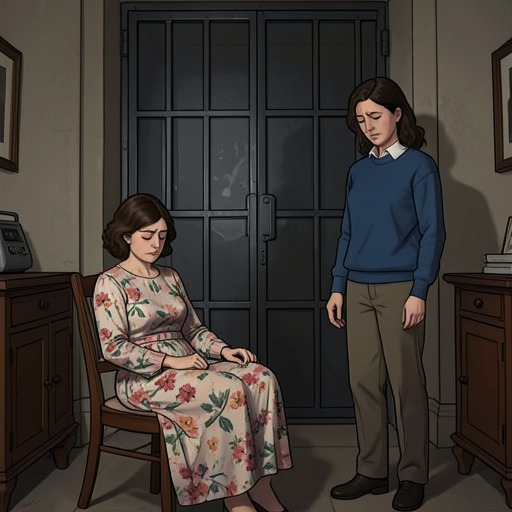
The consultation makes the care arrangement itself part of the prognosis. Dr Benegas tells Rita that a time comes when children must return what their parents gave them, and that Elena will need her in a mothering role. Rita rejects the comparison between an increasingly dependent adult and a baby: the losses she describes are not the gaining of abilities but their progressive disappearance. She says she does not think she can become the mother he is asking her to become. Dr Benegas offers help and support for both women and holds out pamphlets. Rita does not take them; Elena accepts them and helps herself stand before they leave.
The pamphlets carry the consultation into the home. Later, Elena reads their symptom lists and advice for patients and caregivers while Rita is elsewhere in the house. She recognizes herself in descriptions such as facial rigidity and muscle stiffness, and identifies Rita as the pamphlet’s caregiver. Its suggested calming phrases strike her as inadequate beside the work and strain that Rita has described. Dr Benegas’s advice thus survives as printed guidance, but the pamphlets cannot resolve the disagreement over what care will demand or how much either woman can bear.
Rita’s Final Visit and Narrative Role
Two days before Rita is found hanged in the church belfry, she visits Dr Benegas without Elena. Elena learns of the appointment only after Rita’s death, when Inspector Benito Avellaneda tells her that Dr Benegas had mentioned it. The subject of that private conversation is never disclosed in the supplied account. Elena wants to know what her daughter said, but she did not think to ask at the time and is now unable to obtain the answer. The visit becomes a consequential absence in her investigation: it places Dr Benegas among the last people Rita saw, while leaving Elena—and the reader—without the information that might explain what was discussed.
Dr Benegas therefore occupies an uneasy position between knowledge and its limits. He gives Elena a medical account that helps her interpret her body, organizes a thorough assessment, and tells the family the likely course of the illness. Yet the forecast cannot offer a cure, and the practical advice transfers much of the future burden to Rita. His scenes also make visible the distance between clinical description and lived care: what appears in his prognosis as a list of anticipated losses is, for Rita, the daily labor of lifting, feeding, cleaning, and responding to her mother. After Rita’s death, the undisclosed purpose of her last appointment leaves the doctor as a source of possible knowledge that Elena can no longer reach.