Elena and Rita's mother-daughter relationship
Elena KnowsElena and Rita’s mother-daughter relationship joins intense practical dependence to a painful mismatch in what each woman believes she knows about the other. Elena assumes that being a mother gives her complete knowledge of her daughter; Rita’s daily caregiving, anger, and eventual despair expose the limits of that belief. Their bond is neither reducible to resentment nor rescued by love: it is made through intimate acts of care, strained by their bodily and emotional costs, and left unresolved by Rita’s death.
Identity and the Claim of Maternal Knowledge
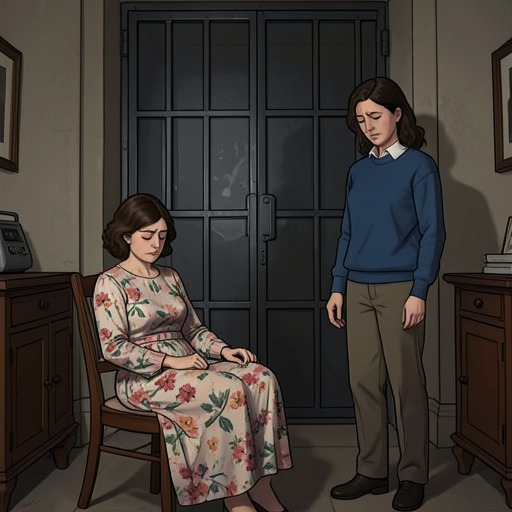
Elena’s confidence rests on a powerful maternal assumption: she believes no one can know a daughter as fully as her mother does, and treats that knowledge as part of motherhood itself. The conviction shapes how she interprets Rita’s choices and what she imagines Rita can bear. But the novel sets that certainty against a relationship in which Elena depends on Rita for the most ordinary movements and needs, while remaining unable to see the full extent of her daughter’s private exhaustion.
The gap becomes especially consequential as Elena’s Parkinson’s disease advances. Her body increasingly requires assistance, and the resulting dependence makes the relationship more intimate in practical terms while exposing how little intimacy guarantees mutual understanding. Elena’s belief that she knows Rita is therefore not simply a source of comfort: it is an assumption the plot tests against Rita’s unspoken limits and the revelations Elena receives only after her daughter is gone.
Care as Routine, Labor, and Resentment
Rita’s care is visible in the repetitive work that structures both women’s days. She helps Elena out of bed, shares meals with her, assists her to the bathroom, manages her clothing and bedding, and responds when Elena calls during the night. She handles Elena’s dentures and brings water for them; she also draws a limit, refusing to wipe her mother after using the bidet. The account of these tasks makes care concrete: it is not an abstract expression of filial devotion but recurring bodily labor, performed at close quarters and without a clean break between day and night.
That labor sharpens Rita’s irritation, but irritation does not cancel attachment. Rita arranges a lengthy beauty-salon appointment for Elena around her medication schedule, ensuring she will not be without Levodopa. Elena resists going, offering to have her toenails cut at home instead. Rita’s insistence is partly about Elena’s appearance, but she explains that she is the one who sees her mother every day: the person who assists her, eats opposite her, and handles her dentures. Her words turn the salon visit into a confrontation about the caregiver’s experience of looking after a parent whose bodily needs have become unavoidable and deeply personal.
At the salon, Elena waits among mirrors, old hairstyle posters, and magazines she struggles to turn. Rita has brought her there, but the practical arrangement does not create emotional ease between them. The scene links care to appearance and to the burden of witnessing: Rita wants something to change, while Elena cannot see herself clearly in the mirror and resents being told how to look. The care that sustains Elena also gives Rita a daily view of the illness that she finds difficult to endure.
Prognosis and the Unequal Burden of the Future
Two weeks before Rita’s death, mother and daughter attend a hospital consultation with Dr Benegas. After a battery of tests, he explains that Elena has Parkinson-Plus syndrome, a diagnosis indicating a more severe course than ordinary Parkinson’s disease. Rita presses him to explain what “more” means in the context of the difficulties Elena already experiences: drooling, incontinence, impaired movement, trouble swallowing, and the loss of everyday abilities. Her challenge makes the prognosis relational as well as medical. The question is not only what will happen to Elena, but what further care will be demanded of Rita.
Dr Benegas tells them that Elena’s condition may progress more quickly than expected. He anticipates that she may become unable to get out of bed, feed herself, or use the bathroom without assistance, and advises Rita to consider hiring a caregiver. Rita responds that she does not know whether she can manage more. She does not want Elena placed in a home; she asks instead to be left in her own house, even if Rita cannot care for her. Elena insists that she can remain there and manage. Their disagreement reveals opposing fears: Elena fears losing her home and autonomy, while Rita fears being assigned a responsibility she cannot sustain.
Dr Benegas frames care as a repayment of what parents once gave their children, telling Rita that she will have to become her mother’s mother. Rita rejects the comparison with infancy: Elena’s decline, she argues, reverses the growth associated with a baby, as bodily control, speech, movement, and independence are lost rather than acquired. She cries and says she does not think she can become the mother the doctor asks her to be. When he offers pamphlets about support, Rita does not take them; Elena accepts them instead. On the walk home, the two move in single file and do not speak. Rita withdraws to her room, while Elena begins to read the information herself. The exchange leaves care unresolved, with no cure or agreed arrangement to relieve the daughter’s burden.
What Elena Cannot Know
The relationship’s limits are clearest in what Elena does not know. Rita visits Dr Benegas two days before she is found hanging in the belfry, but Elena is unaware of the appointment and never learns what was discussed. The doctor tells Inspector Avellaneda after Rita’s death. Elena later recognizes that she is too far away to obtain answers. Her closeness to Rita, and her conviction that a mother knows her daughter, have not given her access to this final conversation or to the precise point at which Rita felt unable to continue.
In her later encounter with Isabel, Elena can say that she loved Rita and that Rita loved her, while qualifying that their love had its own form. She asks whether she was a good mother, a question that receives no simple verdict. Isabel suggests that Rita could not bear Elena’s illness and interprets the rainy day of Rita’s death as a day when something more frightening than the weather drove her out. Elena identifies herself as that source of fear. Isabel’s account offers Elena a possible understanding of Rita’s distress, but not the missing details of Rita’s thoughts or last decision.
Elena also says that she still wants to live, despite her body and her dead daughter. This is not a reconciliation or a recovery of certainty. She has arrived at a distinction between loving Rita and knowing exactly what Rita felt. When Isabel asks what she will do next, Elena cannot answer; she remains with the Domestic cat and pets it. The quiet, limited action contrasts with her former confidence in maternal knowledge: for the moment, she can acknowledge her uncertainty without turning it into an explanation.
Narrative Significance
The relationship makes caregiving both an expression of attachment and a source of strain. Elena’s dependence requires Rita’s repeated attention, while Rita’s work places her in close contact with the bodily consequences of illness and with decisions about how much care can be given. Their conflicts do not prove an absence of love, just as their love does not erase exhaustion, resentment, or the unequal distribution of responsibility.
Rita’s death forces Elena to revise the certainty on which she has relied. She can remember care, anger, and affection, and she can affirm that mother and daughter loved one another; she cannot turn those facts into complete knowledge of Rita. The relationship’s significance lies in that difficult remainder. Motherhood gives Elena a bond with her daughter, but it does not make Rita transparent to her, nor does love guarantee that a caregiver can bear every demand placed upon her.