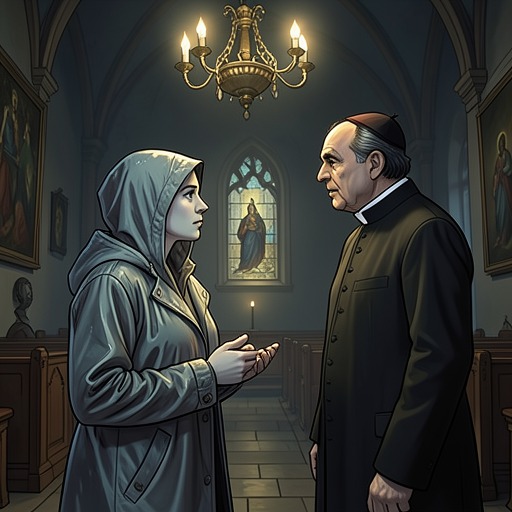
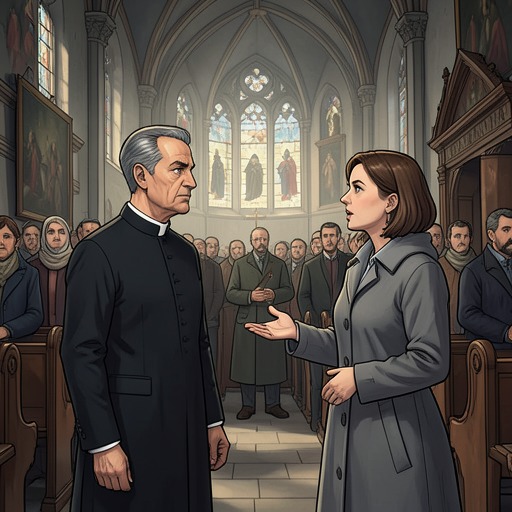
Elena argues with Father Juan about Rita's death
Elena KnowsElena’s argument with Father Juan about Rita’s death is a confrontation over both the facts of the case and the authority to interpret them. Elena comes to the church seeking the missing part of the story, but the priest insists that Rita took her own life and that her reasons died with her. Their exchange turns on a detail Elena cannot set aside: it was raining, and Rita was afraid to go near the church in the rain. By the time Elena leaves, the dispute has widened into a challenge to religious authority, bodily ownership, and the name of mother itself.
The visit and the unanswered question
Father Juan has been reluctant to speak with Benito Avellaneda, the inspector investigating Rita’s death. Elena therefore chooses her own moment to approach the priest, avoiding the hours of Mass, confession, and siesta. At the sacristy door, her difficulty stepping over the threshold makes the physical effort of the visit visible: when she cannot clear it, Father Juan comes to help her. The exchange begins with an invitation to a service for Rita, planned for the following Sunday during the seven o’clock Mass. Elena calculates that the hour conflicts with her medication schedule, but nods rather than explaining the difficulty.
When Father Juan asks how she is coping with grief, Elena says she has not begun to mourn. He urges her to make time for it, citing the biblical division between a time to die and a time to mourn. Elena refuses that sequence: mourning, she says, must wait until she knows the whole truth and learns who is responsible for how Rita ended up at the church. Her visit is not a request for consolation or prayer. It is an attempt to obtain an account of the death that the investigation has not yet supplied.
The rainy day and the church
Father Juan tells Elena that Rita’s reasons are the only mystery, and that Rita took them to the grave. Elena counters with the circumstance that unsettles the apparent explanation: Rita was afraid of being struck by lightning and avoided the church on rainy days. Father Juan says that he had not known this. He also confirms that Rita’s body was found in the church belfry by the Gómez boys, who helped with maintenance and were allowed to ring the bells. His recollection identifies the discovery without explaining how Rita got there, which is precisely the gap Elena is trying to close.
The earlier circumstances of the discovery sharpen the significance of the priest’s response. The boys had gone up to ring the bells for the seven o’clock Mass and found Rita hanging from the bell’s yoke. Father Juan recognized her, but did not say her name; he checked her pulse and called the police. He asked Benito Avellaneda not to interrupt the service, and Mass went ahead without the bells. The congregation attended with Rita’s body still above them, unaware of it. Elena alone noticed the rain falling in the courtyard. In her later conversation with Father Juan, that rain remains more than weather: it is a concrete contradiction between Rita’s known fear and her presence at the church, though it does not, by itself, establish what happened.
Doctrine, belief, and the body
Father Juan interprets the death through Christian teaching. He says that human bodies belong to God and that taking one’s own life is a wrongful use of what is not one’s own. He places suicide alongside murder, abortion, and euthanasia as acts condemned by the Church. To him, the moral category is settled even if Rita’s personal reasons are unknown; he urges Elena to pray for her daughter’s soul and for mercy at the Final Judgement.
Elena rejects the priest’s attempt to turn the conversation toward prayer and religious consolation. She asks what emotions he thinks are mixed in her grief and anger, then challenges the idea that she possesses faith simply because she has not taken her own life. Her own body, she points out, has already been taken from her in practical terms by illness, not by God. The exchange exposes the cost of Father Juan’s abstract language: he speaks of bodily ownership as a universal doctrine while Elena speaks from the experience of a body she can no longer reliably command. When he continues to insist on the Church’s account, she redirects him to what she wants: judgement on earth and help uncovering the truth.
Elena’s later reflections complicate any simple division between a religious priest and a religious daughter. Antonio, her husband, had been a practising Catholic and a theology teacher at a Catholic school, while Elena had concealed her disbelief in the soul and eternal life. Rita, by contrast, combined practices that did not always fit together: she wore a cross and observed fasts, but sometimes skipped Mass when it rained, did not confess every sin, and shaped a faith of her own. Remembering these differences helps explain why the priest’s certainty does not answer Elena’s questions. The family’s religious life consisted not of one shared belief but of distinct, sometimes contradictory ways of living with ritual, fear, and death.
Motherhood and the ending of the encounter
The argument ends not in agreement but in a dispute over who can name Elena. As she struggles to rise and leave, Father Juan helps her over the threshold despite her protests. He then calls her a mother. Elena asks what name belongs to a woman whose child is dead, observing that she is neither a widow nor an orphan. Before the priest can answer, she says that no name is needed if the Church might use it to take away her right to decide how to behave, live, or die. Father Juan answers that she remains a mother and always will be.
Elena does not accept this reassurance as a resolution. Her brief Amen is followed by her departure with the certainty that she will not return. The threshold that required the priest’s help at the beginning of the visit becomes the point from which she leaves his authority behind. The exchange does not resolve Rita’s death, and Father Juan offers no account of the unexplained rainy-day visit. Its consequence is instead a sharpened conflict: Elena refuses both a religious verdict in place of investigation and a maternal identity that could be used to prescribe her conduct. Her search for the truth remains unfinished, but the terms on which she will accept consolation or definition have become unmistakable.