Elena—Father Juan
Elena KnowsElena—Father Juan is a relationship shaped by a shared connection to Rita and the church where she dies, but strained by opposing accounts of that death. Father Juan once helped Rita secure a position at the Catholic school; after Rita is found hanging in the church belfry, he treats the death as a settled suicide, while Elena searches for an explanation that can account for her daughter’s behavior. Their dispute becomes both an investigation into the circumstances of Rita’s death and a confrontation over who has the authority to name grief, faith, and the body.
An earlier connection through Rita
Father Juan’s connection to Rita predates Elena’s investigation. A few weeks after Rita’s father died, when Rita was seventeen, he appealed to the school board to give her a job at the Catholic school despite her age. His intervention helped open a path into work for the bereaved young woman. That history gives him a personal connection to the family, but it does not mean that he understood every part of Rita: when Elena later explains her daughter’s fear of going near the church in rain, Father Juan admits he had never noticed it.
Rita’s avoidance was not a passing preference, in Elena’s understanding. She had repeatedly made excuses to avoid going to the chapel in bad weather, even pretending to faint when necessary. Elena holds fast to this remembered pattern after Rita’s death. Her insistence that the pattern could not simply have changed on the day Rita died turns the priest’s church into a place both bound to Rita’s history and, in Elena’s view, inexplicably at odds with it.
The church and the discovery of Rita
Father Juan is present when the church becomes the scene of Rita’s death. Boys he had assigned to ring the bells for the seven o’clock Mass rush down from the belfry to report what they have found. He initially dismisses their alarm, then follows them upstairs and sees Rita’s body hanging from a rope attached to the bell’s yoke. Although he recognizes her immediately, he does not say her name; he picks up the overturned chair beneath her and stands on it to take her pulse. Once he confirms she is dead, he takes the boys back to the sacristy and calls the police.
The discovery places Father Juan between the dead woman and the living congregation. He asks the police to wait until after Mass rather than cancel the service, since people are already arriving and the day is Corpus Christi. During the service, the rope eventually snaps and Rita’s body falls onto the belfry floor. The officers go upstairs; after Mass, Father Juan clears the church and then joins them at the scene. A coroner takes notes, an officer outlines Rita’s body in chalk, another photographs it, and a third bags the rope as evidence. The priest’s role thus moves from finding Rita and summoning help to witnessing the official handling of a death that he will later present to Elena as having no mystery beyond Rita’s own reasons.
Elena presses for an account
In the days that follow, Father Juan is among the people least willing to speak with Inspector Benito Avellaneda, repeatedly deflecting attempts to meet. Elena urges the inspector to persist and insists that all possible explanations must be investigated. She then chooses her own moment to approach the priest, avoiding the hours around Mass, confession, and siesta. Her visit is not to accept the service planned for Rita or to seek comfort through prayer: she wants to know how her daughter came to be in the belfry.
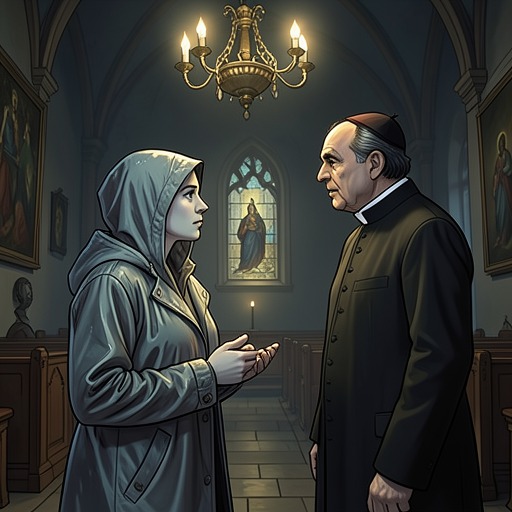
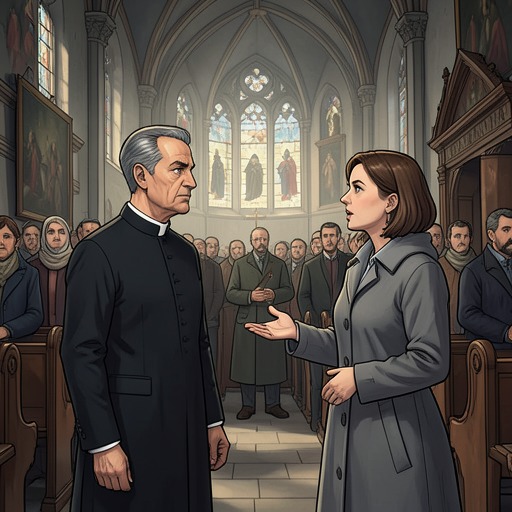
Father Juan offers sympathy, tea, and prayer, but each offer meets Elena’s refusal or redirects the conversation away from the missing account she seeks. He tells her that the death holds no mystery except Rita’s reasons, which Rita took to the grave. Elena answers with the detail she considers decisive: it was raining, and Rita never went near the church on rainy days because she feared being struck by lightning. Father Juan counters that Rita did come to the church and that he saw her body. He can recount how the boys found her, but that knowledge does not answer Elena’s question about how she arrived there. The gap between seeing the body and explaining its presence becomes the center of their exchange.
Disagreement over the body and judgment
Father Juan interprets Elena’s difficulty accepting the death through Christian teaching. He argues that human bodies belong to God and that suicide, like murder, abortion, and euthanasia, is a wrongful use of a body that is not one’s own. He urges Elena to remain calm, keep faith, and pray for Rita’s soul and its judgment after death. His consolation therefore rests on a moral account of Rita’s act, while Elena demands judgment on earth: she wants the truth about who is responsible for how Rita ended up in the church.
Elena rejects the premise that the priest can explain her grief by appealing to a faith she says she has never had. She also points to her own Parkinson’s disease: the loss of control over her body, she argues, was caused by illness, not by God. The exchange exposes the difference between Father Juan’s claim that the body belongs to the Lord and Elena’s lived experience of a body whose use has already been taken from her. When he describes her insistence as pride and arrogance, she turns the charge back on the Church’s claim to speak for God. Their disagreement is not resolved; the priest repeats his account of suicide, and Elena repeats that the rain and Rita’s lifelong avoidance of the church do not fit it.
Motherhood, departure, and the limits of their bond
The encounter also tests what Father Juan thinks he can tell Elena about being a mother. He urges her to make time to mourn, invoking a season for grief; Elena replies that she will mourn when she knows the whole truth. At the end of the visit, after helping her over the sacristy threshold despite her protests, Father Juan reminds her that she is a mother and will always be one. Elena questions what name belongs to a woman whose child is dead and resists having either the priest or his Church define her conduct or decide how she may live or die.
Her final response is not reconciliation. She leaves with the certainty that she will never return. The physical threshold, which she struggles to cross and which Father Juan helps her negotiate, marks the end of their immediate encounter; her refusal to accept his account marks its deeper divide. He offers religious consolation and a permanent identity as mother, while she insists on the unanswered particulars of Rita’s death and on her right to determine what her own identity means. Their relationship therefore remains tied to care and history, but ends in a refusal of the authority Father Juan claims for his account.