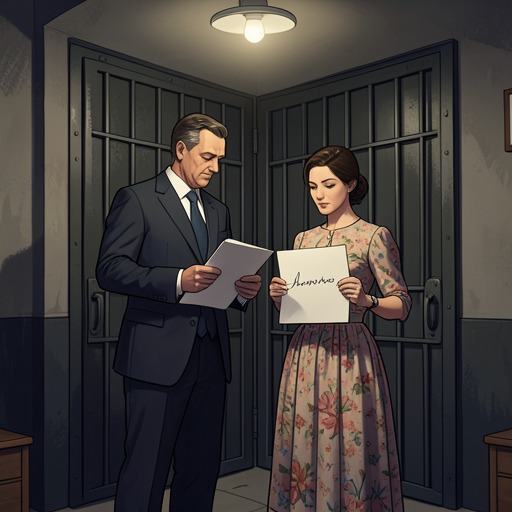
Elena—Roberto Almada
Elena KnowsElena and Roberto Almada are bound less by affection than by proximity, mutual dependence, and their different responses to Rita’s death. Roberto is Rita’s friend and self-described boyfriend, a neighborhood acquaintance whose access to the bank becomes useful to Elena after Rita dies. Elena accepts that practical help while continuing to disparage him; when he accepts the police theory of suicide and offers no answer to her questions, she tells him to stop visiting. Their relationship makes the novel’s distinction between being present for someone and truly hearing them painfully concrete.
Familiarity and Friction
Before Rita’s death, Elena already knew Roberto as a regular presence in her neighborhood. Rita insisted on calling him her boyfriend, a description Elena rejected: she thought a woman of Rita’s age could not have a boyfriend and preferred to call him simply Roberto. Her resistance was not merely verbal. In front of Rita, she called him a cripple to provoke her; she also remembers that the neighborhood children had called him a hunchback when he was young. The labels make visible how readily Elena treats Roberto’s disability as a reason to diminish him, even as Rita insists on recognizing him as a person with whom she has a relationship.
Elena’s route through the neighborhood had once been arranged partly around avoiding Roberto. Before her illness made the longer walk too difficult, she would go around the bank so as not to encounter him there. Roberto worked at the bank, where he had been employed since the age of eighteen, and had proudly explained the special tiles laid outside it for heavy foot traffic. After Rita’s death, Elena cannot afford the extra blocks: her illness has narrowed her choices, and her need to catch the ten o’clock train takes precedence over avoiding an awkward meeting. The route that used to let her evade Roberto now brings them together.
Practical Help After Rita’s Death
At the bank, Roberto greets Elena formally and notices that she is in a hurry. He passes on his mother’s invitation for Elena to visit the hair salon, where she could have another haircut without charge. Elena thanks him, though the invitation carries a painful association: the only time she went to his mother’s salon was on the afternoon Rita died. She has to stop her thoughts from returning to that afternoon so that she will not miss her train. The exchange thus joins an ordinary neighborhood kindness to the loss that Elena is trying, moment by moment, not to revisit.
Roberto has also deposited Elena’s pension cheque for her. After Rita’s death, he offered to handle the bank errand so that Elena would not have to wait in line in her condition. Elena challenged his concern and told him to go to hell, but accepted the help because it had a practical advantage. Before Rita died, she had taken care of going to the bank; with her gone, Roberto’s presence inside the institution fills part of that gap. Elena’s acceptance does not signal trust or reconciliation. It shows how illness and bereavement can make assistance necessary even when the relationship remains resistant and unequal.
The physical details of their meeting underline that imbalance. Roberto touches Elena’s shoulder when she does not respond to his greeting, while she can barely lift her eyes as high as his chest. She notices his new, shiny shoes beside her own worn ones and is conscious of how little energy she can spare. When he asks whether she is travelling alone, she answers that she lives alone and continues her step. He remains behind her as she heads for the station, his shoes still pointed in the direction she is going. The encounter ends not in shared company but in Elena’s determined solitary departure.
Disagreement Over Rita’s Death
Elena’s judgment of Roberto as a possible killer rests on her view of his physical capacity, not on faith in his character or on a verified account of his actions. She reasons that a man with his hunchbacked body could not have been a match for Rita, whom she imagines as stronger than almost anyone. She does not absolve him because he expresses grief, or because she believes he would be incapable of murder in principle. Her reasoning instead reveals the limits of what she knows: she has no suspect, motive, or theory that can explain Rita’s death, and physical comparison is one of the few forms of certainty she can reach for.
Roberto tells Elena that he misses Rita, but his expression of grief does not bring them closer. She remembers that he listened to her at first, yet he did not take action and eventually accepted the police conclusion that Rita had died by suicide. In the report, Elena reads his account that Rita had not been well, had seemed unlike herself, had shown little interest in anything, and did not laugh much. She rereads the words to make sure she has understood them. Her disbelief is not simply anger that Roberto has reached a different conclusion: she thinks he did not know Rita as she did, and resents his turning his impression into support for the official explanation.
Estrangement and the Limits of Listening
The break becomes explicit when Roberto visits Elena’s kitchen on his way home from the bank and begins to cry. Elena tells him not to come by anymore. She acknowledges that he had listened to her, but insists that he had done nothing about what he heard and would not do anything. The distinction is crucial to her: attention without action cannot answer her demand to learn what happened to Rita. Roberto’s earlier role as a sympathetic listener therefore becomes inseparable from his later acceptance of the account Elena rejects.
Their estrangement is not complete independence. Elena still takes advantage of Roberto’s help with the pension, and she must pass him on her way through the neighborhood; but practical contact does not repair their disagreement. As Elena prepares to travel alone to seek help investigating Rita’s death, Roberto remains one of the people who has heard her and failed to give her what she believes she needs. Their connection consequently reflects the novel’s wider contrast between bodily vulnerability and presumed access to knowledge: Elena’s illness limits her movement, but she considers herself better able than the able-bodied people around her to understand Rita. With Roberto, the failure is not a lack of contact. It is the gap between hearing a grieving person and accepting that her account demands more than sympathy.