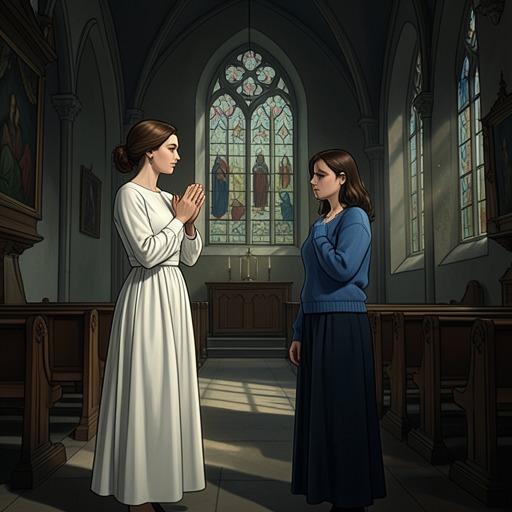
Good Friday
Elena KnowsGood Friday is a recurring point in the religious calendar through which the novel shows how Rita and Elena inhabit faith differently. Rita marks the day with visits to seven churches and fasting, while Elena recalls these practices as part of her daughter’s personally assembled religion. The contrast helps distinguish ritual observance from settled belief and places religious time alongside the novel’s conflicts over bodily authority and death.
Rita’s Good Friday observances
Every Good Friday, Rita visits seven different churches. She fasts and abstains not only on the day itself but also on the preceding Thursday. These practices belong to a broader pattern: she also fasts on Ash Wednesday and on every Friday of Lent. The repetition gives the holy day a concrete, bodily form, organized through movement between churches and restrictions on eating.
Rita’s observance is not simply a matter of following doctrine uniformly. Elena remembers that Rita wears a cross and follows numerous church customs, yet sometimes misses Mass when it rains because she fears being struck by lightning. Rita’s religious life combines formal rituals with personal rules and limits; her Good Friday observance is one especially visible part of that individual practice.
Rita and Elena’s different beliefs
Elena interprets Rita’s faith against the household’s contrasting models of religion. Antonio, Elena’s husband, was a practicing Catholic who worked as a porter and theology teacher at a Catholic school. Elena, by contrast, concealed from him that she did not believe in the soul or eternal life. Looking back, she wonders whether Rita’s ambivalence toward faith arose from being raised by one fervent Catholic parent and one who only pretended to believe.
The Good Friday visits and fasts do not resolve that ambivalence. Elena sees Rita as having fashioned a religion from rituals, traditions, and rules that did not always coincide with church teaching. Rita’s observance therefore registers as neither simple unbelief nor unqualified submission: she attends to religious time intensely, but in a form that remains distinctly her own.
Religious time, the body, and death
The novel sets Rita’s repeated Good Friday practices within a larger pattern of religion measured through the body: fasting, abstinence, and movement between churches. After Rita’s death, Father Juan invokes Christian teaching that the body belongs to God and condemns suicide alongside other acts he regards as wrongful uses of the body. Elena rejects his authority to settle the meaning of her daughter’s death, insisting that she wants an earthly judgment and the truth about how Rita died. The Good Friday observances do not explain the death, but they make clear why religious language and bodily practice are inseparable in the family’s conflict.
The account of Rita’s body being found in the church belfry takes place on a different liturgical occasion: the Thursday after Pentecost, the Solemnity of Corpus Christi. Father Juan allows the evening Mass to proceed, and the congregation attends beneath the unseen body while rain falls in the courtyard. Keeping that event distinct from Good Friday underscores the novel’s recurring contrast between the ordered calendar of religious observance and the private grief and questioning that its rituals cannot settle.