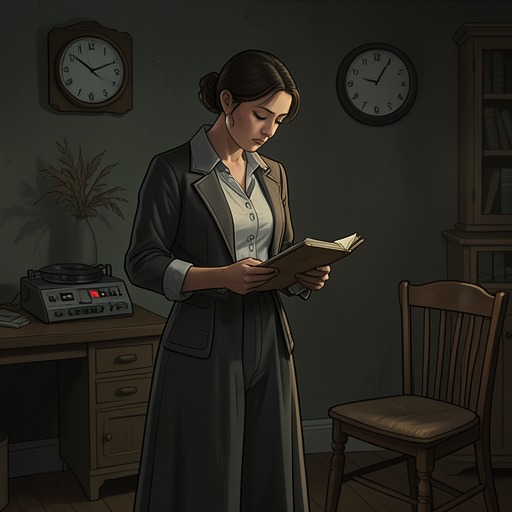
Isabel Mansilla
Elena KnowsIsabel Mansilla is the woman Rita brought into Elena’s home twenty years before the main action, after finding her distressed and seeking to end an unwanted pregnancy. Rita’s intervention led to Isabel’s daughter, but it did not produce the gratitude or uncomplicated family life Elena later assumed. When Elena visits Isabel after Rita’s death, the two women confront incompatible memories of that afternoon, and Isabel reveals the coercion and ambivalence that have shaped her life as a mother.
Identity and First Encounter
Twenty years before Elena visits her, Isabel was a pregnant woman carrying laboratory results and an address for Olga. Rita encountered her on the way to the Sacred Heart Catholic School, where Rita was due to ring the bell for the afternoon classes. Isabel was trying to reach the address to obtain an abortion. Though Rita initially recoiled from the sight of her distress, she turned back, believing a voice had called her to intervene. Rita argued that Isabel should continue the pregnancy, invoking religious belief, the life inside her, and the idea that Isabel was already a mother. Isabel repeatedly insisted that she did not want a child and did not consider herself a mother.
Rita took Isabel to Elena’s house despite her objections. Isabel was exhausted, and Rita was determined to bring her away from the place where she had planned to end the pregnancy. Rita then left to get a taxi, while Elena waited outside Isabel’s closed bedroom door. After returning, Rita and Elena helped Isabel to the car; Rita gave the driver the envelope bearing Isabel’s address and sat beside her. The episode establishes that Isabel’s later family life began not with a choice she embraced, but with other people overriding her stated decision.
Marriage, Pregnancy, and Motherhood
At the later meeting, Isabel explains that she had never wanted to be a mother, even though the people around her expected her to become one. She says her husband, Marcos, had been told of the pregnancy by the time she brought him the test results. She had gone to him hoping to explain that she did not want a child, but he responded with violence and made clear that the pregnancy was the condition on which he would remain married to her. A nurse from his clinic later gave Isabel the address and name for Olga, apparently after seeing her distressed at the clinic.
Isabel also describes her marriage as a relationship in which her wishes and bodily autonomy were disregarded. She says that an early sexual encounter was forced, that the coercion continued until she became pregnant, and that Marcos did not touch her again during the following twenty years. In her account, Marcos’s male partner was present during that first assault and helped Marcos keep her under control during the pregnancy. Isabel says that she was kept almost like a prisoner for the nine months, sedated and watched by nurses, while others treated her as though she were incapable of making decisions. She describes herself as having little strength to resist; the afternoon Rita found her was the one moment when she had tried to act on her own behalf.
After María Julieta Mansilla was born, Isabel carried out the practical work of raising her: she fed her, took her to school, bought her clothes, and held birthday parties. She says she loved her daughter in an unusual way and recognizes her as a good person, but denies having felt like her mother. María Julieta calls her Isabel and, Isabel says, always knew the truth about their relationship. She identifies Marcos and his partner as the people who acted as María Julieta’s parents; the partner was also named her godfather. Isabel characterizes herself as someone closer to a friend, neighbor, roommate, or travel companion than a mother.
The Debt and Its Reversal
Elena arrives at Isabel’s home seeking help with the investigation into Rita’s death. Her Parkinson’s disease makes movement and speech difficult, and she tells Isabel that she needs a capable body to help her search for clues and interview people. Elena frames her request as repayment of a debt: Rita had saved Isabel, and Isabel’s family had subsequently built a life that Elena could see in the annual photographs sent to Rita. Isabel initially understands the purpose of the visit but does not accept Elena’s account of what the debt means.
Isabel says she cannot help Elena because she believes she killed Rita by repeatedly wishing her dead. She makes clear that she did not physically kill Rita: she had not seen or spoken to her again after the afternoon of the rescue, and another person caused Rita’s death. Her claim is an expression of long-held resentment and guilt, not a confession to the act. Isabel sees the rescue itself as a harm done to her, and describes it as the moment Rita locked her in Elena’s room and carried her away from the life she had chosen. The two women have lived for twenty years with opposing accounts: Elena remembers Rita’s persistence as the act that gave Isabel a daughter and a family; Isabel remembers it as the beginning of an unwanted motherhood.
Isabel challenges Elena’s description of her family as a happy ending. Elena points to the yearly photographs, in which Marcos, his partner, and María Julieta appear together, as evidence of the life Rita helped make possible. Isabel instead presents the photographs as an image for other people to admire, not proof that she experienced herself as a mother or that the original coercion had been redeemed. The difference is visible in what each woman considers a debt: Elena asks Isabel to lend her the physical help her illness has taken away, while Isabel refuses the assumption that the past created an obligation of gratitude.
Elena’s Visit and Isabel’s Account
Elena recognizes Isabel at her door and identifies herself as Rita’s mother. Isabel lets her in, offers tea, and watches as Elena struggles to sit, speak, and manage her saliva. Elena explains that the people she suspected of killing Rita all had alibis, leaving her with no useful leads. She has come because she cannot rely on her own body to continue the investigation. Isabel listens without rushing her, but ultimately tells her that she cannot help.
The visit also brings Isabel’s memories of the pregnancy into the conversation. She describes going to Marcos after receiving the test results, his rejection of her wishes, and the nurse’s quiet act of placing Olga’s name and address in her pocket. She recalls that she had been unable to muster the strength to leave the situation once Rita took her home. The account supplies a context Elena did not know when she first understood Rita’s intervention as benevolent: Isabel’s pregnancy and subsequent motherhood were shaped by pressure from her husband, his partner, and Rita, while her own expressed refusal was repeatedly dismissed.
Significance and Unresolved Meaning
Isabel’s account unsettles the idea that an outcome considered fortunate by others can retrospectively justify the means by which it was produced. María Julieta exists, and Isabel says she performed the duties of raising her, but those facts do not make Isabel’s original consent irrelevant or transform her into a mother by her own understanding. The contrast between Elena’s belief that Rita’s action created a family and Isabel’s insistence that it imposed a life she did not want makes motherhood a contested identity rather than a self-evident consequence of childbirth.
Isabel also turns Elena’s appeal to lived experience back toward Rita. She observes that a person cannot fully know an experience until life places it inside the body, using her own pregnancy and Elena’s Parkinson’s disease as examples. She then asks what could have tested Rita so severely that Rita would do what she had once feared: enter a church on a rainy day, climb the tower, and die by suicide. This is Isabel’s speculation about Rita’s final choice, not an established explanation of her motive. The encounter ends with the two women unable to reconcile their versions of the past or the meaning of Rita’s death, leaving the supposed debt unresolved.