Parkinson's disease
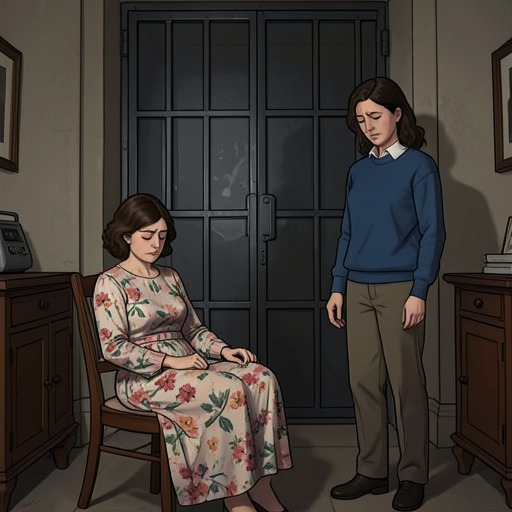
Elena KnowsParkinson’s disease is the progressive neurological condition that reshapes Elena’s daily life and her relationship with her own body in Elena Knows. Its effects reach beyond movement: they alter how she travels, communicates, eats, and imagines the future, while making care an increasingly urgent question for her and her daughter Rita. The novel follows the illness through practical routines and remembered encounters, setting medical descriptions beside the intimate knowledge Elena gains from living with it.
Diagnosis and the Body
Dr Benegas explains Parkinson’s disease to Elena and Rita as a deterioration or alteration of cells in the central nervous system that stops them from producing dopamine. Elena makes sense of this account by imagining dopamine as a messenger: the brain issues an instruction, but the message reaches the feet only if the messenger carries it there. As the disease disrupts that process, the brain seems to her like a dethroned king whose commands no longer govern the body. The illness, which she personifies as Herself, and dopamine, the messenger, become recurring figures in the vocabulary she uses to understand what is happening.
That vocabulary is not a substitute for medical knowledge so much as a way of living alongside what remains difficult to understand. Elena remembers the doctor’s explanations but cannot follow all his terminology. She knows the condition from its presence in her body, yet the language used to describe it can feel remote. She also recalls that she and Rita disliked the word degradation when they first heard it. The clinical term matters because it names change, but Elena’s experience gives that change its particular meaning: her body may no longer carry out an instruction she has consciously made.
The effect is uneven and deeply practical. Elena’s feet sometimes fail to move when she wants them to, while her neck becomes stiff and pulls her gaze downward. She strains to look ahead by moving her eyes and raising her eyebrows, an effort that causes discomfort. Her posture also makes it harder to manage saliva, and she has difficulty with actions that once required no special attention. The condition is therefore registered not just in a diagnosis but in the repeated work of trying to move, look, swallow, and maintain ordinary routines.
Medication, Time, and Adaptation
Levodopa gives Elena a means of managing the illness, though not of curing it. She understands the medicine as something that must dissolve, enter her body, and help the messenger carry the brain’s instructions to her feet. While waiting for it to take effect, she recites the five street names between her home and the train station, first in one direction and then in reverse. The repeated names organize a stretch of time in which she cannot yet make the journey on foot. Medication and recitation become parallel ways of waiting: one bodily and chemical, the other deliberate and verbal.
Her dependence on timing is visible in small decisions. During a taxi ride she takes her medication early, using pieces of a cheese sandwich to make the pill easier to swallow and juice to help it go down. When her body will not allow the slight head movement that would usually assist swallowing, she changes her position on the seat until she can manage it. The episode shows both the importance of the medication and the adjustments required to take it. A pill may be part of treatment, but getting it into her body can itself demand patience and ingenuity.
Elena also practices the movements Dr Benegas has taught her. To stand from a chair, she places her feet and hands in a specific position, rocks forward to build momentum, and rises. Once upright, she lifts each foot in turn and deliberately completes the motions that make a step. She practices because she wants to demonstrate her ability at her next check-up, even though the doctor has warned that her condition is advancing. Such exercises offer no promise of reversal; they are efforts to preserve a capacity that the disease is making less reliable.
As the condition progresses, adaptations accumulate. Elena uses a handkerchief and bibs to manage drooling, and considers equipment and aids that can help her stand, support her neck, use the toilet, swallow, or manage other daily tasks. She treats these devices as practical means of resisting the illness’s growing control. On the train, she moves to a window seat by pulling herself across and holding onto the frame, then watches the passing trees and houses from the limited angle her posture allows. Her field of vision has narrowed, but she continues to work around that restriction rather than accept it as the only possible way to see.
Progression and Medical Prognosis
A journey to a monthly Parkinson’s support group at Hospital de Clínicas marks an earlier point in Elena’s understanding of the disease. She and Rita had gone together, but the experience left Rita feeling worse, and she did not ask to return. For Elena, the meeting became a glimpse of possible futures. She noticed the different symptoms and limitations of other patients, and recognized that their experiences could not simply be mapped onto her own. At that stage she had only a slight shuffle and could still function with medication; even putting on a jacket had become difficult when her left arm would not enter its sleeve.
The sleeve becomes an early sign of how Elena adapts her life to a changing body. Rather than continue struggling with that garment, she adopts a shawl or poncho. She and Rita had also kept the illness relatively private: Rita believed that, because Elena did not shake, other people might not recognize the disease and pity her. At the support group, however, Elena hears that a lack of shaking does not necessarily mean the condition is less serious. The encounter unsettles the assumption that one visible symptom could serve as a reliable measure of what lies ahead.
Two weeks before Rita’s death, Elena is admitted to hospital for two days of tests arranged by Dr Benegas. The team takes blood, performs an MRI, checks her reflexes and eyes, and observes her walking, raising her arms, sitting, and standing. Dr Benegas explains that no single test can definitively establish the presence or extent of Parkinson’s disease; the diagnosis and its progression must be assessed clinically. After reviewing the results, he tells Elena and Rita that she has Parkinson-Plus syndrome, a particular type that the team has identified through its examination.
The doctor warns that Elena’s condition is advancing more quickly than previously expected. He says that in a short time she may be unable to get out of bed, feed herself, or use the bathroom without help; her diet may have to consist of liquids or soft foods, her speech may become difficult to understand, and she may lose the ability to read. He also raises the possibility of dementia symptoms, including memory loss. These are medical predictions rather than events all shown as having occurred, but they make the family’s approaching care needs explicit. Dr Benegas recommends that Rita consider arranging help while she is at work, and stresses that the available support cannot cure the disease.
Care and Family Consequences
Rita’s response to the prognosis reveals how closely Elena’s illness is bound to the question of who will care for her. She presses Dr Benegas to explain what the diagnosis means in practical terms and challenges the implication that she can simply take on more. Her questions enumerate the everyday actions Elena may lose the ability to perform independently. The confrontation does not undo the prognosis, but it refuses to let the clinical phrase Parkinson-Plus stand apart from its consequences for either woman.
Dr Benegas frames the expected change in their roles as a reversal: Rita will have to care for her mother as Elena once cared for her. Rita resists the comparison, seeing a profound difference between a child learning new abilities and an adult losing abilities she already had. She also tells the doctor she is unsure she can bear the demands placed on her. Elena, for her part, insists that she wants to remain in her own home and believes she can manage there. Their exchange exposes a conflict between Elena’s wish for independence, Rita’s fear of what caregiving will require, and the doctor’s warning that the illness will make assistance necessary.
The practical aftermath continues after the appointment. Rita walks ahead of Elena on the way home, and they do not speak. While Rita is in the shower, Elena reads the pamphlets Dr Benegas has given them. She examines the listed symptoms against her own experience, considers the medical history summarized in the pages, and reads guidance intended for both patients and caregivers. Advice to caregivers includes relaxation exercises and repeated breathing practices; Elena considers the proposed routines in light of the strain she has just witnessed. The pamphlets make care appear organized and teachable, while the silence between mother and daughter shows that information alone cannot settle how that care will be lived.
Narrative Significance
The novel presents Parkinson’s disease as a medical condition and as a disruption of Elena’s sense of what her body can be relied upon to do. Instructions that once passed easily from intention to action now meet delay or resistance. Movement becomes a sequence she must consciously rehearse; a train journey depends on medication, physical positioning, and endurance. Familiar objects—the jacket sleeve, a handkerchief, a pill, a straw—register changes in capacity without reducing the illness to a list of symptoms.
Elena’s recurring figures of Herself, the messenger, and the dethroned king give form to the gap between intention and bodily response. They also accompany the novel’s repeated acts of counting and recitation: street names, stations, and medical terms help her mark time while she waits for the medicine to work or travels with the limits of her vision. Her adaptations are small but consequential forms of agency, from choosing a shawl instead of a jacket to practicing how to rise from a chair. At the same time, the diagnosis and prognosis make clear that determination cannot guarantee control. Parkinson’s disease structures not only Elena’s present but also the uncertain future Rita is being asked to help sustain.