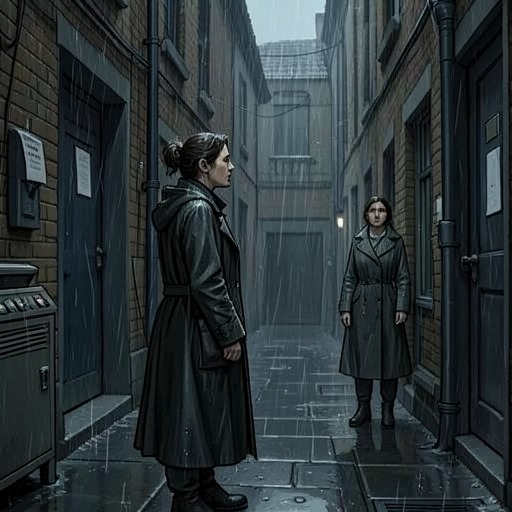
Rita's taboo against going to church or the swimming pool on rainy days
Elena KnowsRita’s taboo against going to church or the swimming pool on rainy days is a personal rule shaped by fear of lightning, but it becomes more than a private habit: it limits Rita’s movements and makes the circumstances of her death difficult for Elena to accept. When Rita is found dead in a church belfry on a rainy day, Elena treats the rule as evidence that her daughter could not have gone there willingly. The rain thus connects a childhood fear to the unanswered question at the center of Elena’s search.
Origin and Logic
Rita’s avoidance began when she was a little girl and learned that lightning was dangerous. Her father told her that the cross above the church attracted lightning; the lesson stayed with her, turning the church into a place to avoid whenever a storm threatened. Her fear extended to the Inchauspes’ house, the only home in the neighborhood with a swimming pool at the time. A report about a lightning accident at a country club reinforced the danger: an engineer explained that water conducts electricity and that pools attract lightning. Rita’s rule therefore joined a strong personal fear to information she understood as practical warning.
She resisted learning whether more pools or lightning rods had later appeared in the neighborhood. Further information, she reasoned, could only add to the places she had to avoid. The rule was protective, but its logic could also contract her world: each newly recognized danger might require another detour. Its force lay not in a formal religious command but in Rita’s conviction that certain places became unsafe when rain was possible.
Daily Practice and Restrictions
The church and pool formed part of a wider pattern of precautions. Rita avoided stepping on the checkerboard tiles outside the midwife’s office, and her movements could be further interrupted by familiar neighborhood omens. When passing a red-haired person, she patted her right buttock and recited a rhyme; when someone mentioned Liberti, a man rumored to be cursed because he repeatedly encountered misfortune, she touched her right hand to her left breast. These gestures show the rule as one strand in a life organized around attempts to ward off bad luck. Their repetition gave the precautions a ritual character, even as they imposed practical limits.
The church taboo affected Rita’s work as well as her private movements. At seventeen, a few weeks after her father died, she began working at Sacred Heart Catholic School. Father Juan had appealed to the school board to give her the position because she was the dead man’s daughter. When she was expected to go to the chapel in bad weather, Rita made excuses, citing pressing tasks or feeling unwell; she would even pretend to faint rather than approach the church’s lightning-attracting cross. The rule was therefore not a passing reluctance. It persisted across settings and required her to find ways around an expectation attached to her employment.
The Rainy-Day Death
Rita’s body was found hanging in the church belfry on a rainy afternoon. Boys assigned by Father Juan to ring the bells for the evening service discovered her and summoned him. The rope was old and worn, and the report Elena later read noted that it had been left in the belfry with scaffolding boards from earlier maintenance. Despite the discovery, a service took place that evening; the rain could be heard in the church courtyard, but Elena alone is described as attending to it. The setting brought the weather, the church, and Rita’s death together in a way that made the taboo newly consequential.
Elena insists that Rita could not simply have changed her behavior on the day she died. She reasons that if Rita entered the church in the rain, someone must have brought her there, dead or alive. Benito Avellaneda, the officer assigned to the case, allows that someone or something might have been involved but offers no explanation. Elena rejects that speculation without evidence. Her claim does not establish what happened; it identifies the conflict between the known pattern of Rita’s avoidance and the circumstances in which she was found.
Faith, Interpretation, and the Rule’s Meaning
Rita’s avoidance of church in rainy weather sits alongside a religious life that followed its own mixture of observance and personal practice. She wore a cross, visited seven churches on Good Friday, fasted on specified holy days, and observed other customs, yet sometimes skipped Mass when rain threatened. Elena understands this combination as evidence that Rita’s religion was shaped by chosen rituals rather than consistent submission to church doctrine. The rain taboo did not erase Rita’s religious practice; it marked one of the points at which fear overrode the expectation to attend.
When Elena explains the taboo to Father Juan, he says he never noticed Rita avoiding church in bad weather and questions whether fear of lightning could account for her absence. He points instead to the body he saw in the belfry and treats Rita’s death as suicide. Elena returns to the rain because, for her, it contradicts a deeply established pattern. Their disagreement shows why the rule matters beyond its immediate practical effect: Father Juan reads the death through religious judgment, while Elena reads the weather and Rita’s habits as evidence that the story remains incomplete. The taboo cannot by itself reveal who brought Rita to the church, but it prevents Elena from accepting the rainy-day death as an ordinary extension of her daughter’s choices.