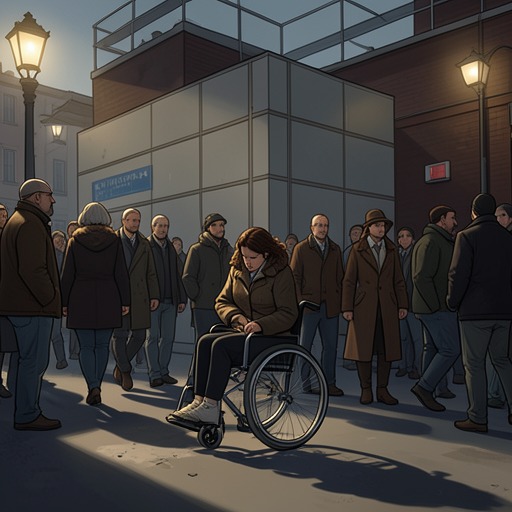
Social marginalization caused by disability and aging
Elena KnowsSocial marginalization caused by disability and aging in Elena Knows is shown in the distance between what Elena intends to do and what her body can manage, and in the social world that often responds to her with pity, impatience, or inattention. Her advanced Parkinson’s disease restricts movement, posture, speech, and ordinary tasks, while the care arrangements around her make those restrictions part of family life. The novel also shows that exclusion is not only physical: Elena struggles to be treated as a credible person with questions and purposes, even as others acknowledge her visible vulnerability.
Bodily limits and everyday barriers
Elena experiences disability through specific changes that accumulate into a transformed daily life. Her neck stiffens and draws her head down; she can look around only by shifting her eyes and straining her face. On the train to Buenos Aires, she watches trees and houses from the corners of her eyes, while the effort of trying to face forward brings pain. The scene makes the constraint both physical and perceptual: her surroundings remain present, but she can take them in only from a limited angle and through movements that hurt.
The disease also changes basic routines. Elena struggles to put her left arm into a sleeve, so she adopts a shawl or poncho instead of explaining her difficulty to neighbors who initially make fun of the garment. She drools, and Rita provides clean handkerchiefs and buys disposable bibs; Elena’s reluctance to discard used bibs reflects her concern about their cost. These practical adjustments do not restore her former independence. They show how dressing, managing saliva, and keeping clean require improvised equipment and another person’s labor, while the visible signs of illness expose Elena to embarrassment and judgment.
Her body’s changing capacities are accompanied by an expanding set of aids and medications: ropes to help her rise, neck braces to lift her chin, a toilet-seat adapter, and medicines that support swallowing or the effects of other medication. These aids address particular tasks, but they also mark how much effort ordinary movement now demands. The narrative contrasts Elena’s determination to keep looking outward with the physical restrictions that repeatedly pull her gaze down. Her defiance is real, but it takes place within a life increasingly organized around managing what the illness has made difficult.
Medical knowledge and caregiving
A hospital evaluation gives Elena and Rita a more serious prognosis than they had understood. During a two-day admission arranged by Dr Benegas, Elena undergoes tests and clinical observation by a medical team. Dr Benegas explains that the findings indicate Parkinson-Plus, and that the disease is advancing faster than expected. He anticipates that Elena may lose further independence, including the ability to get out of bed, feed herself, or use the bathroom without assistance. The prognosis converts a set of present difficulties into a future of greater dependence, without offering a cure or a clear solution.
Rita reacts by naming the many forms of assistance her mother already needs and by questioning what the diagnosis means for the person who will provide it. Dr Benegas tells her to consider hiring help, but also frames care as a responsibility children owe their parents. His account places the burden within the family even as he acknowledges that support may be needed. Rita resists the expectation that she can simply become her mother’s full-time caregiver, while Elena insists that she wants to remain in her own home. Their disagreement reveals how disability can reorganize the lives of relatives as well as the life of the person diagnosed: care is necessary, but its emotional and practical costs do not disappear because it is described as a duty.
After the appointment, Elena reads the care pamphlets herself while Rita is in the shower. She considers advice about symptoms, relaxation, and activities for patients and caregivers, testing its suggestions against the circumstances of their actual household. A suggested activity such as solving a crossword seems possible to her; many other examples do not fit her preferences or environment. When she cannot open a pasta packet with her hands, she uses a knife instead. The sequence presents adaptation as ongoing, particular work rather than as a simple matter of following general advice. It also gives Elena a measure of interpretive agency: she assesses the materials through her own experience, even when she cannot share that task with Rita at that moment.
Stigma, recognition, and credibility
Social marginalization appears in the pressure to conceal illness as well as in overtly visible limitation. For a time, Elena’s Parkinson’s remains a secret shared with Rita and Dr Benegas. Rita sees concealment as a way to avoid other people’s pity, and the shawl allows Elena to adapt her clothing without explaining why a sleeve has become difficult. At the Hospital de Clínicas support group, however, Elena and Rita encounter other patients and recognize that the illness may progress in ways they had not anticipated. Elena does not identify herself with any one person there, but the meeting makes a feared future more legible. Their response illustrates the tension between hiding disability to evade social judgment and seeking information that can prepare them for its consequences.
Elena’s interactions with other people further show that recognition is not the same as inclusion. The account of her disability certificate describes a moment when Roberto Almada asks why she is crying and she answers that she was treated kindly. The response suggests how unusual considerate treatment has become in a life marked by the sidelining of older and disabled people. Her habitual brusqueness can be read in that context as self-protection, not simply as a personal defect: navigating a world that does not reliably accommodate her requires persistence, even when that persistence makes her difficult to others.
Her investigation into Rita’s death adds an epistemic dimension to her exclusion. Elena seeks answers from the police, the coroner, Father Juan, Rita’s co-workers, and neighbors, but encounters people who repeat the conclusion of suicide, offer sympathy in place of investigation, or provide no information. Inspector Avellaneda initially meets her outside official working hours and, in their conversations, reads from a report rather than pursuing the leads she brings him. Elena supplies Rita’s diary, an address book, and her own list of people and places to investigate. The novel does not equate every dismissal with ageism or disability discrimination, but it places these refusals beside Elena’s physical dependence and limited field of vision: she must exert herself to be heard in a world that can mistake listening politely for taking her seriously.
Narrative form and significance
The novel makes the bodily experience of disability part of its narrative form. Elena’s head-down posture limits what she can see; the narration repeatedly attends to the effort of redirecting her eyes and to the physical details that now govern movement. Her day is also structured by medication, while repeated place names help her mark the passage of time as she travels. This form brings readers close to the labor of perception and routine without reducing Elena to a diagnosis. The contrast between the rapid landscape beyond the train window and her deliberate, painful effort to look outward makes the restrictions of her world tangible.
At the same time, the narrative connects those restrictions to relationships and social expectations. Rita’s care is indispensable, but it is also a source of strain and conflict; medical advice can identify impending needs without resolving who will meet them; practical aids can support movement without removing the barriers that make movement difficult. Elena remains determined to investigate her daughter’s death, yet her dependence and the limitations of her body constrain how she can pursue that aim. In this way, the novel presents disability and aging neither as a purely private misfortune nor as a metaphor detached from daily life. They are material conditions that reshape time, domestic labor, access to the world, and the possibility of being recognized as a person whose account deserves attention.