The materiality of death and life after death
Elena KnowsThe materiality of death and life after death emerges through a conflict between religious promises of spiritual continuance and Elena’s refusal to believe that a person survives the body. At Rita’s vigil and burial, this is not an abstract dispute: Elena chooses the coffin, listens to prayers, and confronts the physical finality of her daughter’s absence. Her own illness intensifies the question, as a body that increasingly fails to obey her remains the ground from which she thinks, remembers, and grieves.
Coffin, Burial, and the Body
Elena chooses a simple wooden coffin, in part because it is the least expensive and in part because she wants Rita’s remains to return to the earth without delay. She sees no reason to prolong the material life of a coffin made from valuable hardwood when both the wood and the body inside it will eventually decay. Her choice gives practical form to a conviction that death is not a passage to another life: what remains is matter, and matter does not last.
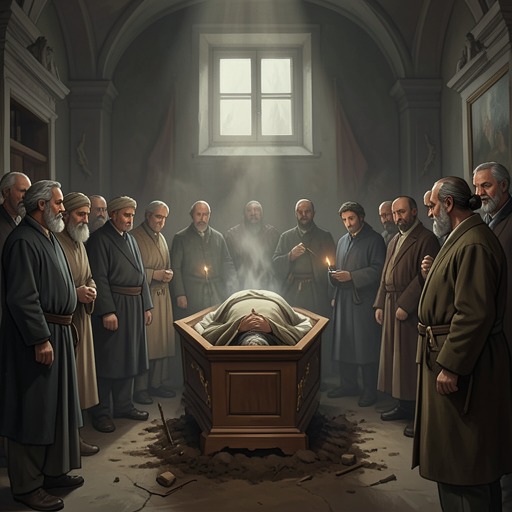
At the vigil, Elena sits beside the coffin and resists the assumption that she would rather not know what has happened. She is not confused about Rita’s death, even when other mourners mistake her response for disorientation or the effects of medication. Her attention to the body and to the coffin is a way of facing what has occurred, not avoiding it. The body is no longer the person Elena knew; its physical presence makes that absence more, not less, definite.
The funeral arrangements also set the private reality of grief against public ceremony. Elena selects the coffin, its fittings, and a floral wreath bearing a message identifying Rita as her mother. At the burial, she moves forward to take hold of a coffin handle despite the expectation that the men will carry it. The action does not undo her physical limitations, but it places her body beside Rita’s at the moment of burial: she insists on participating in the material act of taking her daughter to the grave.
Prayer and the Limits of Belief
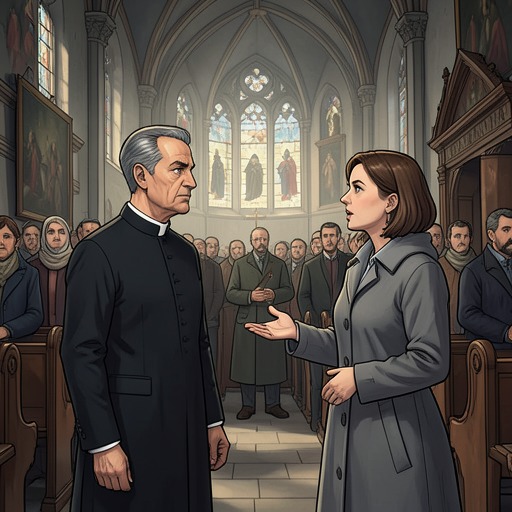
Father Juan’s prayers describe the dead as being in God’s hands and entering a kingdom beyond earthly life. Elena hears these words during the vigil and again at the funeral, but cannot sincerely make them her own. The priest’s language of the just and the foolish unsettles her because it appears to classify both the dead and those who doubt the promise of life after death. Elena cannot accept the consoling interpretation simply because it is spoken as part of a religious rite.
Her disbelief has a concealed history. Antonio, her husband, was a practising Catholic who worked as a porter and theology teacher at a Catholic school; Elena had not admitted to him that she did not believe in the soul or eternal life. The funeral brings this private difference into sharper focus. Father Juan’s prayers echo a faith Elena had outwardly lived alongside, but the language does not provide her with a belief capable of changing what Rita’s death means.
Rita’s religious life, as Elena remembers it, does not resolve the divide. Rita observed numerous Catholic practices, including fasting on religious days, attending churches on Good Friday, and following the rituals of Mass. Yet her faith was individual and selective rather than a simple submission to doctrine: Elena remembers that Rita sometimes skipped Mass, did not confess every sin, and had her own rules for relating to God. The contrast is not between a believer and a wholly faithless daughter, but between Rita’s personal religious practice and Elena’s inability to believe in an afterlife at all.
The Living Body and Irreversible Loss
Elena’s illness makes the distinction between person and body painfully immediate. She experiences her body as something that no longer reliably answers her intentions: ordinary movement and self-care require effort, while medication gives her only intervals of greater capacity. This condition does not function merely as an image for grief. It shapes how she travels, how she approaches the funeral, and how she understands what it means to remain a person when the body will not obey.
In her thoughts, Elena tests the possibility that identity might reside in a soul, a mind, or thought itself. She rejects the soul because she does not believe in its survival beyond the body; at the same time, she confronts the limits of treating the mind as a complete substitute when its commands cannot make her limbs move. Her illness therefore presses the question of bodily identity without offering a reassuring answer. The body is neither an incidental container nor something Elena can simply set aside.
The funeral intensifies that uncertainty by placing Elena’s living but impaired body beside Rita’s buried one. Elena imagines the two bodies together in the earth-bound terms available to her, while knowing that the comparison is not literal: she is alive, and Rita is dead. What joins them is their shared material existence, not a promised reunion beyond death. The bodily connection of mother and daughter makes the separation more intimate, but does not cancel its finality.
Dust, Time, and Continuing Grief
The language of dust recurs as both a religious formula and a material proposition. At the funeral, the prayer that human beings return to dust belongs to a faith Elena cannot affirm as a promise of resurrection. She can recognize the physical return of matter to the earth without accepting that the person will live again. In her understanding, an elaborate coffin cannot preserve the dead, and a prayer cannot reverse the burial.
This conviction gives the funeral’s repeated rituals a double character. The vigil, the eulogy, and the procession organize how the living accompany the dead, but repetition does not grant Elena the certainty of spiritual renewal. Morning, which others present as a reason to return to the funeral parlour, means something different to her: another day of struggling with the body and the tasks it makes difficult. The passage from one day to the next continues for the living, while death admits no corresponding return for Rita.
On her journey to Isabel Mansilla’s home, Elena again encounters the body as a limit on movement and a condition of thought. She has to manage the taxi’s open door and her legs before she can settle into the car; when her medication has not yet taken effect, time becomes a wait imposed by her physical condition. The route through Buenos Aires is tangible where the afterlife is not. Dust on her shoes offers no spiritual answer, but it keeps the novel’s central question grounded in the material world Elena inhabits.
When Elena later tells Isabel that Rita’s burial has left her without the possibility of holding her daughter, grief becomes explicitly bodily and relational. Elena admits that she did not embrace Rita often when she was alive; now the burial makes that missed closeness irreversible. Her appeal to Isabel is framed as a debt arising from the past, but what she names as painful is the present absence of a body she can touch. The novel thus refuses to treat belief in an afterlife as a substitute for mourning: whatever religious language can promise, Elena must live with the material fact of Rita’s death and the continuing physical limits of her own life.