7-Eleven on Clark Street
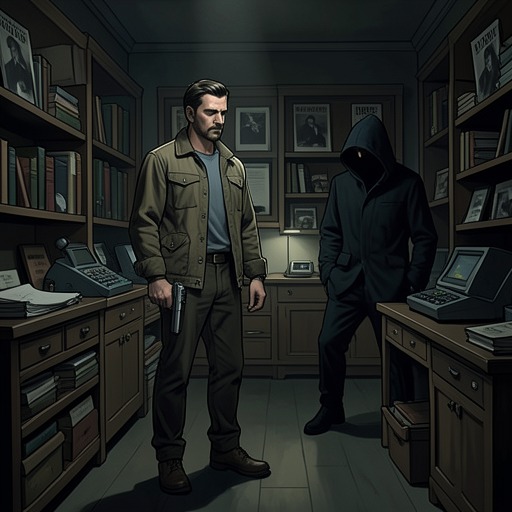
Exorcist FallsThe 7-Eleven on Clark Street is where an ordinary convenience-store stop becomes a test of protection, violence, and accountability. Jason Crowder arrives with Ron Hartman, but three masked, armed men interrupt their conversation; before the episode is over, Ron has challenged an attacker targeting a teenage girl, Crowder has killed Randy Connelly, and police are studying the priest through the store’s glass.
Setting and Arrival
Crowder drives Ron toward the business district and names the 7-Eleven on Clark Street as their destination. Ron has approached the car in an evident state of need, and Crowder lets him in despite making clear that he does not consider himself Ron’s friend. The trip therefore begins with uneasy company rather than a shared errand or easy reconciliation.
The store stands across the street from where Crowder points it out. Ron accompanies him across the road and inside, commenting on the approaching thunderheads along the way. Crowder greets the young Indian woman working behind the counter; although he has never properly introduced himself, the two are cordial and familiar enough to exchange recognition. The clerk’s presence gives the shop a quiet, everyday social texture just before the entrance becomes the point through which armed men force their way into the scene.
The Robbery and Intervention
As Crowder and Ron argue, three masked men burst through the front door carrying guns and order everyone to the floor. The interruption abruptly replaces the conversation with an armed threat. During the robbery, one of the gunmen, Fish, tries to assault a teenage girl. Ron tells him to stop, and Dylan agrees with Ron that the girl should not be targeted. When Fish persists, Ron insists that she is a child. In the middle of an armed hold-up, Ron’s intervention shifts the immediate conflict from obedience to the robbers toward the protection of someone vulnerable.
Crowder also acts, but the store’s violence does not resolve into a clean distinction between rescue and harm. Connelly raises his gun at Crowder at close range. Crowder moves aside, turns Connelly toward the glass door, and drives his face into it; the shattered glass causes catastrophic injuries, and Connelly dies. The glass entrance, first the route through which the masked men invaded the store, becomes the means by which Crowder stops one of them. His action ends the immediate danger from Connelly but leaves a death for which he knows he may face consequences.
Witnesses and Aftermath
After the danger has passed, the teenage girl thanks Crowder for stopping Fish. The clerk squeezes his arm and remarks, “Who needs a policeman when you have a priest?” The line gives Crowder’s intervention the shape of a rescue, but the arriving sirens complicate that judgment: Ron complains that the police have appeared only after the crisis, while their presence brings the store’s violence under official scrutiny.
Police shepherd Crowder outside and give him a folding chair while officers question witnesses and investigate. A red-haired officer takes his account without praising or condemning him. A detective remains inside, watching Crowder through the glass; the barrier that had framed the attack now makes the priest himself seem like an object of inspection. Crowder considers that the police may press charges, recognizing that he was responsible for one death and at least partly to blame for another. The aftermath thus resists the simple image of a cleric praised for saving a victim: the same intervention that earns the clerk’s gratitude also leaves Crowder exposed to questions about his own violence.
Narrative Significance
The store concentrates several competing responses to danger in one public, enclosed setting. Ron’s attempt to protect the girl is an explicit refusal to accept the gunman’s claim to power; Crowder’s response is more physically decisive and ends in death. The clerk’s gratitude and the police investigation remain side by side, so neither the episode nor its setting reduces protection to a morally uncomplicated act.
The shattered entrance and the watching detective also give the 7-Eleven a particular role in the episode’s movement from private conflict to public consequence. What begins with Crowder reluctantly taking Ron along ends with witnesses, police, and an investigation surrounding him. The store is not merely the backdrop for the robbery: it is where an immediate rescue becomes a question of responsibility.