Casey Hartman possession
Exorcist FallsCasey Hartman possession is the event in which Casey’s sudden assault on his family leads Father Sutherland to identify him as genuinely possessed. Recounted first through Danny Hartman’s account of the attack and then through the priests’ examination of Casey, it moves from a family’s bafflement and fear to a religious diagnosis with urgent consequences for how the boy can safely be treated.
Background and First Signs
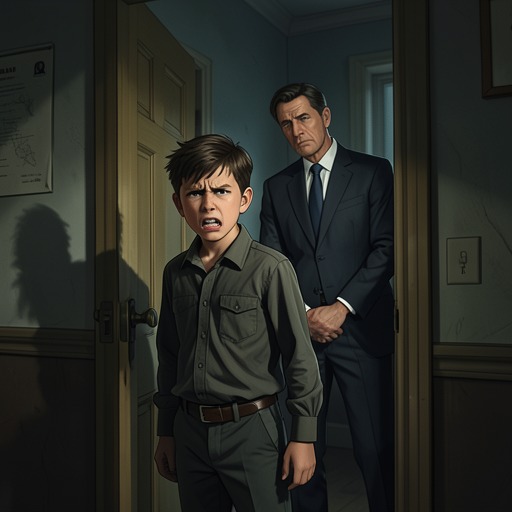
Danny tells Jason Crowder that he and Jack Bittner reached the Hartman home at about eleven o’clock and found Liz Hartman battered, Ron Hartman limping, and Carolyn Hartman shaken. The violence had begun inside the house without warning: Casey’s family had been going about an ordinary evening when they heard noises from his room. Ron, whose account Danny relays, described Casey striking the floor with a relentless rhythm. Though skinny and not yet grown into his body, Casey hit hard enough to rattle the windows and make objects jump on his dresser; the wooden floor was dented and bloody.
Liz went to Casey first, trying to restrain his hands before he injured himself further. He slashed her hairline and struck her in the face. Ron could not overpower his son, who hurled him across the room. Carolyn had entered during the commotion, and Casey then attacked her, hitting her and attempting an act of sexual violence against his sister. Liz intervened. Danny’s account dwells on the reversal at the center of the scene: the child who was ordinarily his family’s boy had become the source of mortal danger to his mother, father, and young sister.
The assault initially presented itself as a crisis with competing explanations, not as an established supernatural fact. Danny could not say what had caused it, but he described Casey’s growling and roaring and the difficulty of restraining him as unlike anything he had witnessed. Jack Bittner had used force to subdue the boy, and Danny acknowledged that the scene might otherwise have looked like excessive force by an officer. His insistence that he had seen Casey’s attack firsthand was what led him to seek a priest’s examination rather than treat the incident as an ordinary arrest.
Examination and Diagnosis
The decision to bring in a priest did not settle what had happened to Casey. Danny Hartman admitted that he was no expert in possession and did not know what to call the episode; what he could testify to was the bedroom’s growling and roaring, Casey’s violent resistance, and the effort it took to restrain him. Jason Crowder, facing Ron Hartman’s demand for an explanation before he had even seen the boy, resisted naming a cause. He said the investigation should consider other possibilities first, including a seizure or a previously undetected psychological condition. The exchange left the family caught between the frightening force of what they had witnessed and the danger of mistaking illness for the supernatural.
Father Sutherland treated that uncertainty as a serious responsibility rather than a reason to rush toward ritual. He told the Hartmans that he had been present at four exorcisms. In two cases, what seemed to be possession was instead an untreated personality disorder or a child’s performance, shaped by an intense desire for attention and her parents’ religious zeal. The consequences of those mistaken judgments were devastating: the untreated woman’s mental and emotional condition worsened, and she eventually died in an institution; the child injured herself, grew resentful of her parents, and later died of a heroin overdose at nineteen. These precedents made misdiagnosis more than a theological error: it could deepen suffering and distort the care a vulnerable person needed.
The other two cases in Father Sutherland’s experience, by contrast, met the conditions he associated with demonic possession, and both people recovered completely. That distinction informed his judgment of Casey. When Danny asked whether the priest was sure, Father Sutherland answered that he was. His certainty followed an acknowledged process of discernment, not the assumption that extreme behavior alone proved an evil presence.
Crowder also explained that possession involved the question of why a particular person had been selected as a host. In cases considered authentic, the choice was seldom random; some logic usually connected the spirit to its host. Liz Hartman heard this as a possible accusation that Casey had somehow deserved his condition. Father Sutherland immediately rejected that implication, telling her there could be many reasons someone became a demon’s host. The idea of selection offered a way to investigate the episode, but it did not establish guilt in the person suffering it.
The diagnosis had immediate practical consequences. Father Sutherland wanted to check Casey’s heart rate and make sure the boy was out of danger without waking the presence he believed was inhabiting him. He opposed calling doctors or paramedics because he expected them to administer a sedative, which he feared could prove disastrous. The episode therefore placed religious and medical responses in tense proximity: the priests were not simply choosing a label, but making decisions about restraint, monitoring, and treatment while trying not to provoke a potentially lethal crisis.
The Presence Speaks
The examination gives way to a more disturbing kind of evidence when the boy answers Father Sutherland’s question about his name. Casey says, “Malephar,” and Sutherland immediately asks where he heard the word. The exchange identifies the name the presence gives for itself, but does not establish where Casey learned it; the question leaves that uncertainty open even as the priests’ concern sharpens.
The voice emerging from Casey also connects the family’s crisis to the Sweet Sixteen killings. When Jason Crowder challenges Jack Bittner about why he thinks Casey is the killer, a deep, ghastly voice answers with a graphic claim about Joy Smith’s rape and the killer’s arousal. The group turns toward the speaker, and Ron Hartman reacts in horror. Casey’s face is described as contorted with unmitigated evil. The moment does not merely add another symptom to the attack: it makes the boy appear to possess knowledge, or to speak with the identity, of the murderer the officers are pursuing.
The presence then turns its attention to Bittner, addressing him by name while the officer is trying to restrain Casey. In a wheedling, derisive voice, it claims that Bittner loves his daughter but lusts after her friends, and begins elaborating on the fantasies it attributes to him. The taunt is presented as a revelation aimed at humiliating and provoking Bittner, not as a confession by Casey in his ordinary voice. The possessed boy has become a channel for an intelligence that exploits private shame as readily as physical violence, making the struggle in the room psychological as well as bodily.
Recurrence and Retrospective Significance
Casey’s possession later becomes a point of comparison when Jason Crowder describes Malephar entering his own body. Crowder believes the demon had tried to govern him as it had governed the teenager, and says it had controlled innumerable human hosts before them. The account recasts the Hartman crisis as more than an isolated outbreak: Casey’s experience had shown Crowder what the demon’s domination could look like, while Crowder’s own later struggle makes clear that the danger could move beyond the family and the boy who first drew the priests’ attention.
The episode’s decisive significance lies in the way it joins bodily violence to a problem of interpretation. The injuries in the Hartman home could prompt medical investigation, police restraint, or a religious diagnosis, and the wrong explanation carried risks of its own. Father Sutherland’s certainty that Casey was possessed therefore stands beside his caution about prior misdiagnoses and the need to assess the boy without provoking the presence. Once Casey speaks the name Malephar and appears to voice the Sweet Sixteen Killer’s knowledge, the crisis expands from a family emergency into evidence of a larger threat—one that Crowder later recognizes as capable of seeking another host.