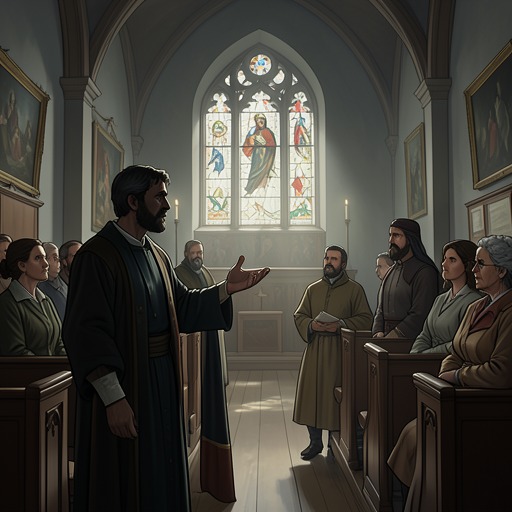
Casey’s confession of murder to Crowder
Exorcist FallsCasey Hartman’s confession to Jason Crowder reverses the investigation’s apparent conclusion: Casey admits that he murdered Julia Deveroux, identifies Danny Hartman as his coach and source of knowledge about the murders, and reveals that Crowder’s own concealed crime gives him leverage. The confession does more than identify another killer. It exposes how Crowder’s repeated misjudgments and buried guilt have made the truth both urgent and dangerous to disclose.
The Evidence That Failed to Settle the Case
Before Casey speaks, Crowder’s investigation has already taught him how easily an apparent clue can become a misleading explanation. In Father Sutherland’s study, a loose floorboard proves to have been lifted and replaced repeatedly. Crowder and Danny Hartman find no keepsakes from the six dead girls beneath it, only a recent Penthouse and an old Hustler. The discovery supplies no trophy collection that could straightforwardly identify the killer; instead, it leaves Crowder weeping over what the search has failed to establish.
Another episode makes the limits of Crowder’s judgment physical. During a conversation, he unknowingly drives a cruciform letter opener through the back of his hand and out the other side. Malephar has made him so insensible to pain that he does not realize he has wounded himself. Crowder recognizes that the demon’s ability to turn an accessible object into a weapon, while concealing the injury from him, is frightening in its own right. His investigation proceeds alongside a compromised awareness of his own actions.
The public account of the latest killing appears to support a different division of responsibility. A printed headline declares that the Sweet Sixteen Killer has struck again and puts the death toll at eight; people are already calling the killing a copycat crime. Crowder, too, concludes that it must have been another killer: if the police have fixed the time of Julia Deveroux’s death at around nine in the evening, he believes Danny could not have killed her. That inference points away from Danny without yet identifying Casey. The confession will reveal how badly the available explanation has failed.
What Casey Reveals
Casey begins by telling Crowder that Danny had disclosed the murders to him. Danny had said that he intended either to kill himself or to surrender, because Crowder would report him to his superiors and arrest was only a matter of time. Casey’s account thus identifies Danny not merely as a relative who knew about the crimes, but as someone who understood that Crowder’s investigation threatened to expose him.
Casey then rejects the explanation Crowder has accepted for Tyler Raines’s death: it was not Raines who killed Julia. Casey tells Crowder that Danny had explained what Crowder did to Father Sutherland, and calls Crowder a killer as well. Before Crowder can answer, Casey holds out Julia’s emerald-lined crucifix. The object connects Casey’s accusation to Julia and makes the disclosure tangible: this is not only a dispute about what Danny told him, but a confrontation over the victim and the crime Crowder had failed to attribute correctly.
Casey says Danny coached him and told him exactly what to do. He then admits that he enjoyed the murder, describing the loss of his virginity and the silencing of Julia’s screams as part of the same confession. His insistence that he was no longer afraid gives the admission a chilling personal dimension: he presents the killing as an experience that changed how he felt about himself, not simply as an act he was forced to perform. The confidence he claims is bound to the violence he has committed.
The Confession Becomes a Threat
Crowder reaches for the crucifix, but Casey snatches it away. He threatens that if Crowder tells anyone what he did, he will tell everyone the truth about Crowder. The threat binds the two men through separate crimes: Casey can expose Crowder’s concealed responsibility for Father Sutherland’s death, while Crowder now knows that Casey killed Julia. Casey refuses Crowder’s attempt to talk and walks away with the crucifix, retaining both the evidence and control of the encounter.
Crowder flees down the stairwell to an empty basement corridor, crying over Casey’s admission. He recognizes that he has once again mistaken an innocent man for a murderer. The reversal does not make Raines innocent of every troubling thought: Crowder believes Raines harbored unsavory desires and might, given time, have acted on them. But Danny killed him because Raines was not the killer and could identify Danny. Crowder is relieved that he did not kill Raines himself, even as he acknowledges that Danny did.
That distinction does not absolve Crowder. Casey’s accusation returns him to the unresolved fact of Father Sutherland’s death, and he understands that Casey is likely to tell the police after an arrest. Crowder privately reasons that he would then have to admit he killed Father Sutherland in error and face a long prison sentence. His own guilt is therefore not a hypothetical secret invoked only by Casey; it already shapes what Crowder believes he can do next.
The Choice Afterward
Crowder weighs reporting Casey against the cost to Liz Hartman. He tells his companion that going to the authorities would stop the murders but break Liz’s heart. The reply insists that Liz should begin healing now if doing so means no more dead children. Crowder accepts the argument. The decision is not a clean escape from his own exposure: if Casey tells the police what Crowder did, Crowder says he will tell them the truth about Father Sutherland’s death.
The confession therefore closes one mistaken line of reasoning while opening a moral decision Crowder cannot keep private indefinitely. Casey’s disclosure identifies Julia’s killer and clarifies Danny’s influence; Casey’s blackmail simultaneously forces Crowder to confront his own crime. The scene’s final pressure falls on the difference between protecting a family from grief and preventing further deaths. Crowder chooses the latter, accepting that the truth about his own actions may follow.