Chicago Deep Tunnel Project
Exorcist FallsThe Chicago Deep Tunnel Project is an underground system of immense concrete tubes that carries storm runoff toward Jewel Reservoir. In the novel, its significance is not confined to drainage: its concealed, water-filled passages connect urban infrastructure to criminal evasion and physical peril. The same hidden geography that helps Danny Hartman avoid detection becomes the route through which Jason Crowder is driven toward a potentially fatal current.
Physical Setting and Function
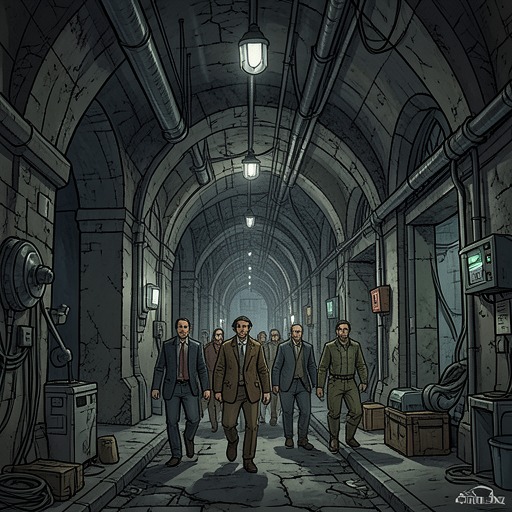
The project appears as a slimy, vast concrete tube, encountered below the city after a descent through stairways leading to freight tunnels. Danny Hartman explains that the city sealed most freight-tunnel entrances because indigent people had found ways to enter, but that a person familiar with Chicago could still locate a few remaining ways in. The distinction matters: access has been restricted, not made impossible. The underground remains legible to someone with local knowledge, even when it is hidden from ordinary view.
Further along, Jason Crowder recognizes the concrete passage as part of the Chicago Deep Tunnel Project. Water reaches ankle height, and the current is strong enough to carry someone toward the reservoir. The tunnel’s scale and force become clear through Jason’s prior experience at Jewel Reservoir, where he has watched excess water gush from giant tubes and strike the water below. The project is thus shown both as a submerged passage and as part of a larger system that channels runoff into the reservoir.
Concealed Routes and the Alspaugh Murder
The tunnels acquire investigative significance through the murder of Mary Ellen Alspaugh. In an earlier discussion of the case, Liz Hartman had reasoned that the killer must have had a way to enter and leave the area without being seen. There were too many witnesses near the murder site, and security cameras were widespread; simply walking away would have risked detection. The underground offered a possible answer to that problem by placing movement beyond the visible street-level routes.
When Danny Hartman leads Jason, Father Patterson, and Tyler Raines down toward the freight tunnels, the setting makes that earlier deduction newly concrete. Jason connects Liz’s account to Danny’s access to the city’s underground passages and accuses him of using them the night he killed Mary Ellen Alspaugh. Danny’s reaction does not resolve every detail of the route, but the connection exposes the tunnels as more than an incidental hiding place: they provide the kind of concealed access the investigation had identified as necessary. Their partial closure and difficult entrances help explain how such a route could remain obscure while still being usable by someone who knew where to look.
From Urban Passage to Immediate Danger
The project’s function shifts sharply when Jason is pursued underground. After being injured and disoriented, he regains his footing and moves through ankle-high water. He identifies the tube as part of the Chicago Deep Tunnel Project and sees a light downstream that indicates he is not far from Jewel Reservoir. The light offers a direction, but not safety: the water is already moving with enough force to make the passage dangerous.
Jason understands the choice in terms of the tunnel’s flow. If he wades farther into the current, it will sweep him through the tube and into the falls; he knows from watching the runoff at the reservoir that a fall there would be unsurvivable. Going downstream therefore means certain death, while his only hope is to hurry upstream and find another way out. Danny Hartman appears behind him with a gun, cutting off the route back and pressing him toward the light. The infrastructure becomes an active constraint on the pursuit: water, direction, and the narrowing possibility of escape shape what Jason can do.
Narrative Significance
The Chicago Deep Tunnel Project links two forms of concealment. In the investigation, the tunnels help explain how a killer could evade witnesses and cameras; in the chase, their scale and current make the same hidden city physically lethal. Aboveground evidence points toward the need for an unseen route, while below ground that route becomes immediate, bodily experience. The sequence converts an investigative inference into a survival problem.
The contrast also gives the project a double role without making it a simple symbol. It is working infrastructure, carrying excess water toward Jewel Reservoir, but its ordinary function creates conditions that can be exploited or feared: obscurity offers access, and powerful flow removes safe options. The closed entrances do not erase the underground; they make knowledge of its remaining openings consequential. By carrying the action from freight passages into a water-filled tube, the project reveals a Chicago beneath the visible city where criminal movement, pursuit, and the forces of runoff converge.