Danny Hartman–Jack Bittner police partnership
Exorcist FallsThe Danny Hartman–Jack Bittner police partnership joined two men whom Jason Crowder regarded as an unlikely pair. Their work together was tested during the crisis at the Hartman home, where Danny’s effort to protect Casey collided with Bittner’s suspicion and escalating violence; Bittner’s death left Danny to defend his actions while concealing his own crimes.
Formation and Contrasting Temperaments
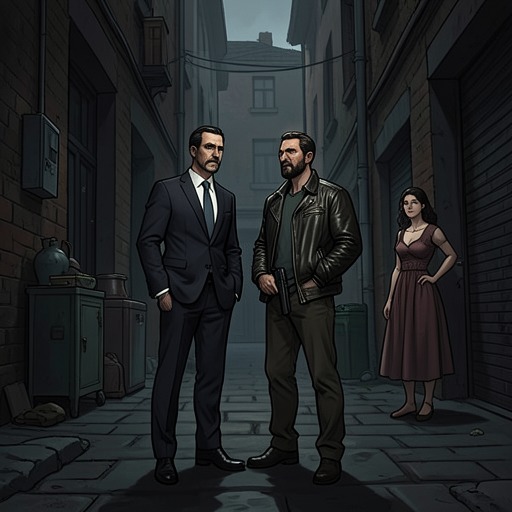
Danny identified Bittner as his partner when Jason asked whether he had been on duty. Jason knew both men and thought the Chicago Police Department’s higher-ups could hardly have chosen a more mismatched pair. Danny was a faithful parishioner who stayed after Mass for fellowship. Bittner attended church infrequently and, when he did, sat in the back row with a forbidding expression that had long intimidated Jason.
Their contrasting temperaments also shaped how they responded to the Sweet Sixteen killings. Danny said that the crimes had cost him sleep and left him brooding, but that no one had taken the case harder than Bittner. Jason, who had not thought Bittner seemed like someone to take police work personally, questioned why the officer would show an unusually strong interest in the murders. That difference in how the partners carried the case foreshadowed the conflict between Bittner’s suspicion and Danny’s efforts to control what happened at the Hartman house.
The Hartman-house Crisis
At the Hartman home, Danny used his authority and his partnership with Bittner to keep the crisis from immediately becoming a police arrest. He persuaded Bittner to let a priest examine Casey first, then arranged for Bittner to ride in Ron’s car, where he could not use the police radio; Bittner also had no cell phone. Danny explained that he wanted to be present to protect Casey when Bittner returned. The maneuver kept the officers away from headquarters for the moment, but it did not resolve the suspicion driving Bittner’s response.
After Liz left the room, Bittner dropped his restraint and revealed his theory that Casey was the Sweet Sixteen Killer. Danny had brought the accusation to the priests, hoping Father Sutherland’s experience might help, but Bittner’s fixation made the boy’s examination increasingly dangerous. When Casey’s voice exposed Bittner’s sexual interest in his daughter’s friends, Bittner struck Casey and reached for his gun. Danny, already bloodied, aimed his own weapon at his partner and refused to let him shoot the child. The partnership’s crisis had become an armed confrontation: Danny’s loyalty to Bittner could no longer outweigh his decision to protect Casey.
The conflict ended with Bittner dead by suicide, a fact that continued to shadow Danny. Later, when Detective Ambrose questioned whether Jason could have caused Bittner’s death, Danny defended his former partner’s conduct and denied that Jason had anything to do with it. He described Bittner as a time bomb, connecting his instability to the loss of his daughter after his ex-wife took her away. His defense neither erased the violence at the Hartman home nor made the partnership simple: Danny had once tried to restrain Bittner through procedure and presence, then had to point a gun at him to stop a killing.
The Partnership's Hidden Asymmetry
After Bittner’s death, Danny Hartman helped Jason Crowder construct an account that separated the supernatural crisis from its human consequences. They agreed to tell the truth about the demon possessing Casey Hartman and Bittner’s suicide, but to say that Father Sutherland had killed himself after attacking Jason. Danny called Liz Hartman with this version, and she agreed to repeat it. The surviving partner thus helped conceal the circumstances around the death of the man he had once tried to stop from shooting Casey.
Danny later defended Jason when Detective Ambrose questioned whether he had caused Bittner’s suicide. He insisted Jason had nothing to do with it and described Bittner as a time bomb, attributing his instability to the loss of his daughter after his ex-wife took her away. The defense complicates Danny’s role: he could speak in sympathy for his partner while withholding the truth about his own actions and identity.
That concealed identity radically changes the partnership’s meaning. Danny was the Sweet Sixteen Killer, even as Bittner suspected Casey Hartman of the murders. When Danny turned on Jason, he taunted him about having mocked the killer’s choice of sixteen-year-old victims and his prom date. The earlier investigation had therefore placed the partners on opposite sides of the case without revealing the deepest reversal: the officer most invested in the partnership was himself the murderer they were seeking.
Secrets and the Partnership’s Dark Mirror
The scene at the Hartman home exposed Bittner’s sexual interest in his daughter’s friends, a revelation that helped provoke his attack on Casey Hartman. Danny’s later disclosures make that moment an unsettling mirror rather than a clean division between a violent partner and a protective one. Speaking to Jason Crowder, Danny described watching Liz Hartman and fantasizing about mutilating her. The contrast does not make the men’s actions equivalent, but it shows how the partnership’s public roles concealed private appetites and danger.
The reversal is sharpened by Danny’s eventual identity as the Sweet Sixteen Killer. Bittner suspected Casey Hartman, while his own partner—the officer who had intervened to save Casey from being shot—was the murderer. In retrospect, Danny’s defense of Casey was real in that immediate crisis, but it could not make him a trustworthy partner or disentangle his police work from the violence he concealed. The partnership thus becomes one of the story’s bleakest ironies: the officer who challenged Bittner’s deadly misjudgment was himself hiding the crimes that the investigation was meant to uncover.