Father Joe Patterson
Exorcist FallsFather Joe Patterson is the senior priest who becomes Jason Crowder’s direct supervisor after Father Sutherland’s death, and the first authority figure to challenge Crowder’s account of what happened. His severity is personal as well as institutional: he is Sutherland’s best friend, has long regarded Crowder’s theological views with contempt, and now suspects Crowder of responsibility for Sutherland’s death. When Crowder injures himself under Malephar’s influence, Patterson shifts from interrogation to immediate intervention, but handles the injury within the cathedral rather than summoning an ambulance. His character is defined by that combination of formidable judgment and tightly controlled action.
Identity and Position
Patterson is a senior priest at St. Matthew’s Cathedral, more than fifty but appearing considerably younger. He is tall and powerfully built, with brown skin, carefully groomed black hair without gray, and a physical presence that makes Crowder—himself over six feet tall—feel dwarfed. The description establishes a contrast between Patterson’s imposing exterior and the measured authority he exercises in the cathedral: he does not need to raise his voice or offer reassurance to dominate a room.
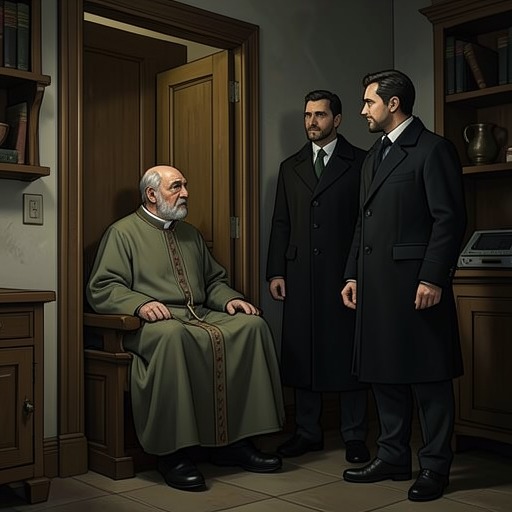
After Father Sutherland is gone, Patterson is not only Crowder’s superior but his direct supervisor. Crowder understands that the new reporting relationship carries additional weight because Patterson and Sutherland were best friends. Patterson therefore has both institutional authority over him and a close personal connection to the man whose death is under scrutiny. Their interview takes place in Patterson’s office, reached by descending from the reception area to the cathedral basement and walking along a long, dim corridor. Crowder’s approach through this space is shadowed by the awareness that the protector who once mediated their disputes is no longer present.
A Longstanding Intellectual Conflict
Patterson’s hostility toward Crowder predates the crisis. In metaphysical discussions, he habitually identifies weaknesses in Crowder’s reasoning; when Crowder contradicts him, Patterson rebuts him mercilessly. Crowder recalls that Father Sutherland sometimes acted as intermediary, smoothing the tension between the two priests. Even with Sutherland’s intervention, Patterson’s contempt for Crowder and what he considered Crowder’s radical views was plain to those present.
That history shapes Crowder’s conduct during their meeting. He tries to moderate his own judgment of Patterson, recalling Sutherland’s admonition that Patterson had seen and endured much and should not be judged too harshly. Crowder feels that effort is difficult because he experiences Patterson as judging him just as harshly. He nevertheless tries to honor Sutherland by approaching Patterson with restraint. The former mediator’s absence thus changes the balance between them: disagreements that Sutherland once softened now unfold directly between supervisor and subordinate.
The Accusation over Sutherland’s Death
Patterson questions Crowder about the events surrounding Sutherland’s death, including why Malephar entered Sutherland rather than Crowder. Crowder struggles to give a satisfactory account. When he asks Patterson to state plainly what he believes happened, Patterson identifies him as responsible for Sutherland’s death. The accusation is direct, not an abstract theological disagreement, and makes their personal history inseparable from the investigation.
Patterson’s approach is uncompromising. He watches Crowder closely, notices how guilty Crowder’s movements appear, and directs his attention to Crowder’s hand when the danger becomes visible. The scene puts Patterson’s powers of scrutiny to a concrete test: the priest who had previously exposed flaws in Crowder’s arguments now observes a bodily injury that Crowder himself has not consciously recognized. His suspicion does not disappear, but the immediate crisis forces a different kind of response.
Crowder’s Injury and Patterson’s Response
During the conversation, Crowder has driven a gilded cruciform letter opener through the back of his right hand and out through the other side. He had thought he had replaced the object on the stand beside him, but Malephar has gained access to it. The demon’s influence also blunts the pain so effectively that Crowder does not initially realize what he has done. Patterson sees the puncture wounds and the spurting blood, swears, and calls for a nurse through his office phone.
Patterson then seizes Crowder’s wrist and keeps him pinned in the chair when Crowder tries to move. His size is again emphasized: despite Crowder’s height, Patterson is taller in effect, with shoulders described as twice as broad. Patterson does not know whether removing the embedded letter opener is advisable, so he tells Crowder to hold still until Sister Rebecca arrives. The action is practical and controlled, a sharp change from the accusation that preceded it; Patterson responds to the immediate physical danger before attempting to settle its cause.
When Sister Rebecca enters and examines Crowder, she asks why an ambulance was not called. Patterson explains that discretion is sometimes necessary and that the cathedral would have had difficulty explaining Crowder’s wounds as an accident. His choice is therefore not simply an unconsidered omission: he explicitly frames it as a decision about how the injury can be handled and explained. The episode shows him exercising authority over the response while leaving Sister Rebecca to examine the wound and ask Crowder how it happened.
Narrative Role
Patterson occupies the institutional and personal space left vacant by Father Sutherland. He is a superior who knew Sutherland intimately, a theological opponent who has long distrusted Crowder’s ideas, and the person who turns that distrust into an explicit accusation. Yet the same scene refuses to reduce him to an antagonist: when Crowder’s hand is punctured, Patterson notices, calls for medical help, restrains him from worsening the injury, and waits for Sister Rebecca rather than attempting an uncertain removal himself.
The contrast does not resolve their conflict. Patterson’s intervention makes Crowder’s immediate danger unmistakable, while the choice to keep the matter within the cathedral adds a question of discretion to the medical emergency. In this sequence, Patterson’s authority is expressed in both scrutiny and containment: he presses Crowder to answer for Sutherland’s death, then manages the physical consequences of Malephar’s influence without withdrawing the accusation. His arrival as supervisor marks a new phase in Crowder’s life at the cathedral, in which the former mentor’s mediation has ended and responsibility is demanded by a man who is at once Crowder’s critic and Sutherland’s closest friend.