Hartman house
Exorcist FallsThe Hartman house is the family residence where the investigation of Casey Hartman’s condition turns into a violent supernatural crisis. Its spacious, carefully decorated rooms first offer a composed domestic setting for Jason Crowder and Father Sutherland’s visit; the route upstairs to Casey’s bedroom then draws the visitors into the center of the danger. The house’s most consequential events culminate outside, when Jason Crowder throws Father Sutherland through a damaged window onto the concrete patio, and the survivors begin shaping what they will tell the authorities.
Setting and Access
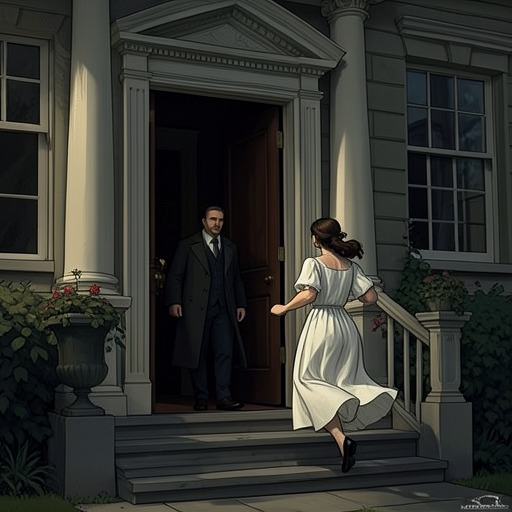
The visitors enter without knocking and find a sprawling, stylishly decorated historic home, more imposing than uncanny. Its foyer rises about thirty feet, with a sleek black baby grand piano dominating the parlor to the left. A second room lies to the right behind a shut door. The details establish a substantial, orderly residence before the crisis disrupts its apparent composure.
Liz Hartman appears from a doorway on the right, her blonde hair and careworn expression registering the strain already surrounding the family. She asks Danny Hartman whether he has brought both visitors. In the kitchen, Jason Crowder tries to answer Ron Hartman’s questions cautiously, explaining that Casey’s condition cannot yet be diagnosed and that possible causes include a seizure or an undetected psychological condition. His carefully qualified response reflects the uncertainty with which the visitors approach the house: they have not yet seen Casey, and Crowder resists naming the cause in advance.
Father Sutherland asks Liz to lead the way. Crowder follows the others out of the kitchen, up the stairs, along the second-floor hallway, and toward Casey’s bedroom, feeling like an unprepared understudy pushed into a leading role. The movement from shared family rooms to an upstairs bedroom gives the house a clear dramatic geography: the investigation begins among the adults, then narrows toward the child whose condition has brought them there.
A Home Under Investigation
The possibility of an exorcism is not treated as harmless or automatic. Father Sutherland recounts four previous exorcisms: in two cases, he believed the symptoms arose from other causes, and the rites worsened the affected people’s lives. One woman, who had gone untreated for years, sank into greater mental and emotional turmoil and later died in an institution; a child who feigned possession injured herself, became resentful of her parents’ religious zeal, and eventually died of a heroin overdose. Sutherland contrasts those outcomes with two cases in which the affected people met the conditions for demonic possession and recovered after the rites.
That history makes the Hartman house a place of diagnostic hesitation as well as fear. The family’s immediate crisis must be assessed without confusing mental illness, play-acting, and possession. When the sound of rapid thudding breaks out upstairs while the visitors have bowed their heads, Sutherland moves first. Liz and Crowder follow him up the staircase, with Ron behind them; Danny appears at the top, frightened, before a roar from the hallway drowns out his words.
The consequences of choosing how to respond remain physical and immediate. Sutherland wants to check Casey’s heart rate without waking the presence, but argues against summoning doctors or paramedics because he fears they will sedate the boy, potentially with disastrous results. Crowder recalls the violence Casey’s body has endured and its inexplicable regeneration. The bedroom is thus not simply the destination of the investigation: it is where the competing risks of medical intervention, spiritual danger, and delay converge.
The House Becomes a Scene of Violence
The threat moves beyond Casey’s room into the second-floor hallway. After Crowder urges Liz to take Carolyn Hartman to the guest room for safety, an unholy burst of laughter erupts behind them. The group sees a figure standing motionless outside Casey’s bedroom door. Crowder tells Liz to go, and she reluctantly leads Carolyn away and closes the guest-room door. A domestic act of protection—moving a child farther from danger—briefly separates the family from the confrontation, but does not end the danger within the house.
The most decisive violence takes place at a damaged window. Crowder lifts Sutherland and smashes his upper body against it; when the window gives way, rain and icy wind enter the room. Crowder then casts the priest out. From the jagged opening, he sees Sutherland fall to the Hartmans’ concrete patio, land face-first, and lie unmoving as rain washes away his blood. The house’s interior and exterior become part of a single violent scene: the broken window opens the room onto the patio, where the night’s confrontation ends in death.
Aftermath and Narrative Significance
Danny Hartman sees Crowder at the doorway after Sutherland’s fall. Later, while Danny drives Crowder toward Saint Joseph Hospital, the two agree on an account that includes the demon possessing Casey and Jack Bittner’s suicide but describes Sutherland as having killed himself after attacking Crowder. Danny calls Liz, who agrees to repeat their version. Their decision makes the house not only the site of the violence but also the setting whose events must be selectively recounted afterward; Ron, who was not in the room with Crowder and Sutherland, is left outside that particular arrangement.
The house’s significance rests on the collision between its recognizable domestic spaces and the extraordinary events they contain. The foyer, kitchen, staircase, bedroom, hallway, guest room, and broken window organize the crisis into successive movements: arrival, investigation, eruption, attempted protection, and death. Its elegant rooms do not explain or contain the danger. Instead, the house becomes the setting in which the family’s private emergency forces religious judgment, physical risk, and the need for a shared public story into the same night.