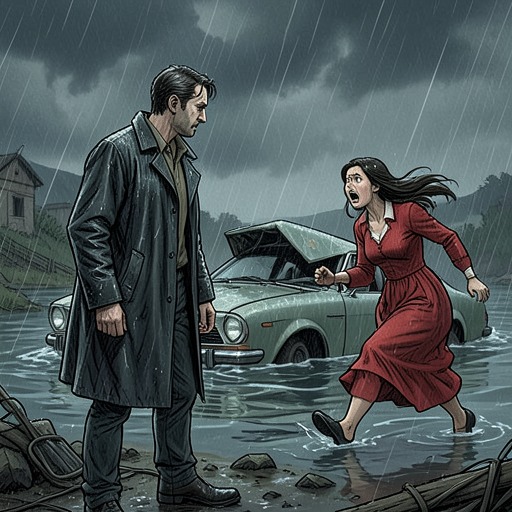
Jack Bittner
Exorcist FallsJack Bittner is a Chicago police officer whose personal wounds turn the investigation of the Sweet Sixteen Killer into a volatile struggle over guilt, family, and control. He is Danny Hartman’s mismatched partner, a forbidding presence within the police department, and a father whose love for Celia becomes inseparable from rage at the people and circumstances he believes have taken her away. His death, compelled by Malephar, transforms him from an accusatory authority figure into one of the clearest casualties of the demonic conflict.
Identity and Background
Jack Bittner serves with the Chicago Police Department and partners with Danny Hartman. Jason Crowder regards the pair as an unlikely match: Danny is a faithful parishioner who remains after Mass for fellowship, while Jack attends church rarely and, when he does, sits in the back with an intimidating expression. That contrast establishes Bittner as a man resistant to religious community and difficult for others to approach. His authority as a police officer is therefore accompanied by an atmosphere of threat rather than reassurance.
Danny’s account supplies the history beneath that hard exterior. Bittner was born and raised on the South Side and endured a harsh childhood after his father abandoned the family and his mother died by suicide. He repeatedly imagined his mother burning in hell, a memory that connects his early life with guilt, judgment, and religious terror. Later, Bittner’s wife left him for another man, and he moved north to create distance from the marriage’s collapse. Danny describes the resulting hatred toward Bittner’s ex-wife as unusually intense, placing abandonment at the center of the officer’s emotional life. The man who appears aggressive and immovable is also someone shaped by repeated experiences of being left.
Bittner’s daughter Celia is sixteen, a detail that gives the Sweet Sixteen killings an especially intimate meaning for him. Danny explains that most people do not know Celia exists, but Bittner’s distress over the murders is inseparable from the fact that his daughter is approaching the age associated with the killer’s victims. The case is not merely professional for him: it threatens to convert the pattern of violence into a prophecy directed at his own child.
Partnership and Investigation
Danny says that no one has taken the killings as hard as Bittner. The statement presents grief as a professional burden, but it also foreshadows the way Bittner’s private fears will distort his judgment. When he confronts Casey Hartman, Bittner does not approach the boy as a suspect whose guilt must be established. He arrives ready to discard restraint and demands that the family leave so the investigators can determine what Casey knows without interference. His blunt language and contempt for procedural delicacy make the interrogation feel like an act of domination.
Bittner’s central theory is that Casey is the Sweet Sixteen Killer. Danny reports the theory uneasily, while Bittner embraces it with certainty. He claims that Casey had been attracted to Joy Smith, killed her when frustrated, and then developed a taste for killing other girls. The theory gives Bittner a simple chain of motive and escalation, but its emotional force exceeds its evidentiary basis. Casey is not only a possible murderer in Bittner’s eyes; he is a hated figure onto whom the officer can project sexual violence, predation, and the danger surrounding his daughter.
The confrontation becomes more unstable when Casey’s condition and the supernatural crisis undermine ordinary police interpretation. Bittner’s suspicion remains fixed even as other characters attempt to understand Casey as possessed by Malephar. Later, Malephar reads Ron Hartman’s innermost thoughts and exposes Ron’s double life, illicit drug use, and aberrant sexual behavior. Terrified that these secrets will become public, Ron releases Bittner from the squad car where the officers had confined him. Bittner had been locked up because he believed Casey was the killer; once free, he nearly murders Casey. The release is therefore not a rescue but a transfer of danger from one imprisoned body to another.
Bittner’s actions also reveal the institutional weakness of the investigation. Danny remains loyal to his partner even after the death, presenting Bittner as a man who had become a time bomb under the pressure of his ex-wife taking Celia away. Detective Ambrose later notes that a man killing himself in Jason Crowder’s presence has happened twice in the same week, inviting suspicion that the apparent suicide was part of a larger pattern. Danny insists that the Bittner incident was different and that Crowder had nothing to do with it. His defense depends less on a demonstrable police explanation than on personal knowledge of Bittner’s accumulated despair.
Confrontation with Casey Hartman
Bittner’s suspicion reaches its most dangerous point during the confrontation with Casey. A demonic revelation provokes him into drawing his weapon, and his rage makes him clumsy while he frees the gun from its holster. He appears intent on shooting the child before another voice stops him. The scene concentrates the contradictions of his character: the father terrified for a sixteen-year-old daughter becomes a heavily armed man prepared to kill another family’s son, and the officer who claims to protect children becomes an immediate threat to one.
The conflict is sharpened by the way sexual accusation circulates among the men. Casey is accused of desiring Joy Smith and murdering her out of frustrated lust, while Malephar exposes other men’s hidden sexual conduct as a weapon. Bittner’s paternal concern thus exists within a wider economy of male suspicion, surveillance, and possession. His anger is directed outward, but the narrative repeatedly shows that the men who claim authority over women and children are themselves entangled in fantasies of control.
Bittner is not allowed to convert suspicion into a completed act of execution at that moment. He remains a dangerous captive of his own certainty, and the weapon that should restore his authority instead marks the point at which his judgment has become unusable. The novel’s supernatural forces exploit precisely this collapse between professional duty and personal grievance.
Malephar’s Control and Death
Malephar eventually turns Bittner’s violence against him. After the demon has climbed off Bittner’s supine body, Bittner reaches his knees and retrieves his gun. His hand first appears unsteady, then becomes sure; yet the weapon brings him not confidence but puzzlement and dread. The change suggests that the decisive will no longer belongs to Bittner. When he draws the gun, the action that once threatened Casey becomes the mechanism of his own destruction.
Celia’s voice addresses him as he recovers the weapon, but the intervention does not prevent the fatal act. Bittner squeezes the trigger and dies from the gunshot, the rear of his head destroyed before Jason Crowder can turn away. The brutal image gives physical finality to a death that has been spiritually coerced. Bittner is responsible for the weapon and for the history of violence that made him vulnerable to manipulation, but Malephar controls the immediate act, converting the officer’s authority into a spectacle of helplessness.
Danny and Crowder later decide to tell the truth about the demon possessing Casey and to describe Bittner’s death as suicide. They recognize that the actual circumstances are difficult to explain and that any account implicating Casey would endanger him. The proposed story must absorb both the supernatural fact and the police officer’s apparent self-destruction. Bittner’s death consequently enters the official world as an unstable narrative: Detective Ambrose sees a suspicious repetition, Danny supplies a psychological explanation, and the survivors protect the living by withholding the full truth.
Even after Bittner’s death, his presence continues to shape Crowder’s actions. A later memory of the officer just before Malephar forced him to shoot himself awakens images connected to the killer’s thoughts. Crowder also recognizes Celia while following her and understands that she is the daughter of the man he watched die. Bittner’s death therefore does not end his narrative function. It becomes a clue, a moral wound, and a reason for Crowder to intervene when Celia is in danger.
Fatherhood, Loss, and the Memory of Celia
Bittner’s relationship with Celia remains the most painful measure of his divided character. His daughter’s sixteenth birthday is presented not as a simple family milestone but as the point at which the murders become personal prophecy. The loss of Celia through his separation from his wife compounds the childhood abandonment already embedded in his history: his father left, his mother died by suicide, and his wife left him for another man before taking his daughter away. His grief consequently hardens into possessiveness and resentment. Danny’s description of Bittner as a time bomb does not excuse the violence that follows, but it identifies the pressure accumulating behind the officer’s public severity.
The surviving characters later encounter Celia in circumstances far removed from the police investigation. Jason Crowder recognizes her as the daughter of the man whose death he witnessed, and the recognition changes the meaning of the girl before him. In the montage associated with the Sweet Sixteen Killer’s thoughts, Crowder has seen both Liz Hartman and Julia Deveroux, the latter identified as a victim of Tyler Raines. When he realizes that Celia is still exposed to danger, Bittner’s memory becomes an impetus to protect rather than an invitation to condemn. Crowder tells Celia that he knew her father and that Bittner loved her more than anything and wanted her safe. The statement preserves a truth that Bittner’s violence had obscured: his love was real, even though it had become entangled with fear, rage, and the urge to control.
Death, Cover Story, and Institutional Interpretation
Bittner’s death produces an immediate crisis of explanation. On the way to Saint Joseph Hospital, Danny Hartman and Crowder agree to report that Casey Hartman had been possessed by a demon and that Bittner had committed suicide. They also decide to claim that Peter Sutherland killed himself after attacking Crowder. Liz Hartman accepts the account that Danny gives her, while Ron Hartman is deliberately excluded from the deception because he was not present for the relevant confrontation. The arrangement shows Danny’s loyalty operating beyond ordinary police procedure: he protects Casey by refusing to make the boy the public cause of Bittner’s death, even as the survivors construct a version of events that cannot expose Malephar’s intervention.
The official explanation remains vulnerable because the death resembles another apparent suicide. Detective Ambrose observes that a man killing himself in Crowder’s presence has occurred twice in the same week. The repetition turns Bittner’s death into a forensic and narrative anomaly, especially because Crowder is the common witness. Danny answers that the Bittner case was different and that Crowder had nothing to do with it. He then supplies a social explanation: Bittner had been damaged by his ex-wife taking Celia away, and the pressure had eventually become unbearable. This account is partly credible because Bittner’s history genuinely contains abandonment, anger, and despair, but it also demonstrates how psychological plausibility can conceal supernatural causation.
The survivors’ uncertainty is explicit. Crowder does not know whether Danny’s story about Sutherland will be accepted and cannot see what explanation could account for Bittner’s abrupt decision to shoot himself. A suicide pact or a reckless truth-or-dare game might be offered as alternatives, but neither corresponds to what actually happened. Bittner’s death thus occupies a strange border between evidence and concealment: the gunshot is undeniable, the visible act appears self-inflicted, and the controlling force behind it cannot be entered into a conventional police report.
Legacy and Narrative Significance
Bittner’s later significance lies in the tension between the man others feared and the father Crowder chooses to remember. At first, Jason Crowder is intimidated by his forbidding manner and sees him chiefly through the contrast between the threatening officer and the devout Danny Hartman. Bittner’s history then complicates that first impression without redeeming his conduct. His childhood trauma, hatred of his ex-wife, and fixation on Celia explain why the Sweet Sixteen killings strike him with exceptional force, but the novel keeps explanation separate from absolution. His suffering is part of the machinery that produces danger, not a defense against it.
His treatment of Casey Hartman makes that distinction unavoidable. Bittner’s theory that Casey killed Joy Smith and then continued murdering girls is expressed as certainty, not as a cautious investigative hypothesis. When he draws his weapon, the father protecting his daughter and the policeman pursuing a suspected killer collapse into the same figure. The resulting threat is especially disturbing because Casey is not merely questioned or arrested; he is nearly subjected to an improvised execution. Bittner’s professional authority has become inseparable from personal rage, while the supernatural crisis makes that authority available to Malephar as a weapon against Casey and against Bittner himself.
The narrative also places Bittner within a broader pattern of male violence and concealed desire. Casey’s alleged violence toward Joy Smith, Ron Hartman’s exposed double life and sexual misconduct, Tyler Raines’s murder of Julia Deveroux, and Fish’s sexualized assault all show men converting desire, shame, or entitlement into bodily danger. Bittner is not identical with these figures: his stated concern is the safety of his daughter, and his death is forced by Malephar. Yet his readiness to shoot Casey demonstrates how protective rhetoric can enter the same cycle of domination. The novel’s moral contrast is therefore unstable. A man may love a child sincerely and still become an agent of terror when fear turns love into possession.
Bittner’s final image carries that instability forward. Crowder remembers the officer at the instant Malephar compelled him to fire, while Celia survives as the living recipient of the love that Bittner could no longer express safely. The dead officer becomes both warning and inheritance: warning that private wounds can deform public power, and inheritance because his concern for Celia moves through Crowder into an act of protection. Bittner’s story ends not with a vindication of the policeman, nor with a reduction of him to a monster, but with the recognition that the same damaged man contained devotion, cruelty, grief, and vulnerability to evil.