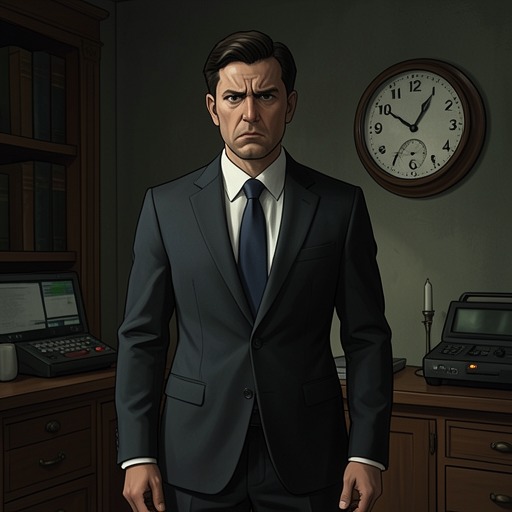
Jack Bittner suicide
Exorcist FallsJack Bittner’s suicide is a turning point in the attack at the Hartman home: the demon makes a police officer kill himself, using Bittner’s daughter and his own service weapon to turn fear into a fatal act. Witnessed by Jason Crowder, the death exposes the demon’s ability to manipulate a person through intimate emotional pressure as well as physical violence. Bittner fires once, but the bullet strikes the headboard; moments later, the demon’s taunts and impersonation of Celia drive him to put the gun in his mouth and pull the trigger.
Background and Intrusion
During the possession crisis, Crowder is isolated in a bedroom and terrified that the demon may attack him again. He expects Father Sutherland or Danny Hartman to come through the door, but it is Bittner who arrives. The circumstances of Bittner’s escape from the police cruiser are not explained at that moment; Crowder notes that he will learn how it happened later. In the room, Bittner fires a shot that bursts plaster above the headboard. The demon is attached to his upper body, and he blunders backward before landing on the floor.
The immediate scene makes Bittner appear to be both armed and under attack. He has apparently dropped the gun while trying to slap the demon, which taunts him in an indecent-sounding language. The demon then climbs off his supine body. Bittner scrambles to his knees and retrieves the weapon. That brief change in the demon’s position creates the opening for its next tactic: it does not simply overpower him, but speaks in a new voice, calling him Daddy and pleading that he not leave.
The Demon Uses Celia’s Voice
Bittner recognizes the voice as Celia’s and says her name. The appeal is specifically shaped around the father-daughter relationship; the voice repeats its plea, presenting itself as a child afraid of being abandoned. Crowder can see Bittner’s face despite the blood on it, and describes his eyes as wide and staring. The demon has shifted from attaching itself to Bittner’s body to addressing him through a voice that he understands as his daughter’s.
The deception becomes explicit when the creature expands and no longer resembles a child. It tells Bittner that Celia despises him and accuses him of abandoning her. When he reaches uncertainly toward the gun, the demon urges him to use it and taunts him about the futility of doing so. Bittner recognizes that the voice is not Celia’s, whispering that it is not his baby. The demon confirms the impersonation, then threatens that Celia will hear all about her father the next day. The threat turns the apparent plea into a calculated humiliation: the demon presents Bittner’s death as something his daughter will be made to learn about.
The Suicide
As Bittner steadies his hand and draws the gun, the demon recites details about him as if delivering a death notice: his name, his age of forty-six, his twenty years as a Chicago Police Department veteran, and a report that he died the previous night in an upscale Lincoln Park home. The speech places his identity and public occupation beside the death the demon is bringing about. Bittner looks at the gun as though it has become a deadly viper and asks what he is doing. The demon answers by celebrating the prospect of sending him to join his mother in hell.
Bittner’s expression registers the horror of what is happening. The barrel drifts toward his open mouth, passes his lips, and his trigger finger turns white. Crowder looks away too late: he sees Bittner squeeze the trigger and sees the back of his head explode. The event is therefore a suicide in its physical action, but the scene frames it as a killing engineered by the demon. Bittner handles the weapon and pulls the trigger; the demon has manipulated the moment through threats, an impersonated daughter, and language that makes the gun seem both frightening and inescapable.
Witnesses and Significance
The door swings toward Crowder, narrowly missing his face, and Danny Hartman stumbles into the room. He stops beside Crowder, gaping as Bittner’s slouching body topples sideways. The demon turns toward them, now unmasked in expression but still wearing Casey Hartman’s body. Danny’s response is a whispered expression of shock. The arrival comes after the shot, so neither he nor Crowder can intervene before Bittner dies; both are left to witness the body and the demon’s revealed face.
The scene also makes the demon’s cruelty personal rather than merely spectacular. Bittner is not killed in an impersonal struggle: the demon invokes Celia, an accusation of abandonment, and the prospect of her learning about her father’s death. Its use of Bittner’s police identity in the death-notice-like recitation sharpens the contrast between his long public service and his helplessness in the room. For Crowder, the death is a firsthand horror: his account moves from hoping Bittner will release him from danger, to fearing that the officer might shoot him, to watching Bittner die by his own hand. The demon’s control of the scene lies in making that weapon, that family bond, and Bittner’s own actions converge on a death witnessed by the two men who enter too late.