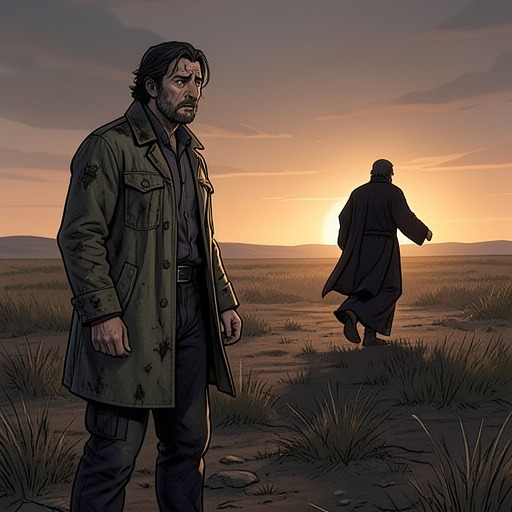
Jason Crowder–Peter Sutherland mentor–protégé relationship
Exorcist FallsJason Crowder–Peter Sutherland mentor–protégé relationship begins as a bond of priestly guidance and practical formation, then fractures when Crowder suspects that Peter Sutherland is the Sweet Sixteen Killer. Sutherland trains and counsels Crowder, but the relationship’s deepest test comes amid the exorcism of Casey Hartman: the older priest’s hard-won caution helps direct the work, while the history behind that caution exposes its cost. Later, Crowder’s accusation and Sutherland’s assault transform a relationship built on trust into a struggle over betrayal and the possibility that a revered mentor has become a murderer.
Formation and Trust
Crowder regards Sutherland as the best priest he has ever met and identifies him as his mentor. Their bond is not merely professional: Sutherland’s presence gives Crowder a model for how a priest should behave in a crisis, and Crowder expects him to arrive when Casey Hartman’s violent episode brings the Hartman household into danger. Sutherland appears composed in his sable cassock and purple stole, a steadiness that answers Crowder’s expectation of a capable guide even as the circumstances unsettle him.
Sutherland’s investment in Crowder becomes explicit much later, when he reminds him that he found him with nothing, brought him into his church, trained him, remained patient despite his awkwardness, and counseled him. The recollection describes an extended relationship shaped by welcome, instruction, and personal attention, rather than a single act of mentorship. Crowder’s later resistance therefore cuts across a bond in which Sutherland has claimed the roles of teacher, protector, and spiritual authority.
A Dangerous Inheritance
During Casey Hartman’s exorcism, Sutherland supplies Crowder with a second Bible, an aged brown volume combining the King James version with other versions and handwritten passages. Crowder has brought his own Bible and is apprehensive about using one that has been altered. The detail makes their difference in experience concrete: Sutherland brings a practiced tool adapted to his work, while Crowder’s unease registers his distance from the older priest’s methods. Sutherland does not simply offer instruction; he draws Crowder into a practice whose risks and rules Crowder has not yet fully understood.
Sutherland’s caution grows out of an earlier catastrophe involving his own mentor. He explains that he has attended four exorcisms. Two, in his judgment, were not authentic cases of possession: one involved an untreated personality disorder, and another a child acting out amid attention-seeking and parental religious zeal. Both exorcisms caused serious harm. By contrast, the other two cases met the conditions he associates with possession, and the affected people recovered. These distinctions show Sutherland resisting the idea that every crisis should be given a demonic explanation, even as he argues that Casey’s condition warrants an exorcism.
The most painful precedent is personal. In one earlier case, a host died after the lead priest turned to modern medicine instead of driving out the demon swiftly; the malevolent presence then overcame the officiating priest. That priest was Sutherland’s own mentor, who had selected him at seminary and nurtured him for more than a decade. Sutherland remembers him as a great and renownedly gentle, pious man, yet the possessed mentor nearly strangled him. The scar across Sutherland’s throat and collarbone, with damage to his carotid artery, makes the old relationship’s violence visible. Sutherland’s guidance to Crowder is thus also an inheritance of trauma: the mentor teaches from an experience in which love and reverence did not prevent a trusted priest from becoming dangerous.
Shared Work and Its Limits
Sutherland’s past governs what he asks Crowder to do in Casey’s case. He opposes calling doctors or paramedics because he fears that sedation could prove disastrous, and he insists that the matter belongs to faith rather than science. Crowder has witnessed Casey’s extraordinary violence and apparent physical recovery, but Sutherland’s account supplies a further reason for urgency: his fear is shaped by the death of a former host and the attack on his own mentor. The two priests share responsibility for Casey, yet do not meet the crisis on equal terms. Sutherland carries experience that Crowder lacks, while Crowder must decide whether that experience justifies the older priest’s choices.
Sutherland also admits that he lied to the Hartmans to secure permission for the exorcism. He had initially described the outcomes of his earlier cases in a way that concealed that only one person had lived in the disastrous case he later recounts. The confession complicates his authority. His deception is presented as a means of obtaining permission he believes necessary to save Casey, but it also means Crowder and the Hartmans have been asked to trust a priest who withheld the full stakes. Mentorship here passes on knowledge and judgment, but it does not eliminate secrecy or the possibility of error.
After the exorcism, Sutherland tells Crowder that they succeeded and credits him personally. His gesture of squeezing Crowder’s shoulder is met with an abrupt rejection: Crowder tells him not to touch him. The exchange marks a change in their physical and emotional distance. Sutherland offers recognition and a familiar sign of care; Crowder, still responding to the ordeal, refuses the contact. Their shared achievement has not restored ease between them, and Sutherland’s reassurance cannot settle what the experience has done to Crowder.
Accusation and Rupture
The decisive break comes when Crowder confronts Sutherland about the Sweet Sixteen murders and asks how he chose the victims. Sutherland initially responds by invoking his history as Crowder’s teacher, emphasizing the church, his training, his patience, and his counseling. The appeal to their past does not answer the accusation. Instead, their roles reverse: Crowder questions the man who had taught him, and Sutherland tries to reassert the authority of a mentor whose moral standing is now in doubt.
Sutherland strikes Crowder and continues beating him while using words associated with betrayal, Satan, and deception. Crowder, badly hurt, fears that losing consciousness could mean death. He reasons that a seasoned killer would have little reason to spare someone capable of exposing him, and he worries about the safety of Casey Hartman, Danny Hartman, Carolyn Hartman, and Liz Hartman. The danger is not abstractly theological: Crowder imagines the consequences for the people in the house if Sutherland is indeed the murderer and silences potential witnesses. The former mentor’s violence makes the suspicion immediate, though Crowder’s thoughts at that moment remain a fearful assessment rather than a settled account of what Sutherland intends.
Significance of the Bond
The relationship gives the exorcism story a human chain of transmission: Sutherland learned from a mentor whose goodness did not protect him from possession, and Crowder learns from Sutherland while questioning the limits of that authority. The scar on Sutherland’s throat embodies the cost of his earlier apprenticeship; the modified Bible and his warning about sedation show that he carries its lessons into Crowder’s first major crisis. What passes between the two priests is therefore both practical knowledge and a burden of fear, secrecy, and contested judgment.
Their eventual confrontation overturns the assumption that a mentor’s history guarantees his moral reliability. Sutherland’s experience equips him to recognize danger, but his lie to the Hartmans and his assault on Crowder make trust increasingly difficult. Crowder’s accusation does not erase the years of formation Sutherland describes, just as those years cannot settle the accusation. The relationship’s force lies in that unresolved conflict: the priest who taught Crowder how to face evil becomes someone Crowder must fear and investigate.