Jason Crowder’s possession by Malephar
Exorcist FallsJason Crowder’s possession by Malephar makes the priest who studied demonic possession its next contested host: the demon enters him after being driven from Casey Hartman, yet Crowder resists the domination that had governed Casey. The possession is not a simple takeover. It becomes a struggle over bodily control, the meaning of host selection, and whether Crowder can turn his knowledge of evil against the force inside him before it escapes into another person.
Identity and Discovery
Before the danger is understood as demonic, the family faces uncertainty over Casey’s condition. Crowder initially adopts the cautious language he believes Father Sutherland would use, refusing to speculate before examining the boy and naming a seizure or an undetected psychological condition among the possible causes. His restraint reflects the stakes: Father Sutherland recounts having witnessed four exorcisms, including two cases in which mistaken judgments of possession worsened a woman’s untreated personality disorder and a child’s deliberate performance of possession. In those cases, the woman eventually died in an institution, while the girl later died of a heroin overdose. By contrast, Father Sutherland says that the two cases he judged authentic met the conditions of possession and ended in recovery.
The name Malephar enters the investigation when Father Sutherland asks Casey to identify himself and the boy answers with that name. Father Sutherland immediately asks where he heard it. The question makes the name evidence to investigate, not proof by itself; later, Crowder likewise qualifies his identification, referring to Malephar as the demon’s identity only if that is truly what it is. Crowder’s account places the crucial question after the demon is driven out of Casey: where did it go? The answer is that it entered Crowder, making the priest’s subsequent resistance part of the same crisis rather than a separate encounter.
Resistance and Bodily Control
Crowder says Malephar had entered his body two nights earlier. He describes the demon as trying to govern him as it had governed the teenage Casey and, in Crowder’s understanding, innumerable other hosts. Crowder has nevertheless thwarted its attempts to control him. That resistance is not effortless or secure: he once woke at a bathroom mirror with a razor blade moving toward his throat, and he later resolves to remove lethal objects from his cottage or put them beyond reach when his defenses are weak. The threat is expressed through a possible act against his own body, while the decision to restrict access to the razor shows how deliberately he must protect his remaining agency.
The possession also changes the boundary between thought and speech. During an episode in which Crowder cannot make his vocal cords work, Malephar addresses him internally. Crowder realizes that he does not need to speak aloud for the demon to hear him because Malephar resides in his head. The exchange reveals a private channel of communication that leaves Crowder physically impaired but mentally able to question the presence. His account thus distinguishes the demon’s access to his body from complete possession of his will.
After a satanic pact is sealed, Crowder regains awareness in a bathtub beneath the shower. The water is scalding, and he is initially too weak to resist it; then he can move his limbs and begins to push himself upright. The sequence registers a change in bodily control without establishing that the pact has freed him from Malephar. The demon immediately orders him to remain still. Crowder’s return of movement is therefore only a temporary, contested recovery, not a clean end to the possession.
Host Selection and the Search for an Exit
Crowder understands that authentic cases of possession rarely involve a spirit choosing a host at random; he considers there to be some logic to the selection. Father Sutherland intervenes when Liz Hartman hears that possibility as an accusation against her son, explaining that there can be many reasons a person becomes a demon’s host. The exchange matters to Crowder’s own case because it frames host selection as a question, not a judgment that Casey deserved what happened. The evidence does not specify why Malephar entered Crowder, but Crowder sees the demon’s presence in himself as consequential: it has a host who can resist it.
Crowder believes that Malephar wants him dead because the demon needs another host, one without his discipline and willpower. He presents that belief as the reason the presence is trying to kill him, and as the basis for his refusal to yield. He does not describe himself as invulnerable; he describes himself as still in control, a man of faith who intends to use his knowledge of evil against it. That resolve is measured against the razor episode and the effort required to govern not only his actions but his thoughts.
At the reservoir, the question of transfer becomes explicit. Danny Hartman offers himself as a better vessel for the passenger, describing his willingness to do the dirty work. Crowder then recognizes what Malephar wants: Danny. The offer reveals that the possession is tied to a contest over the demon’s next host, while Crowder’s recognition makes him an active interpreter of Malephar’s strategy rather than only its victim. Earlier, Father Sutherland warns against sedating Casey because doctors or paramedics might administer a sedative with disastrous consequences. That warning belongs to the effort to manage Casey’s immediate danger; it also underscores how little room the characters believe they have to treat a possessed body by ordinary emergency measures.
The Reservoir and Its Unresolved Ending
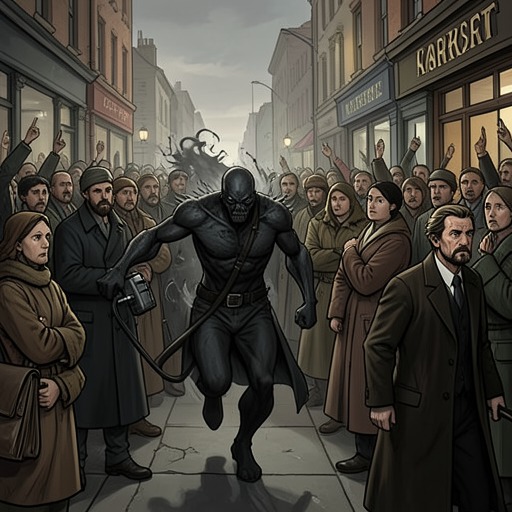
At the reservoir, Malephar appears to take physical form without a host, a possibility Crowder says he had never considered in his reading, conversations with Father Sutherland, or nightmares. Even as he confronts the figure, Crowder interprets its appearance cautiously: he reasons that the visible monster may be a projection of his worst imaginings rather than the demon itself. The figure is humanoid, larger than a person, and marked by red eyes and a fanged mouth; Crowder reads relief in its expression because it has grabbed him before he can leave the water and escape its reach. He suspects that sustaining physical matter strains Malephar and cannot last long.
Father Patterson saves Crowder’s life, and Crowder is taken by ambulance to the hospital. It is his second hospital visit in a week. The doctors are perplexed by the wound in his side: a Korean doctor identified only by the surname Kim says it looks as though Crowder was shot a month earlier and the wound has mostly healed. Crowder feels a moment of gratitude toward Malephar for that recovery, without mistaking it for evidence that the demon is benevolent or dead. He has no illusion that Malephar has been destroyed: the demon has sunk to the reservoir’s bottom, its uninjured red eye still gleaming with hatred. The possession’s ending is therefore provisional. Crowder survives and retains his purpose, but the hostile presence remains, and the possibility of another host continues to hang over the struggle.