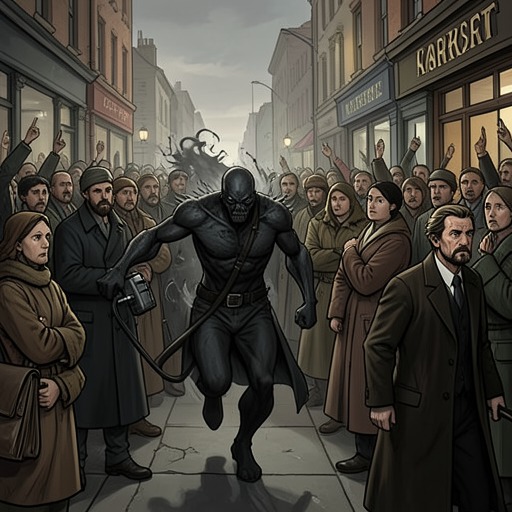
Jason and Malephar’s demonic pact
Exorcist FallsJason and Malephar’s demonic pact is a bargain made under possession, not a clean exchange between equal parties. Jason tries to use the demon’s appetite and power without surrendering his moral agency; Malephar treats the arrangement as permission to act and threatens to punish any attempt to escape its terms. Their dispute over what counts as a breach turns the pact into a test of control: Jason can reason about its limits, but he cannot make Malephar accept them.
An Unstable Agreement
The agreement’s original terms are not fully laid out in these passages. What is clear is that Jason has, at some point, permitted Malephar to seize control and satisfy its desires. Jason later insists that he honored their agreement by allowing this, and connects that choice to having saved someone, though the thought is cut off before he identifies whom. Malephar rejects Jason’s account as an effort to break their pact. The disagreement establishes a crucial imbalance: the same act can be presented by Jason as a limited concession and by Malephar as an invitation to claim more.
The pact sits uneasily beside Jason’s experience of being possessed. Malephar entered his body two nights before one pivotal encounter, and Jason had been trying to keep the demon from governing him as it had governed Casey Hartman. His resistance was not abstract: he once awoke at a bathroom mirror with a razor moving toward his throat, while he felt Malephar battering at his defenses. Against that history, permitting the demon to take control is not a routine choice but a calculated risk. Jason has reason to fear that once Malephar gains full command, he may be unable to reclaim his body.
Terms and Tactics
Jason’s most important interpretation of the pact is that Malephar may punish deeds, but not thoughts. When he resolves to expose Danny, he argues that considering a course of action is not the same as carrying it out, and that Malephar cannot harm him merely for thinking about it. This distinction gives Jason a narrow space in which to plan against the demon while remaining, in his own understanding, within their agreement. Malephar answers not with a shared interpretation of the terms but with threats of grotesque bodily injury, accompanied by vivid images that leave Jason’s hands shaking. The pact therefore governs more than supernatural control: it makes Jason’s own body the threatened ground on which their argument is fought.
The same tactic appears when Jason follows Tyler Raines rather than Danny. Malephar protests that Jason is shattering their covenant and insists Danny will be with Raines. Jason replies that he has not told Father Patterson about Danny and that surveillance of Raines was Father Patterson’s idea. He also argues that Danny is responsible for involving others in his butchery. By directing suspicion toward Raines while keeping his knowledge of Danny from Father Patterson, Jason tries to preserve the letter of the arrangement while making events more dangerous for Malephar’s preferred ally. The demon’s silence after Jason’s defense does not settle the dispute; Jason’s dread at the absence of an answer suggests that he cannot treat silence as consent or safety.
Danny as a Rival Host
The pact’s pressure intensifies when Jason and Father Patterson are in danger in the underground tunnels. Malephar warns Jason that another transgression will lead to his death and that the demon will then leap into another body. Jason doubts this threat is as simple as Malephar makes it sound: if transferring hosts were so easy, he reasons, Malephar would already have abandoned him for someone more suitable. Yet Jason also recognizes that their arrangement cannot remain workable indefinitely. He knows he is a coward for having made the deal, and remains conflicted about whether to use Malephar to escape the killers pursuing them.
Danny Hartman reveals why Malephar may be reluctant to leave Jason. He presents himself as someone willing to do the dirty work and asks whether he would make a better vessel for the demon. Jason understands that Danny wants Malephar inside him, and that Malephar wants the same transfer: Danny is more tractable, while Jason will no longer cooperate with the demon’s wishes. The offer reframes the pact as a contest over the next host. Danny is not simply a threat to Jason; he is a potential replacement who would give Malephar a more compliant instrument.
Jason refuses to exorcise Malephar on the terms Danny wants. He reasons that if both he and Danny were dead, Malephar could not continue, and tells Danny he will not help secure the transfer. This refusal makes the pact’s central contradiction plain. Jason has previously allowed Malephar to act, but will not let that concession become a route by which the demon survives in Danny. His leverage is terrible but real: while Malephar depends on a living host, Jason can threaten to make the demon’s continued existence inseparable from his own.
Limits, Survival, and Significance
Jason ultimately performs the rites against Malephar even as the demon claims that it saved him from dying in the reservoir rapids. Jason accepts that this may be true, but does not accept Malephar’s interpretation of the rescue as benevolence or as a reason to preserve their arrangement. He judges the demon’s intervention as self-serving: Malephar acted to perpetuate its own existence. Jason continues the exorcism, prepared for either the demon to leave his body or for the attempt to kill him. The bargain’s logic reaches its limit when survival itself becomes an argument for ending the pact rather than renewing it.
The exorcism does not resolve the supernatural rules as neatly as Jason’s reasoning might hope. He had never imagined that a demon could take physical form without a host, yet at the reservoir Malephar appears to do so. Jason understands the figure as a projection of his worst imaginings, while also perceiving that Malephar has become something apparently material and has seized him before he can leave the water. Its emergence complicates any confidence that the pact’s host-dependent logic can contain it. The agreement is therefore a temporary, perilous strategy rather than a dependable set of safeguards: Jason can bargain, argue, and refuse, but Malephar’s power repeatedly exceeds the boundaries Jason tries to draw.