Priestly celibacy
Exorcist FallsPriestly celibacy enters the story as a personal vow shaped by fear rather than as an abstract rule. At twenty-nine, Jason Crowder explains that he entered the priesthood because the world frightened him; his vow seemed a way to avoid a particularly unsettling part of it. Yet the choice does not free him from desire. The narrative instead makes the vow a measure of the distance between the safety he sought and the difficult life he found.
A Vow Chosen from Fear
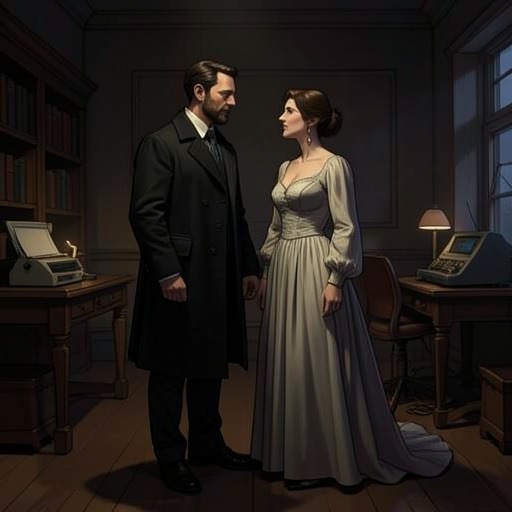
Crowder describes men entering the priesthood for varied reasons, including a wish to atone for an old sin. His own explanation is more immediate: he was afraid of the world. He has also long feared women, though he is attracted to them. Their unpredictability and physical presence leave him feeling dizzy and powerless, and celibacy initially seems a natural response to that vulnerability.
The account does not establish that celibacy is imposed on Crowder by a specific institutional order or that all priests make the same choice for the same reason. It centers his vow as a decision he made in response to his own fear. That distinction matters: the vow offers him a strategy for managing desire, not proof that desire has disappeared.
Attraction and Temptation
Crowder’s experience of priesthood overturns his expectation that the vow will make life simpler. He finds that being a priest makes matters more difficult, not less, and that a married woman can be deeply tempting even as she intensifies his fear. He singles out Liz Hartman, dwelling on her green eyes and the way her clothes fit her body. The attraction is clear, but the evidence establishes temptation and attention, not a consummated relationship.
The tension is therefore not simply between religious duty and a desire that can be switched off. Crowder’s fear and attraction coexist: the same women he regards as dangerously powerful also draw him toward them. His vow marks the point at which that conflict becomes especially charged, because the choice intended to shield him from the world cannot prevent him from encountering its emotional and erotic pressures.
Sexuality and Violence in the Wider Story
The narrative places Crowder’s private conflict beside more threatening expressions of male sexuality. During the crisis in the Hartman home, Casey Hartman attacks Liz Hartman and Carolyn Hartman, and Danny Hartman describes Casey’s assault on his sister in explicitly sexual terms. The episode presents sexual violence as an act of bodily harm and family terror, not as an extension of Crowder’s attraction or a consequence of celibacy.
A later confrontation exposes another, distinct pattern. While Casey is possessed, the voice speaking through him taunts Jack Bittner with an accusation about lusting after his daughter’s friends. The scene uses intimate knowledge as an instrument of humiliation; the accusation is made by the possessing voice and should not be confused with a neutral account of Bittner’s thoughts.
Danny’s own fixation on Liz becomes explicit when he tells Crowder that he watches her and fantasizes about her body. He couples that voyeuristic desire with a fantasy of carving her flesh. The disclosure turns attraction into a threat and sharply contrasts with Crowder’s self-conscious struggle to contain his desire. The contrast does not make celibacy a cure for violence; rather, it distinguishes Crowder’s inward conflict from the coercion and violent entitlement displayed elsewhere in the story.
Narrative Significance
As a character detail, Crowder’s vow explains both his retreat from ordinary intimacy and his vulnerability when attraction breaks through that retreat. Celibacy does not make him immune to desire; it gives his desire a religious and personal framework, intensifying his awareness of the conflict instead of settling it. His account also complicates any simple opposition between a priestly identity and human sexuality: the vow shapes his choices, but it does not erase fear, attraction, or temptation.