St. Matthew’s Cathedral
Exorcist FallsSt. Matthew’s Cathedral is the institutional and religious setting that frames Jason Crowder’s work as a priest: its confessional offers a private space for penitents, while its sanctuary gathers the parish around public worship. As the story’s supernatural violence spills into Crowder’s life, the cathedral’s ordinary duties become entangled with danger, grief, and the difficult act of telling the truth.
Identity and Setting
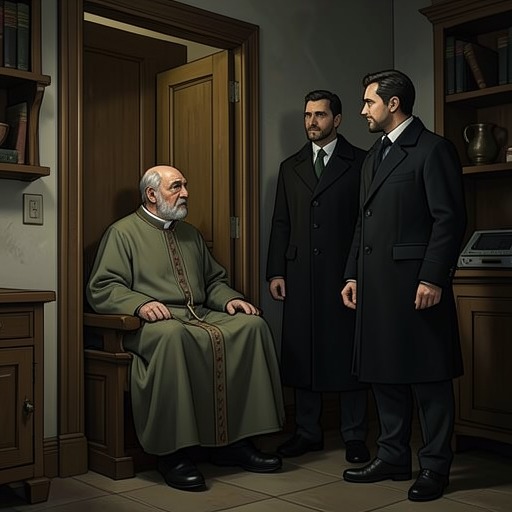
The cathedral is shown through the spaces Crowder uses rather than through a broad architectural description. Its upper wing contains the confessional, reached by a stairwell and carpeted passage; elsewhere, the sanctuary holds the congregation for Mass. The contrast between these spaces is consequential: the booth is enclosed and private, while the sanctuary is public and communal.
The cathedral is also Crowder’s workplace, a place he returns to even when his cottage feels like a torture chamber. After the convenience-store incident, he fears that Father Patterson may use it as further grounds in his effort to remove him from the priesthood. The confrontation does not occur then: Crowder’s secretary tells him that Father Patterson has been called away on important business and will return later. The reprieve is temporary, but it places the cathedral within the institutional pressure surrounding Crowder as well as his religious life.
Confession and the Revelation of a Killer
Confession at the cathedral is both a regular priestly duty and a point where the private and public crises of the plot meet. Crowder is scheduled to hear confessions one afternoon, but Father Richards has taken his place in the booth. Crowder asks to relieve him, describing the work as the distraction and therapy he needs. Though unconvinced that Crowder is ready, Father Richards leaves, and Crowder enters the confessional.
The setting’s privacy soon becomes precarious. A penitent begins by describing himself as a relatively new police officer with a popular partner, then reveals that he is a cop. Crowder recognizes the danger in what he is hearing. The officer is Tyler Raines, and his account identifies the partner’s murderous nature. Crowder throws open the door and calls Raines a murderer; Raines bolts for the stairs, and Crowder pursues him. The confessional has therefore become more than a place for spiritual counsel: what is disclosed behind its door leads directly to a physical confrontation outside it.
That disclosure also changes Crowder’s understanding of the case. Raines’s confession means Crowder did not kill Julia Deveroux, a possibility that had burdened him. Relief surfaces, but it does not soften his response: outrage takes over, and the pursuit continues down the stairway. The cathedral’s secluded booth gives the revelation its intimate form; the adjoining stairs turn that revelation into action.
Clerical Routine Under Strain
The cathedral’s ordinary schedule continues while Crowder is dealing with consequences that strain his identity as a priest. His return follows a night of danger, and he approaches the building expecting possible censure from Father Patterson. Instead, the absent superior and the reassignment of confession duty leave Crowder to choose whether to resume a familiar pastoral task. His decision to take the booth is not presented as an uncomplicated return to normal: he seeks distraction, and Father Richards doubts that the encounter will be easy for him.
The confessional also carries a wider association with the clergy’s obligations of secrecy. Father Sutherland had previously disclosed that the Sweet Sixteen Killer visited his confession booth and revealed details that had not appeared in the newspapers, including items taken from victims and concealed at home. Father Sutherland said that his vows bound him to secrecy, though the extraordinary case led him to share his suspicion with others. The account establishes confession as a site where crucial knowledge can emerge under strict limits; it does not establish that this earlier confession took place in the same booth Crowder later occupies.
Mass, Grief, and Public Speech
After Crowder’s hospitalization, the cathedral becomes a place of public responsibility. On Saturday, Father Patterson is scheduled to conduct Mass, but the previous night’s events and his sleepless vigil at Crowder’s bedside have left him too exhausted to speak. With Father Sutherland gone and Father Patterson unable to lead, Crowder takes the service. It is his first time leading Mass, and the reverence shown him by his fellow clergy makes the responsibility more intimidating rather than less.
Crowder has been discharged from the hospital and hopes to find quiet in his office and pray. His faith has strengthened over the preceding week, and he understands that he has much to be thankful for. Instead, Father Richards meets him at his car with evident joy at seeing him well. The scene places Crowder’s recovery in a community’s view: the cathedral is not only where he performs his duties, but also where other clergy respond to his survival.
In Chapter Twenty, Crowder prepares to speak to an exceptionally large congregation at St. Matthew’s. The pews are full, folding chairs have been added, people stand shoulder-to-shoulder at the back, and others look in from the chapel doorway; even the choir loft appears crowded. Crowder begins by promising to correct rumors about Father Peter Sutherland’s death. He is nervous, but resolved to speak truthfully—while acknowledging that he will tell only most of it. The packed sanctuary makes the address a public reckoning, yet the qualification preserves the tension between disclosure and concealment that has already marked the cathedral’s confessional scenes.
Narrative Significance
St. Matthew’s Cathedral gathers the story’s competing forms of speech into one setting. The confessional gives private disclosures a formal religious frame, but Raines’s revelation breaks out of that enclosure into a chase. Mass and Crowder’s later address reverse the direction of communication: instead of one penitent speaking to one priest, Crowder faces a crowded congregation. Across these scenes, the cathedral’s spaces connect spiritual obligation to investigation, institutional scrutiny, communal grief, and the limits of what Crowder is prepared to make public.