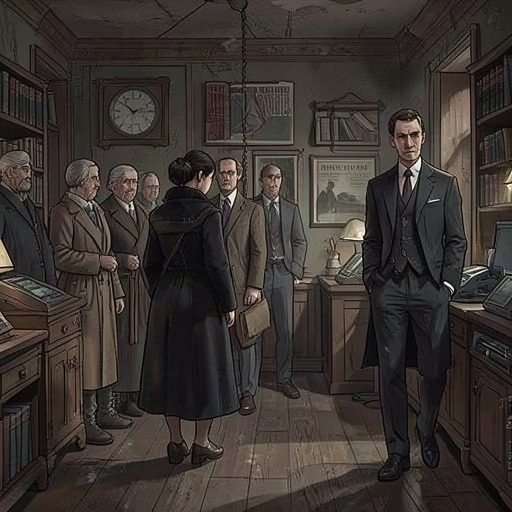
Andrew suppresses the newspaper story
Expecting The CEO's Baby - The Complete Series: BWWM Interracial Billionaire Pregnancy RomanceAndrew suppresses the newspaper story at the point when a private reproductive bargain is about to become a public scandal. His intervention does more than protect personal embarrassment: it shields Ryanna Owens from a degrading public label, preserves the secrecy of the three-million-dollar arrangement, and buys time for Andrew to complete the Bullen Microsystems acquisition before hostile members of the Rutledge Electronics board can use the revelation against him.
Causes and Background
The threatened story originates in Andrew’s decision to offer Ryanna three million dollars to have his child. The payment is divided into three stages: one million dollars when they sign an agreement committing them to attempt conception for at least twelve months, another million when conception is confirmed, and the final million when the child is born. Andrew rejects artificial insemination and in vitro fertilization because, as the CEO of a publicly traded company, he believes that any disclosure through a fertility clinic could create a scandal. He insists that the child must be conceived organically and that the arrangement remain between them.
His secrecy is tied directly to corporate governance. Andrew wants to broaden Rutledge Electronics beyond electronics, while much of the board wants the company to retain its existing focus. He fears that directors already seeking to force him out would interpret the arrangement as evidence of poor judgment. The proposed acquisition of Bullen Microsystems therefore becomes inseparable from the secret: Andrew believes that completing the deal will bring in new board members who can outvote his opponents, whereas an earlier exposure could give those opponents the pretext to remove him and scuttle an acquisition they already oppose.
The leak comes from Natalie, Ryanna’s former roommate and confidante. A reporter approaches Ryanna with a camera and tape recorder and asks whether she is Andrew’s surrogate and whether he is paying her three million dollars to have his baby. Ryanna realizes that the reporter knows details that only she, Andrew, and the person she had trusted with the secret could know. Later, she finds two check stubs from The Philadelphia Ledger in Natalie’s wastebasket, one for $3,500 and another for $8,500, and discovers a month of calls and text messages between Natalie and the tabloid. The $12,000 payment identifies the betrayal and converts the private arrangement into an imminent media crisis.
What Happens
The disclosure initially reaches Andrew through Ryanna’s distress and through the threat of publication. At his office, he becomes absorbed in the danger to the company, lamenting that only a few more months were needed to complete the Bullen Microsystems acquisition. He fears that hostile directors will cite his supposed lack of judgment, remove him as CEO, and use the resulting leadership change to defeat the transaction. His reaction shows that the newspaper story is not merely a romantic inconvenience; it is a threat to corporate control and strategic expansion.
The crisis also damages the relationship between Andrew and Ryanna. When Andrew responds dismissively to the immediate situation and tells her to go home, Ryanna refuses to remain in a relationship that appears to value the board’s opinion above her dignity. She offers to return the money already paid and declares the arrangement ended because she is not yet pregnant. She leaves the Rutledge Electronics headquarters, returns to the Rutledge estate mansion, and begins packing, allowing herself to cry only after she has reached her suite. The threatened story thus helps trigger their first separation before Andrew’s later protective action can repair the damage.
Andrew’s suppression of the story is carried out through institutional resources rather than through a public explanation. His corporate security team investigates the source of the leak after he tells them what is happening. His lawyers then work to stop the articles before publication. Andrew explains that he has connections with the corporation that owns The Philadelphia Ledger and that the corporation has substantial business interests that could be jeopardized by publishing allegations about him and falsely libeling Ryanna. He says that the paper represents less than one percent of its owner’s total net worth, making the threatened publication appear commercially expendable beside the hundreds of millions of dollars at stake in the wider business relationship.
The intervention succeeds: the stories are killed before they reach the public. Andrew later tells Ryanna that there will be no articles about their arrangement and that no one will publicly call her a “gold-digging whore.” He characterizes the legal reasoning as “Lawyer speak” and acknowledges that he kept most of the company’s attorneys busy making the crisis disappear. At the same time, he assures her that his corporate staff does not learn the intimate details of the agreement. They understand only that his personal life must remain private and must not affect Rutledge Electronics.
Consequences and Aftermath
The immediate consequence is the preservation of confidentiality. The reporter’s knowledge and Natalie’s payments do not become a published scandal, so the three-million-dollar agreement remains hidden from the public, the board, and the wider media. Andrew’s use of corporate security and legal influence prevents the accusation from acquiring the force of a headline and keeps the private arrangement from being reframed publicly as either a business scandal or a moral spectacle.
The suppression also allows Andrew to continue protecting his position and the Bullen Microsystems acquisition. The later narrative confirms that the board approves the acquisition, while the media focuses on Rutledge Electronics’ increased power and prominence rather than Natalie’s rumors. The corporate objective that Andrew feared losing is therefore preserved, although the method exposes how closely his private life is managed through the same networks of capital, reputation, and institutional authority that govern his company.
For Ryanna, the outcome is more complicated than simple rescue. Andrew prevents the public from repeating the insult directed at her, but the story makes clear that her reputation has been placed within a system controlled by Andrew’s wealth and corporate connections. Her friend’s betrayal supplies the leak, while Andrew’s resources determine whether the leak becomes public knowledge. The event therefore protects Ryanna from immediate humiliation while also emphasizing the unequal power surrounding her consent, her body, and the arrangement’s secrecy.
The suppression becomes part of Andrew and Ryanna’s reconciliation. Andrew already knows about Natalie when Ryanna discovers the check stubs and confesses that she should have listened to him instead of trusting her friend. He tells her that he feared revealing Natalie’s betrayal would drive them farther apart, and he is relieved that she uncovered it herself. By explaining that the stories have been stopped, he removes the most immediate external threat and gives their damaged relationship room to recover.
The secret does not disappear simply because the articles are stopped. During the pregnancy, Rutledge Electronics’ public-relations department releases a brief statement describing Andrew’s marriage to Ryanna, and Natalie attacks Ryanna on Facebook and Instagram by claiming that she was “bought” and that the marriage was a “sham.” The newspapers and tabloids refuse to give Natalie’s claims attention, and the approved Bullen Microsystems acquisition draws more media interest than her attempted campaign. The contrast shows the difference between a suppressed institutional story and a failed social-media accusation: both seek to define Ryanna publicly, but neither succeeds in displacing the company’s preferred account of Andrew’s growing prominence.
Narrative Significance
Andrew suppresses the newspaper story by turning corporate power into a form of private damage control. The event links the reproductive arrangement to boardroom politics, the acquisition of Bullen Microsystems, newspaper ownership, corporate security, legal work, and social-media reputation. A secret that begins as a contract between two people becomes a problem of information control, and the solution depends on Andrew’s ability to command institutions beyond the intimate sphere.
The event also sharpens the novel’s central contrast between contractual secrecy and emotional commitment. Andrew originally requires confidentiality because public exposure could endanger his company, while Ryanna experiences the same secrecy as a condition that leaves her vulnerable and isolated. After the leak, Andrew’s intervention demonstrates protection and practical loyalty, but it cannot erase the fact that the arrangement was shaped by wealth, corporate danger, and unequal access to legal and media power. The later destruction of the original agreement, after Andrew and Ryanna become engaged in marriage, marks the deeper change: the newspaper story is suppressed while the contract still governs them, but once they marry, Andrew can say that they no longer need it because their vows are binding enough.
As an action, Andrew’s suppression of the story is therefore both a successful corporate maneuver and a revealing moral compromise. It prevents false allegations from reaching the public, protects Ryanna from being branded for a decision she made under severe financial pressure, and preserves the company’s strategic future. Yet it achieves those ends through concentrated wealth and influence rather than through open acknowledgment. The silence Andrew creates is protective, but it is also the condition under which the relationship can continue moving from a secret transaction toward marriage and family.