
From Spectator to Actor
FabianThis thread follows Fabian’s uneasy movement from detached observation toward responsibility, culminating in an action that is morally decisive but personally fatal.
increasing Bearing strength in each event
 decreasing
Bearing strength in each eventdecreasingThe Man in the Crowd

The Man in the Crowd
Distance from the self
As Fabian moves through the brightly lit city, he imagines himself looking down from an airplane at his own small figure in the street. The experience makes him feel both identical with the young man below and oddly detached from him.
Observation as shelter
The episode introduces the distance that will define Fabian’s response to his world. He notices absurdity and danger with precision, but his elevated perspective also turns his own life into something to watch rather than inhabit.
A Philosophy of Nonaction

A Philosophy of Nonaction
Refusing conventional ambition
Fabian tells Labude that he has no desire for money, power, or conventional advancement. He does not see how a person can function meaningfully inside a system whose goals he rejects, and he claims that observing whether people can become decent is itself a purpose.
The challenge of responsibility
Labude argues that Fabian uses impossible ideals to avoid attainable, imperfect work. Fabian is unconvinced that power can be used cleanly, but the disagreement exposes how his moral criticism may protect him from the risks of participation. The question is no longer simply whether society is corrupt; it is whether witnessing corruption can count as an adequate response.
Compassion in Small Acts
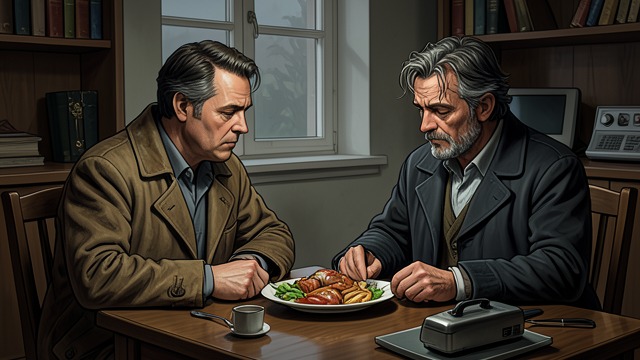
Compassion in Small Acts
Interrupting an indignity
When café staff push a shabby unemployed man toward the door, Fabian intervenes, gives the stranger a place at his table, and offers him food. He challenges the beggar’s own reluctance to sit as though poverty had made him responsible for others’ contempt.
Action without mastery
Fabian’s response is immediate and humane, but the man disappears while Fabian tries to deal with the staff. The encounter suggests that he is capable of action without possessing a program for social change. His compassion is real, yet it cannot by itself alter the conditions that produce hunger and humiliation.
The Lost Chance to Intervene
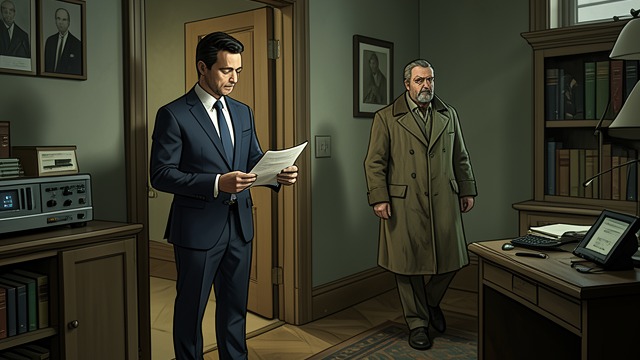
The Lost Chance to Intervene
A life suddenly without a role
Fabian arrives at work to find that the cigarette company has dismissed him and has already handed his advertising proposal to his colleague. He leaves the office with severance money and no clear plan, while Fischer takes the project that Fabian had devised.
Help arrives too late
Soon afterward, Fabian meets an inventor living in poverty, who explains that his productivity-enhancing machines helped displace workers. Fabian offers him a place to sleep, a small act of practical care, but the inventor is later taken away to a sanatorium. Fabian can recognize injustice and help particular people, yet he remains unable to secure a durable role from which to challenge the larger structure.
The Final Leap
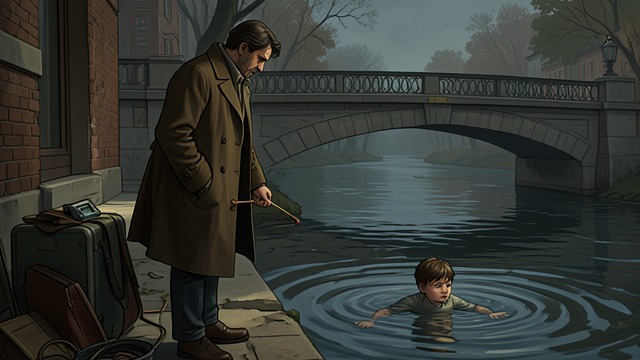
The Final Leap
A decision before reflection
Fabian has been considering whether to accept a newspaper job, retreat to the mountains, or resume a more active life. Near a bridge, he sees a young boy lose his balance and fall into the river. He runs forward, removes his jacket, and jumps in without knowing how to swim.
The limit of moral action
The boy makes it to shore, but Fabian drowns. The closing action transforms the observer into someone who accepts immediate responsibility, but it cannot be read as a simple conversion or triumph: his rescue is effective, and its price is his life. The novel’s ethical demand becomes stark precisely because the world offers no guarantee that action will save the actor.
During Fabian’s first evening wandering through Berlin
During Fabian and Labude’s debate at Haupt’s dance hall
After Fabian finds a beggar being driven from his regular café
On the morning after Fabian loses his advertising job
At the novel’s final scene beside the river
