
The Human Cost of Progress
FabianThis thread traces the novel’s critique of technological productivity when social institutions treat greater output as success despite the workers and moral relationships it destroys.
increasing Bearing strength in each event
 decreasing
Bearing strength in each eventdecreasingMachines and Displaced Workers
Machines and Displaced Workers
Productivity without shared prosperity
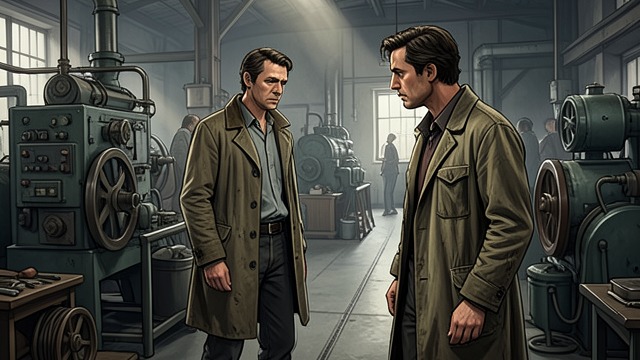
Malmy explains that technical production continues to expand while the workforce shrinks and the purchasing power of ordinary people weakens. Goods become abundant, yet workers lose both employment and the means to buy what industry produces.
A crisis hidden by routine
The apparent contradiction is sustained by state support for powerful interests and by policies that leave mass hardship untreated. Malmy’s account presents technological progress not as an automatic social good but as a force whose benefits depend on the economic order that directs it.
The Inventor’s Reckoning
The Inventor’s Reckoning
Progress seen from the factory floor
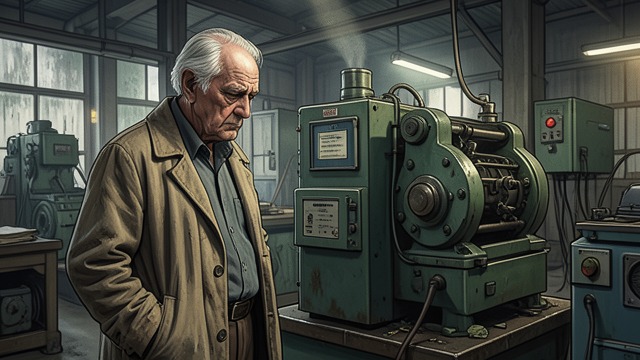
The elderly inventor tells Fabian that his machines enabled textile production to multiply, and that he once believed this achievement to be peaceful. He later saw that the same machinery reduced the number of employed workers and helped shatter the livelihoods of whole communities.
Responsibility after invention
He recalls police attacking locked-out workers and a child being trampled, then recognizes himself as implicated in the system he had helped build. His withdrawal from engineering is morally serious but cannot restore the jobs already lost. The episode gives technological change a human witness who refuses to mistake technical efficiency for social progress.
The Machine That Eats People
The Machine That Eats People
An industrial nightmare
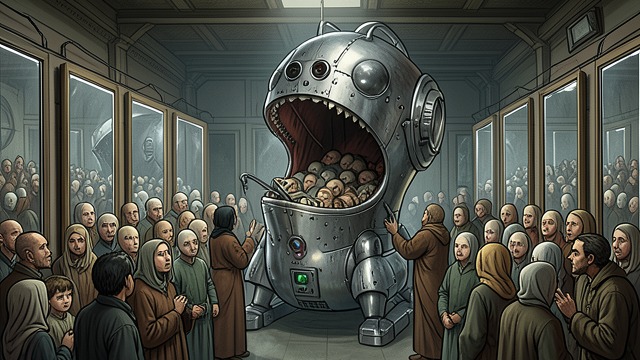
Fabian dreams of a vast machine that consumes children and produces crowds of people who stare at unreachable reflections of themselves. The inventor’s creation appears at once technically organized and morally monstrous, turning human beings into raw material and standardized output.
Progress without human purpose
The machine claims to have shortened working hours and introduced a shorter workweek, but these measures do not prevent it from swallowing its maker or reproducing the same trapped humanity. The dream enlarges the inventor’s real-world reckoning into an image of a society that can improve production while losing sight of the people for whom production should matter.
Unemployment as Bureaucratic Labyrinth
Unemployment as Bureaucratic Labyrinth
A worker sent from office to office
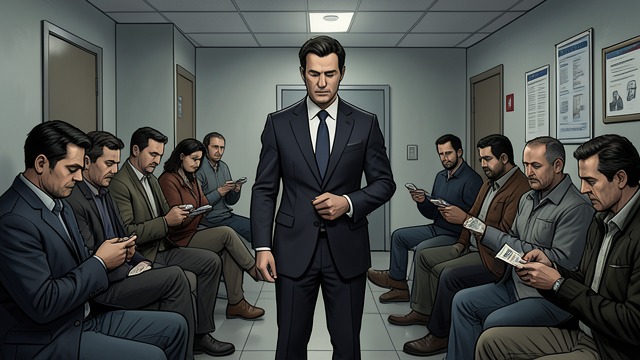
After losing his job, Fabian travels between agencies that repeatedly tell him he is in the wrong place or not yet officially unemployed. Each referral consumes time and bus fare without bringing him closer to assistance or work.
Idleness imposed by procedure
In the waiting rooms, other job seekers calculate how little their benefits provide and describe the cost of repeated applications. Fabian’s enforced inactivity is not a private preference but an institutional outcome: administrative routines make unemployed people spend their limited resources proving a condition everyone can already see.
Progress Without Redemption

Progress Without Redemption
A questionable new position
Back in his hometown, Fabian considers accepting a job connected to the right-leaning newspaper Tagespost. He imagines using advertising and commercial techniques to enlarge its circulation, even though that work could help extend an ideology he distrusts.
The unresolved meaning of work
Fabian rejects the prospect and thinks instead of retreating to the mountains, but he remains unsure whether withdrawal is another form of evasion. The novel does not offer a clean professional solution to unemployment: work may provide income while serving destructive institutions, and refusal may preserve a moral boundary while leaving the larger crisis untouched.
During Malmy’s explanation of the economic crisis after the newsroom shift
During Fabian’s conversation with the old inventor on Kreuzberg
In Fabian’s nightmare after Cornelia has left him
During Fabian’s day moving between employment offices
Near the ending, as Fabian considers work at the right-leaning newspaper
