
Political Violence and Its Human Cost
FabianThis flow traces how factional hostility in Berlin moves from ideological provocation to gunfire, police repression, and the broader prospect of national catastrophe.
increasing Bearing strength in each event
 decreasing
Bearing strength in each eventdecreasingWarnings in the News
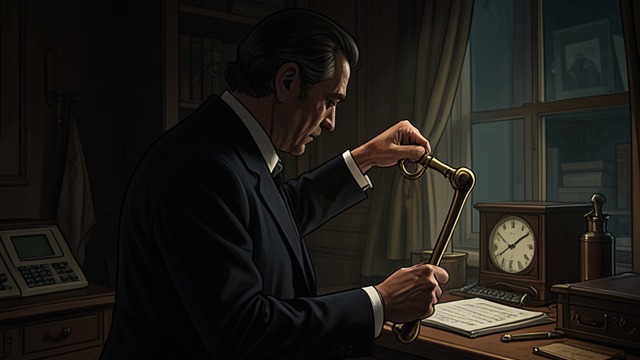
Warnings in the News
Crisis made ordinary
The headlines combine a failed political election, a threatened strike, scandals, and international events into the evening’s routine reading. Their accumulation hints at a society under strain but offers no clear account of how the separate crises connect.
A crisis without response
Jakob Fabian calls the headlines nothing special. His reaction reflects how political instability can become background noise, making it easier for readers to remain spectators even as the country approaches a breaking point.
A Bullet on the Street
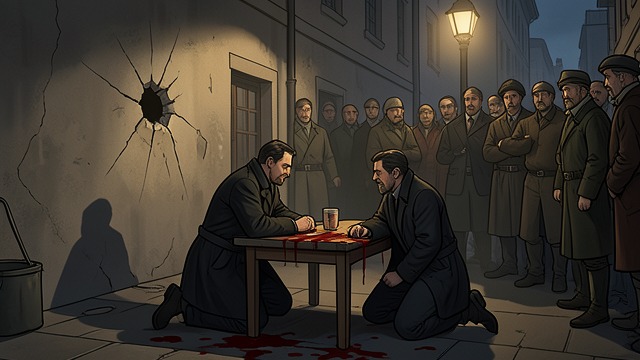
A Bullet on the Street
Provocation and retaliation
Near the Märkisches Museum, Jakob Fabian and Stephan Labude hear gunshots and find two political opponents wounded. One man says the quarrel began when a swastika was drawn on a table and escalated into a fight over political allegiance.
The conflict enters the body
The injuries make ideological antagonism concrete: each man has been shot by someone he regards as an enemy, yet both now depend on the same rescue. Jakob Fabian and Stephan Labude arrange transport to a hospital rather than letting the political dispute determine whether either man survives.
The Hospital Diagnosis
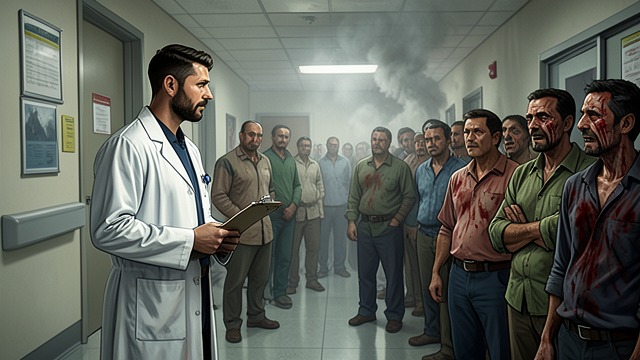
The Hospital Diagnosis
A doctor’s wider view
At the hospital, the doctor explains that several people have been admitted after political shootings, most of them workers and clerks from the suburbs. He compares the incidents to dance-hall fights, suggesting that organized political identity has failed to make the violence any less petty or personal.
A nation in fever
The doctor describes the continent as suffering from hunger typhus, with the patient beginning to strike out. His diagnosis links street violence to deprivation and social illness rather than presenting it as an isolated dispute between two individuals.
Clashes at Wedding
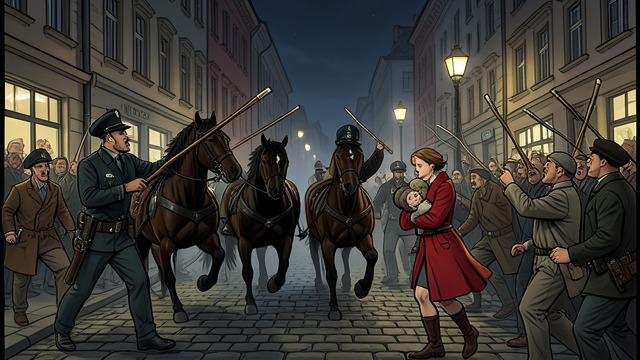
Clashes at Wedding
Police lines and workers
Jakob Fabian follows police vehicles toward Wedding, where police block a street against approaching workers. Songs turn to angry shouting, mounted police charge, gunfire breaks out, and officers use batons as the crowd disperses and regroups.
Order enforced by force
The confrontation shows that the state’s response to unrest is itself violent. Jakob Fabian walks away as the noise recedes, while a woman worries that her partner has gone back into the fighting; beyond the main clash, conflict persists in households and neighborhoods.
A Death Behind the Report
A Death Behind the Report
Selective public accounting
The next day, Jakob Fabian reads that a police officer wounded in the Wedding violence has died, while demonstrators have been injured and others arrested. The newspaper presents the police as protectors against irresponsible agitators and uses the incident to argue for maintaining police funding.
Violence justified in print
The report converts a complex confrontation into a case for stronger enforcement, leaving the conditions that brought workers into the street in the background. Its framing recalls the newsroom’s earlier willingness to fabricate or suppress information and completes the movement from street violence to political narrative.
at the opening of the story, as Jakob Fabian reads the evening papers
one night near the middle of the story, after Jakob Fabian and Stephan Labude leave a dance hall
immediately after the shootout near the Märkisches Museum
the night Cornelia Battenberg leaves Jakob Fabian
the morning after the Wedding clashes
