24-Hour Book Retention Rule
Fahrenheit 451The 24-Hour Book Retention Rule is a formal policy within the fireman system of Ray Bradbury's Fahrenheit 451 that permits a fireman who has inadvertently taken a book home to retain it for exactly one day before it must be surrendered for burning. The rule functions as a calculated concession to human curiosity, a temporary safety valve designed to contain and neutralize the very impulse it appears to indulge. By granting a brief, legally sanctioned window for private examination, the system transforms a potential act of rebellion into a self-correcting procedure, ultimately reinforcing the authority it seems to relax.
Origin and Official Stated Purpose
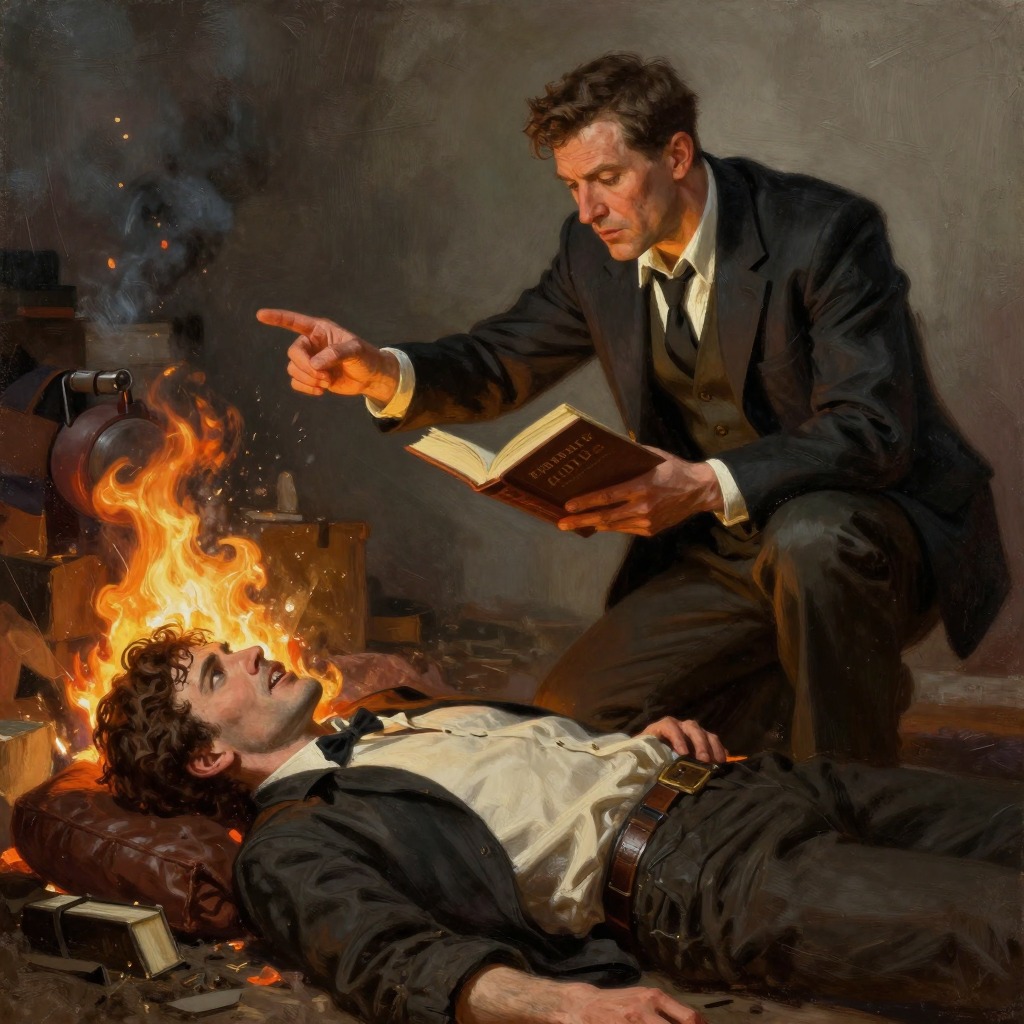
The rule is articulated by Captain Beatty during his visit to Montag's home after Montag has feigned illness. When Montag, testing the boundaries of his situation, asks hypothetically what would happen if a fireman "accidentally, really not, intending anything, takes a book home with him," Beatty responds with practiced ease. He describes the scenario as "a natural error" driven by "curiosity alone" and explains the department's response: "We don't get over-anxious or mad. We let the fireman keep the book twenty-four hours. If he hasn't burned it by then, we simply come and burn it for him." The rule is presented not as a punishment but as a procedural grace period, a gesture of understanding toward a predictable human weakness. Beatty's tone is reassuring, almost paternal, as he frames the policy as a routine part of firehouse management rather than an acknowledgment of any legitimate value in the books themselves.
Operational Mechanics and Enforcement
The rule operates on a strict timeline: the fireman is granted exactly twenty-four hours of unsupervised possession, after which the book must be destroyed either by his own hand or by the firemen themselves. The policy implicitly assumes that the fireman will comply, but it also contains a built-in enforcement mechanism—the threat of a visit from Beatty or another captain to carry out the burning if the fireman fails to do so. This dual structure creates a psychological pressure that is more insidious than outright prohibition. The fireman is given a taste of forbidden knowledge but is simultaneously reminded that his every move is monitored and that the system will close in if he oversteps. The rule thus functions as a trap disguised as a privilege, allowing the fireman to believe he has agency while ensuring that any deviation from the expected outcome—voluntary burning—will be met with swift, impersonal correction.
Montag's Experience and the Rule's Failure
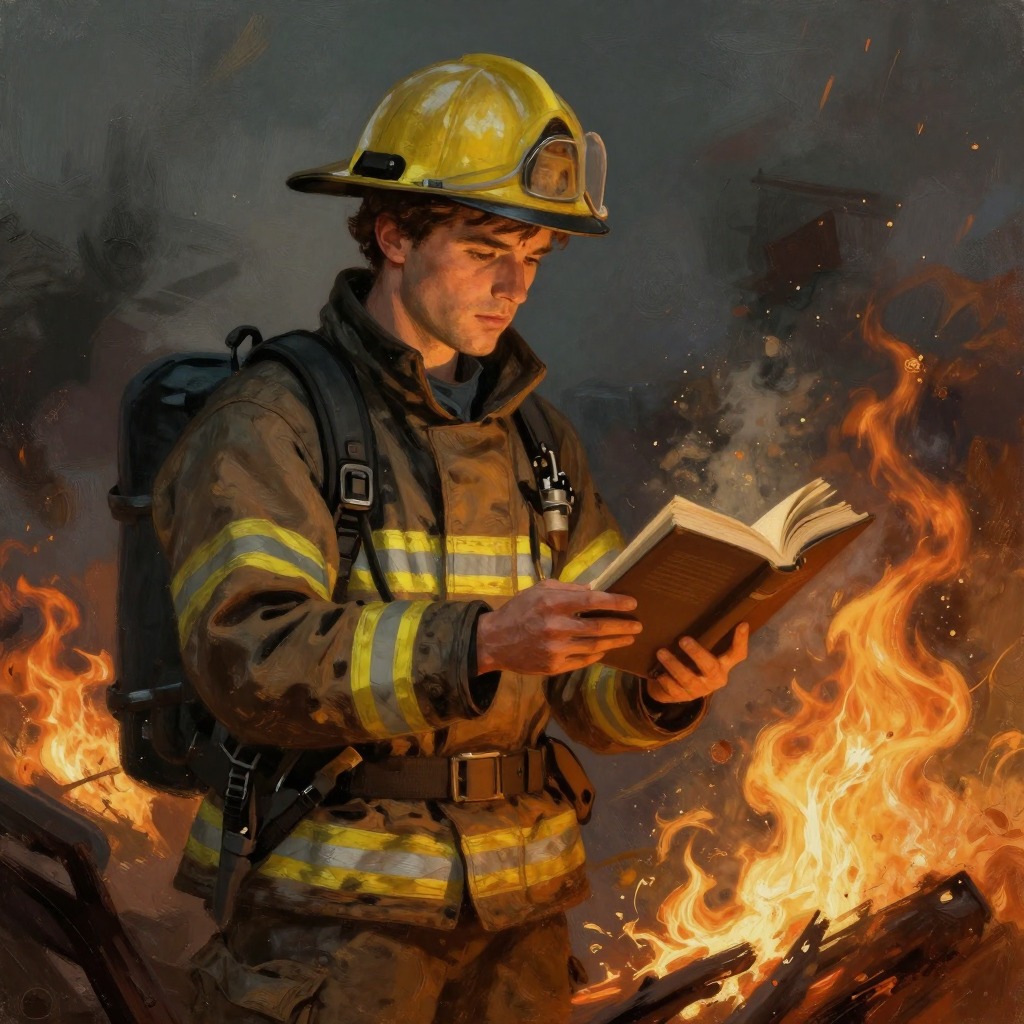
Montag's own trajectory demonstrates the rule's intended function and its ultimate failure. When he steals a book during the burning of the old woman's house, he does so not out of casual curiosity but out of a profound, involuntary compulsion—his hand acts "with a brain of its own, with a conscience and a curiosity in each trembling finger." The book he takes is not a random sample but a volume that contains the line "Time has fallen asleep in the afternoon sunshine," a phrase that blazes in his mind "as if stamped there with fiery steel." Montag hides the book under his pillow, and later, when Beatty visits, he is acutely aware of the twenty-four-hour deadline. He knows that Beatty is aware of the theft and that the clock is ticking. The rule, designed to contain curiosity, instead accelerates Montag's crisis. Rather than providing a safe outlet for his questions, the twenty-four-hour window becomes a countdown to confrontation, forcing him to decide whether to burn the book or to commit himself fully to the path of rebellion. He chooses the latter, and the rule, far from preventing his defection, becomes the catalyst that pushes him toward open defiance.
The Rule as a Reflection of Systemic Control
The 24-Hour Book Retention Rule is a microcosm of the fireman system's broader strategy of control through managed transgression. Beatty's explanation of the rule is part of a longer monologue in which he outlines the history and philosophy of book burning, arguing that the system arose not from government decree but from "technology, mass exploitation, and minority pressure." The rule fits seamlessly into this worldview: it acknowledges that curiosity is inevitable but channels it into a harmless, time-limited experiment that ends in destruction. The system does not need to eliminate curiosity entirely; it only needs to ensure that curiosity never leads to lasting change. By allowing a brief, supervised encounter with books, the rule inoculates firemen against the very danger it pretends to address. It is a form of controlled exposure, a small dose of poison that builds immunity rather than killing. In this sense, the rule is not a concession to freedom but a refinement of oppression, a technique that makes the system more resilient by appearing more lenient.
The Rule's Thematic Significance
The rule encapsulates the novel's central tension between knowledge and power, freedom and control. It represents the fireman system's attempt to manage the dangerous allure of books by incorporating it into the system itself. The twenty-four-hour window is a parody of genuine intellectual freedom: it offers the appearance of choice while ensuring that the outcome is predetermined. Montag's violation of the rule—his refusal to burn the book within the allotted time—is therefore not just an act of disobedience but a rejection of the entire framework that the rule represents. He refuses to treat knowledge as a temporary indulgence, a curiosity to be satisfied and then discarded. Instead, he insists on treating it as something permanent, something worth risking everything to preserve. The rule's failure in Montag's case is a measure of the system's inability to contain the very thing it fears most: the transformative power of ideas.