Burning Bright
Fahrenheit 451Burning Bright is the title of the third and final part of Ray Bradbury's Fahrenheit 451, a section that brings the novel's central conflicts to a violent and transformative resolution. The phrase itself, drawn from William Blake's poem "The Tyger" ("Tyger Tyger, burning bright"), evokes the dual nature of fire as both a destructive and a creative force, a theme that reaches its fullest expression in this climactic sequence. Here, Guy Montag, having stolen and read books, is forced to confront the consequences of his awakening: his wife Mildred betrays him, he kills his superior Captain Beatty, he escapes the Mechanical Hound, and he ultimately finds refuge with a group of wandering intellectuals who preserve literature by memorizing it. The section ends with the atomic bombing of the city and Montag's tentative steps toward a new life, carrying the Book of Ecclesiastes in his memory.
The Burning of Montag's House and the Killing of Beatty
The section opens with Montag and the other firemen arriving at his own house, the alarm having been turned in by Mildred and her friends. Beatty, with dry satisfaction, forces Montag to burn his own home using a flamethrower, a task Montag performs with a mixture of horror and a strange, reawakened pleasure in fire. As the house collapses into red coals and black ash, Beatty arrests Montag and taunts him, revealing that he knows about the green bullet communicator given to Montag by Professor Faber. When Beatty threatens to trace the device and find Faber, Montag, in a moment of desperate fury, turns the flamethrower on him. Beatty dies in a "shrieking blaze," a "jumping, sprawling, gibbering mannikin," and Montag, stunned by his own act, then knocks out the other two firemen and destroys the Mechanical Hound with a burst of flame. This sequence represents the culmination of Montag's rebellion: he has not only rejected his former life but has physically destroyed its representatives, crossing a line from which there is no return.
The Escape and the River
After killing Beatty, Montag, wounded in the leg by the Hound's needle, flees through the city. He pauses to plant books in a fireman's house, then makes his way to Faber's home, where he receives instructions to follow the river and the abandoned railroad tracks into the country. Faber gives him a valise of old clothes and whisky to mask his scent, and Montag, after a harrowing crossing of a wide boulevard where a carful of teenagers nearly runs him down, finally reaches the river. He strips, douses himself with whisky, and floats downstream, leaving the city and its pursuit behind. The river becomes a symbol of cleansing and rebirth, carrying him away from the "unreality" of the city toward a "reality that was unreal because it was new." As he floats, he reflects on the nature of fire and time, realizing that "he must never burn again in his life."
The Book People and the Bombing
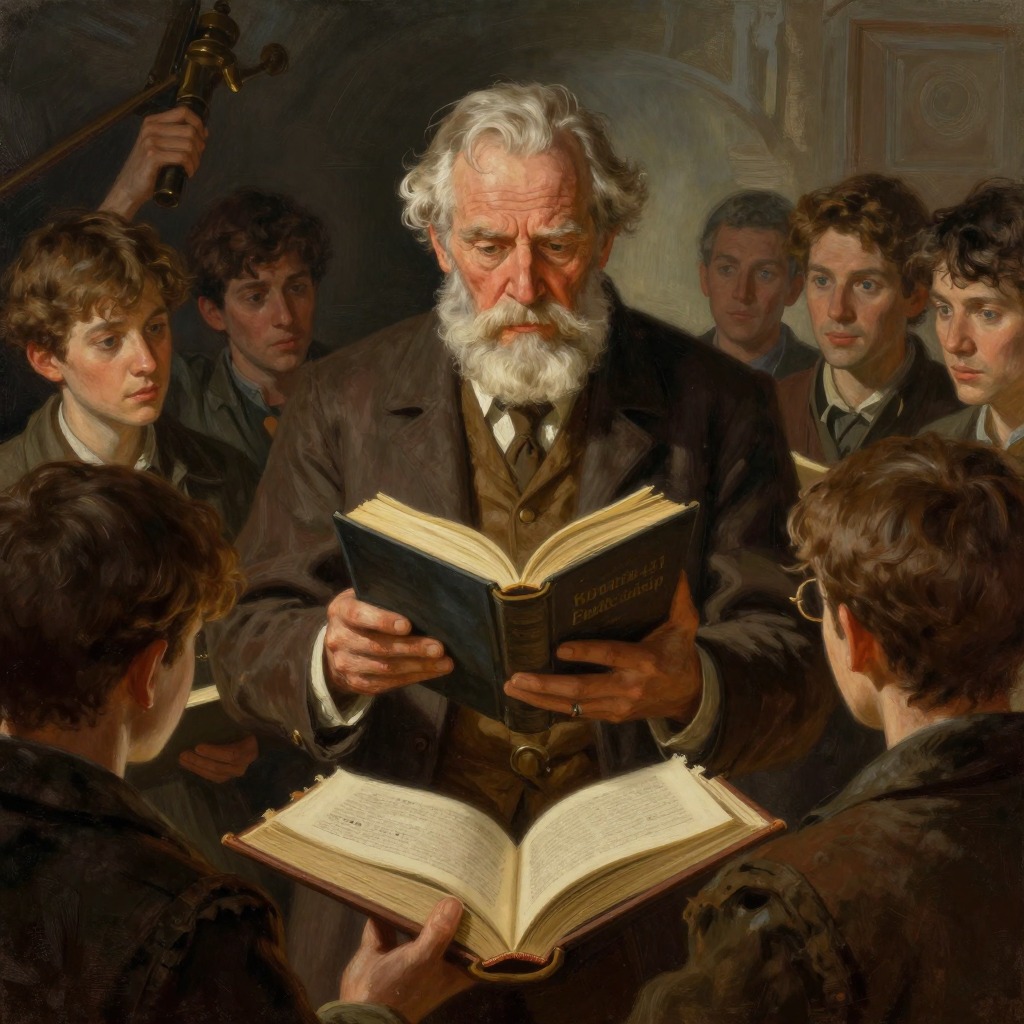
Montag emerges from the river and follows the railroad tracks until he finds a campfire surrounded by five men. Their leader, Granger, welcomes him, explaining that they are part of a loose network of "book people" who have memorized entire works of literature to preserve them from destruction. Granger introduces the others as former professors and scholars, each carrying a book in his memory: "I am Plato's Republic," says one; "Mr. Simmons is Marcus." Montag, who has lost the physical Bible he stole, discovers that he has retained part of the Book of Ecclesiastes and Revelation in his memory, and Granger tells him that if anything happens to the man who carries Ecclesiastes, Montag will become that book. As they sit by the fire, the city is destroyed by atomic bombs, and Montag, lying flat on the ground, remembers the words of Ecclesiastes. The war ends as quickly as it began, and the men, after a breakfast of bacon, begin walking north along the river, with Montag leading the way, carrying the seed of knowledge into a new world.
Thematic Significance
Burning Bright is the novel's most intense and thematically dense section, bringing together the motifs of fire, destruction, and rebirth that have run throughout the story. The title, with its allusion to Blake's tiger, suggests a world of fierce, untamed energy that can be either creative or destructive. Montag's journey from burning his own house to witnessing the city's annihilation to joining the book people enacts a kind of death and resurrection: he loses his wife, his home, his job, and his former identity, but gains a new purpose as a keeper of memory. The section also resolves the novel's central debate about the value of books, as the book people demonstrate that the true value of literature lies not in the physical objects but in the ideas and experiences they contain, which can be preserved in human memory even when the books themselves are gone. The final image of Montag walking north, with the words of Ecclesiastes and Revelation in his mind, offers a tentative hope that knowledge and humanity may survive even the most complete destruction.