Captain Beatty
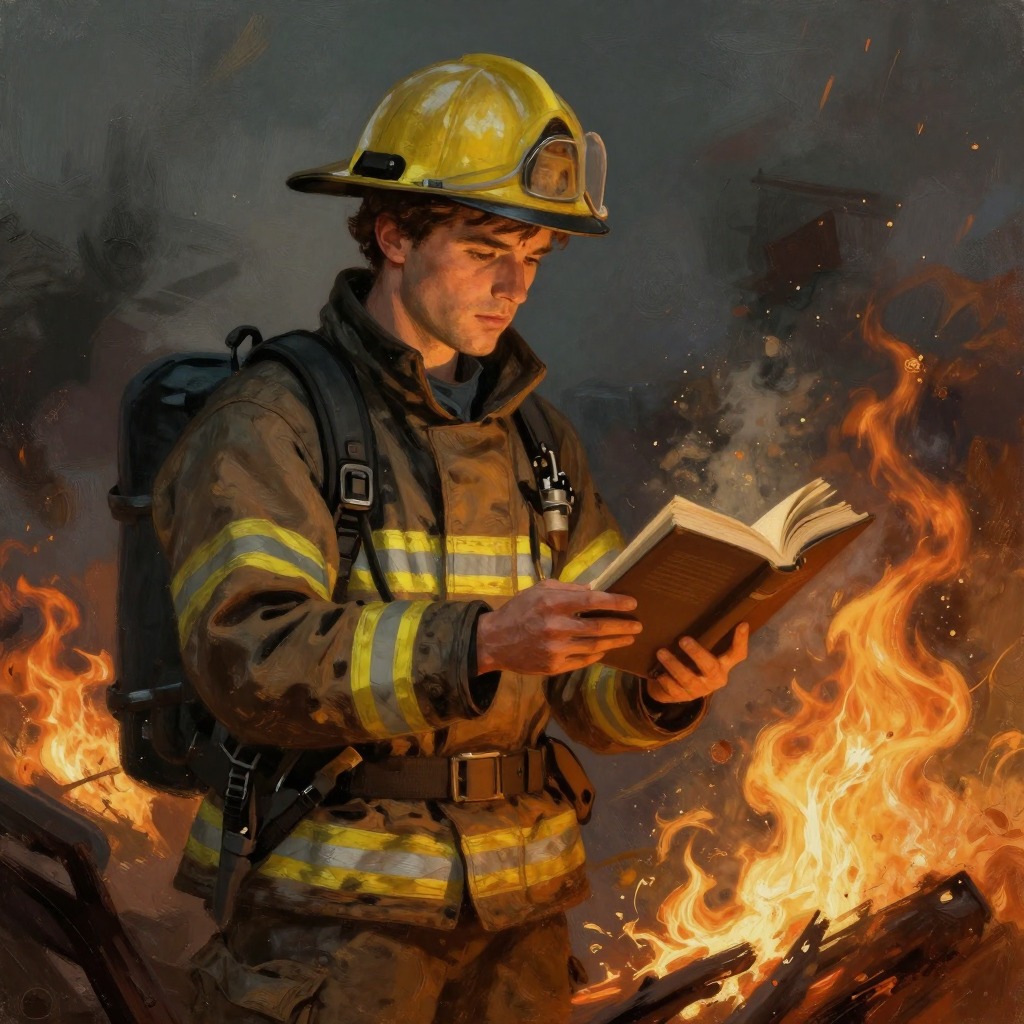
Fahrenheit 451Captain Beatty is the fire chief of the unnamed city's firemen, a man whose pink, phosphorescent cheeks and candy-pink gums mask a deep and unsettling erudition. He is the novel's most articulate defender of the status quo, a figure who has read widely but uses his knowledge as a weapon to maintain the system of censorship and enforced happiness. His role is not merely that of an enforcer; he is the system's philosopher, its historian, and its most persuasive apologist, making him a far more complex and formidable antagonist than a simple tyrant.
Identity and Background
Beatty is a man of considerable learning, a fact he reveals with a mixture of pride and contempt. He admits to having read a few books in his time, "to know what I was about," and he can quote from a vast range of sources, from Shakespeare and Alexander Pope to Sir Philip Sidney and Dr. Johnson. He is intimately familiar with the history of his profession, tracing its origins not to the official founding in 1790 by Benjamin Franklin but to the Civil War and the rise of mass media. He explains that the firemen's role evolved from putting out accidental fires to becoming "custodians of our peace of mind," a shift driven by technology, mass exploitation, and minority pressure, not by government decree. This historical knowledge gives his arguments a veneer of inevitability and authority, making him a formidable opponent for the intellectually awakening Montag.
Role as Antagonist and Philosopher of Censorship
Beatty's primary function is to confront Montag's growing dissent with a fully articulated, cynical philosophy. He argues that books are dangerous because they create conflict and unhappiness, and that the firemen's job is to protect society from the "torrent of melancholy and drear philosophy." He frames censorship as a benevolent act, a way to ensure everyone is happy by making them all alike. "We must all be alike," he declares. "Not everyone born free and equal, as the Constitution says, but everyone made equal." He sees the firemen as the "Happiness Boys," standing against the small tide of those who would make everyone unhappy with conflicting theory and thought. His arguments are not those of a brute but of a sophisticated intellectual who has chosen the path of comfort and control over the difficult work of critical thinking.
Key Actions and Confrontations with Montag
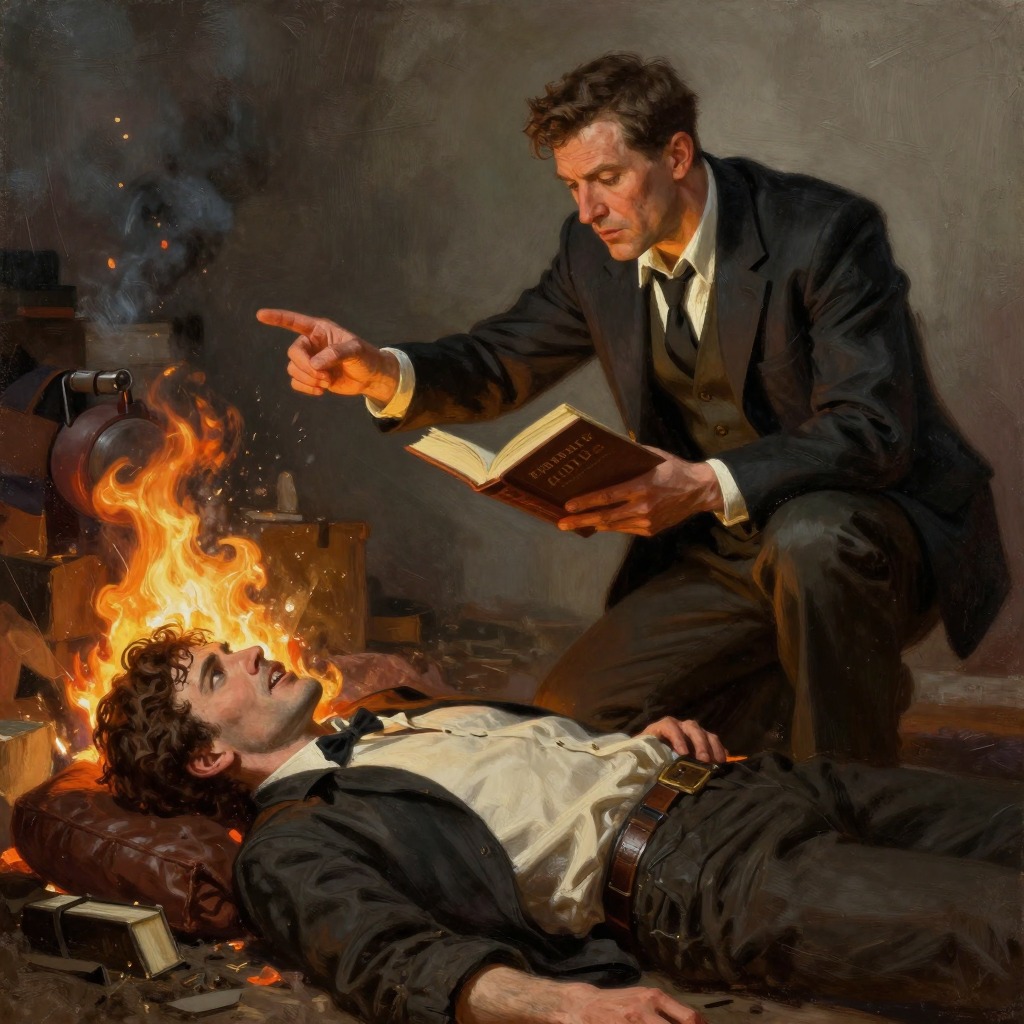
Beatty's interactions with Montag are a series of psychological and intellectual battles. He visits Montag when he feigns illness, delivering a long, mesmerizing lecture on the history of censorship, designed to reassure and re-indoctrinate him. He uses his knowledge of literature to parry Montag's every thought, quoting from the very books Montag is beginning to cherish. In a dream he recounts, he imagines a debate where he "calmly parried every thrust" Montag made, using quotes to rebut him on every point. This tactic is designed to confuse and overwhelm Montag, to show him that books themselves are treacherous and can be used to support any argument. Beatty's final confrontation comes at Montag's own house, where he forces Montag to burn it himself, a cruel act of psychological domination. He reveals that he knew about Montag's book all along, having sent the Mechanical Hound to threaten him, and that Mildred and her friends had turned in the alarm. His taunting and needling, his refusal to back down even when faced with a flamethrower, ultimately provoke Montag to kill him. Montag later realizes that Beatty had wanted to die, that he had stood there "joking, needling" until he got someone mad enough to end his life.
Relationships and Conflict
Beatty's central relationship is with Montag, whom he treats with a mixture of paternal condescension and predatory interest. He sees Montag's rebellion as a predictable phase, an "itch" that every fireman gets, and he believes he can talk him back into line. He is dismissive of Clarisse McClellan, calling her a "time bomb" and saying she is "better off dead." He has a record on her family and has watched them carefully, viewing her as a product of a bad home environment. His relationship with the other firemen is one of casual authority; he plays poker with them and jokes, but he is always in control. He is a man who has no real peers, only subordinates and targets.
Change and Ending
Beatty does not undergo a change; he is a static character who remains committed to his philosophy until the end. His death is a direct consequence of his own actions. After Montag kills him with the flamethrower, Montag reflects that Beatty had wanted to die, that he had deliberately provoked the confrontation. This suggests a deep-seated despair or self-loathing beneath his confident exterior. He is a man who has read the books and found them wanting, who has chosen the path of destruction over the difficult path of meaning, and who ultimately engineers his own destruction at the hands of the man he was trying to control.
Thematic Significance
Beatty is the living embodiment of the novel's central paradox: the most dangerous enemy of knowledge is not ignorance but a learned cynicism that uses knowledge to justify its own destruction. He represents the intellectual who has sold out, who has taken the side of the majority and the state. His arguments are a powerful and seductive articulation of the society's values, making him a far more compelling antagonist than a simple brute. He is the voice of the system, and his death is a necessary but not sufficient step in Montag's liberation. He leaves behind a legacy of doubt and a warning about the seductive power of a comfortable, thoughtless existence.