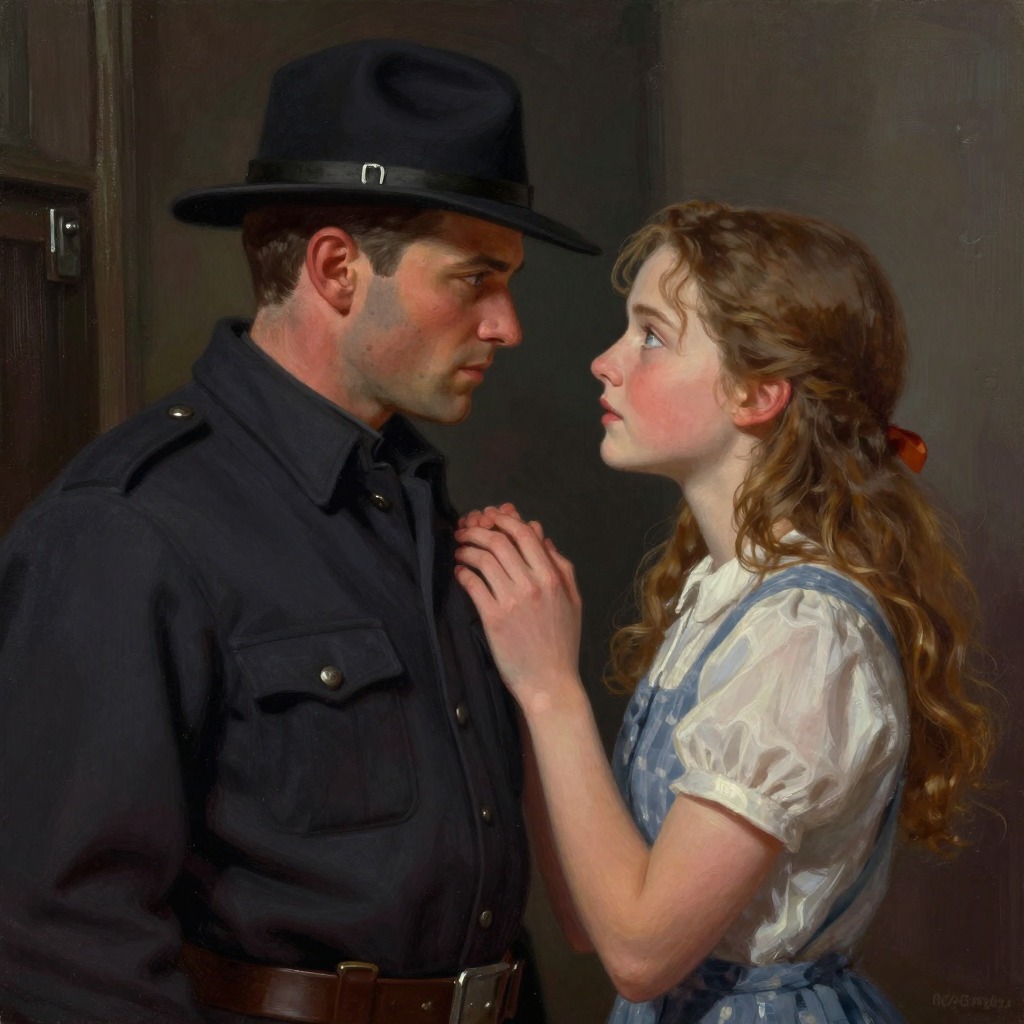
Clarisse McClellan
Fahrenheit 451Clarisse McClellan is the seventeen-year-old girl who, through a series of chance encounters, awakens Guy Montag from his numbed existence as a fireman and sets him on the path to rebellion. She is the novel's moral and emotional catalyst, a figure of natural curiosity and human connection in a world that has systematically suppressed both. Her brief presence in Montag's life—spanning only a few days—unlocks a flood of repressed feeling and thought, and her reported death deepens his crisis, pushing him irrevocably toward dissent.
Identity and Background
Clarisse McClellan is introduced on a moonlit autumn night, walking alone and stirring the fallen leaves with her shoes. She is described as having a slender, milk-white face and dark, shining eyes that seem to fix on the world with tireless curiosity. She tells Montag she is seventeen and "insane," a phrase her uncle uses to describe the two qualities that always go together. Her family is unusual in their society: they keep their house brightly lit late at night, sit around talking, and have been arrested for being pedestrians and for driving slowly. Clarisse herself is under psychiatric observation, required to see a psychiatrist who calls her "a regular onion" because he must keep peeling away layers. She collects butterflies, hikes in forests, and sometimes just sits and thinks—activities that mark her as dangerously anti-social in a world that values constant, mindless stimulation. Her uncle, a recurring figure in her conversation, has taught her to question the world around her, telling her about front porches, slow driving, and a time when children did not kill each other.
Life and Plot Trajectory
Clarisse's interactions with Montag unfold over a single week. On their first meeting, she walks him home and asks if he is happy—a question that shatters his complacency. Over the following days, she appears repeatedly: shaking a walnut tree, knitting a blue sweater, leaving bouquets of late flowers and handfuls of chestnuts on his porch. She walks him to the subway each day, talking about the stretched-out billboards, the dew on the grass, the man in the moon, and the way people no longer talk about anything real. She tells him that he is not like other firemen—that when she speaks, he looks at her, and when she mentioned the moon, he looked at the moon. After seven days, she vanishes. Montag learns from his wife Mildred that Clarisse's family has moved away and that she is dead, run over by a car four days earlier. Mildred delivers the news casually, having forgotten to mention it. Montag later wonders whether the teenagers who nearly run him down in their beetle were the ones who killed her.
Key Actions and Objectives
Clarisse's primary action is simply to be present and to ask questions. She does not preach or argue; she observes, wonders, and invites Montag to see the world differently. She tells him she loves to smell things and look at things, to stay up all night walking and watch the sun rise. She rubs a dandelion under her chin to test whether she is in love, and when she tries it on Montag, she tells him the flower shows he is not in love with anyone—a revelation that disturbs him deeply. She explains that she is "very social indeed," but that social means talking about things like how strange the world is, not gathering people together and then not letting them talk. She describes her school as a place where they never ask questions, where the answers are run at them "bing, bing, bing," and where students are left so exhausted they can only go to bed or head for a Fun Park to bully people. Her objective is not to change Montag but to be herself, and that very authenticity becomes the force that changes him.
Relationships and Conflict
Clarisse's relationship with Montag is one of genuine, unforced connection. She tells him she is not afraid of him, unlike most people who are afraid of firemen. He feels that she is walking in a circle around him, turning him end for end, shaking him quietly and emptying his pockets without moving herself. She has an "incredible power of identification," anticipating his every gesture and thought. Montag feels that if his eye itched, she might blink; if his jaw stretched, she would yawn. She is the first person in years who has looked straight at him as if he counted. The conflict in their relationship is not between them but between Clarisse and the society that finds her threatening. Captain Beatty later tells Montag that Clarisse was "a time bomb," that her family had been feeding her subconscious, and that she was better off dead. Beatty dismisses her love of flowers, butterflies, leaves, and sunsets as "trash," and accuses her of making others feel guilty with her "holier-than-thou silences."
Change and Ending
Clarisse's death is reported by Mildred in a single, offhand sentence: "I think she's dead." Montag receives the news in the dark bedroom, lying beside his wife, and the revelation deepens his already profound unease. He later stands outside her house and sees that it is completely dark and deserted. In the final pages of the novel, as the bombs fall on the city, Montag cries out to her to run, even though he knows she is already dead. Her absence haunts him throughout his flight and his eventual joining of Granger's group of wandering intellectuals. He walks along the railroad tracks and is suddenly certain that Clarisse had once walked there, too. Her memory becomes a touchstone for the world he is trying to reclaim.
Narrative Role and Evaluation
Clarisse McClellan functions as the novel's conscience and its lost possibility. She is the character who, in a few short days, shows Montag what it means to be fully alive: to notice the dew on the grass, to taste the rain, to smell old leaves like cinnamon, to ask why. Her death—casual, unremarked, absorbed into the background noise of a violent society—becomes the emblem of everything the novel condemns. She is also the figure who, in Montag's memory, remains connected to the books he later tries to save. When he reads the line "We cannot tell the precise moment when friendship is formed," he thinks of her. When he reads "That favourite subject, Myself," he reflects that Clarisse's favourite subject was everyone else. She is the human face of the quality, leisure, and right to act that Faber later identifies as the three things missing from the world. In the end, Clarisse is not a character who develops; she is a character who is lost, and that loss is the wound that will not heal, the spark that finally ignites Montag's rebellion.