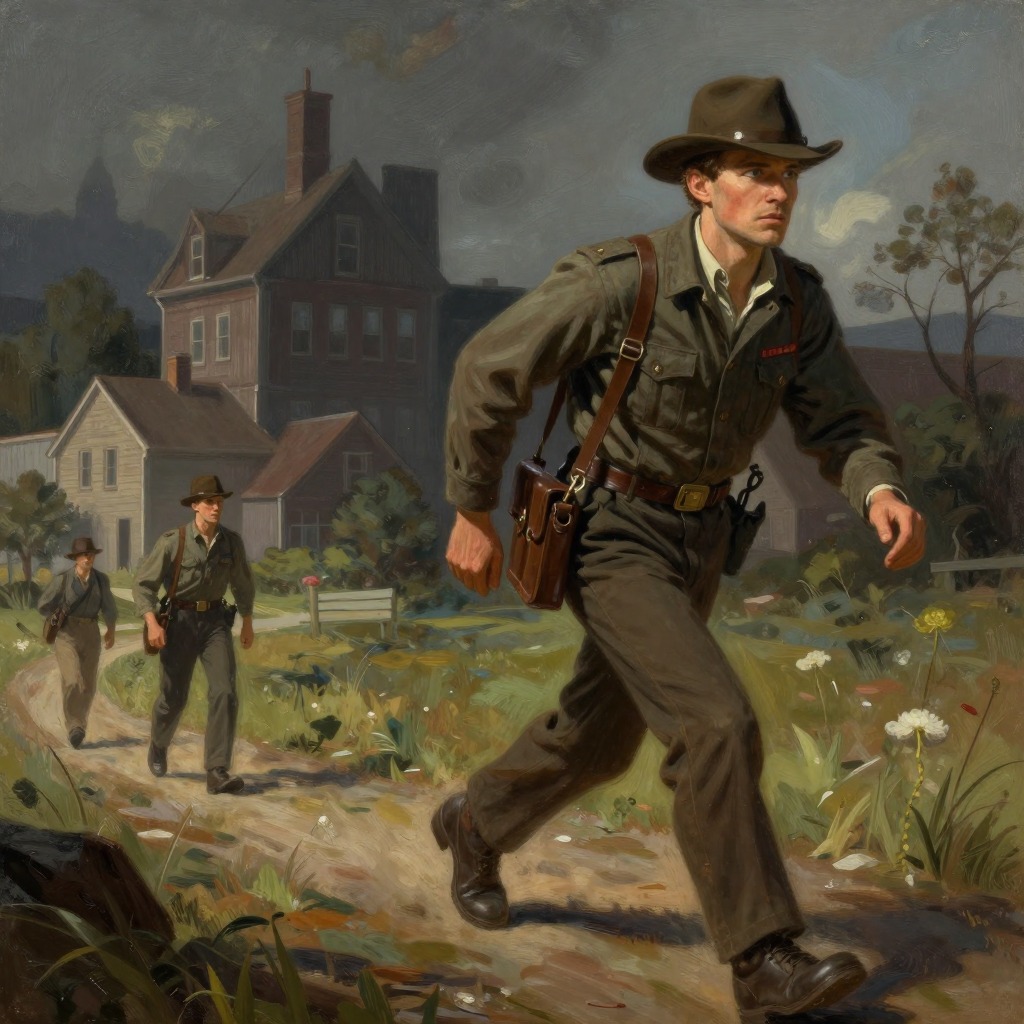
Escape across the boulevard
Fahrenheit 451After killing Captain Beatty and destroying the Mechanical Hound, Montag stumbles through back alleys, his leg wounded by the Hound's needle, carrying four salvaged books. He knows the police are hunting him and that helicopters are sweeping the sky. The alley opens onto a wide, empty thoroughfare ten lanes across, a "vast stage without scenery" under high white arc-lamps, where crossing means exposure to certain capture or death. He must walk, not run, to avoid drawing attention, but the boulevard is a trap: a car could appear at any moment, and the police are already broadcasting his description.
The Crossing
Montag stands at the edge of the boulevard, calculating the distance. It seems like a hundred yards, and he figures a slow stroll might take thirty or forty seconds. A car three blocks away could cover that distance in fifteen seconds. He puts his right foot out, then his left, and begins to walk, forcing himself not to count his steps, looking neither left nor right. The light from the overhead lamps is as bright and revealing as midday sun. He hears a car picking up speed two blocks away on his right; its headlights jerk and catch him. He falters, takes a few quick running steps, then talks out loud to himself and pulls up to a stroll again. The beetle roars toward him, its engine whining higher, reaching 120, then 130 miles per hour. The heat of the racing headlights burns his cheeks and flushes sweat out all over his body. He breaks into a run, legs pumping, dropping a book, gasping, flailing, the beetle scuttling after him, two hundred feet away, then one hundred, then ninety, eighty, seventy. He stumbles and falls, certain he is done.
The Near Miss
An instant before reaching him, the wild beetle cuts and swerves away. Montag lies flat, his head down. Wisps of laughter trail back with the blue exhaust. He lifts his hand and sees, across the extreme tip of his middle finger, a faint sixteenth of an inch of black tread where a tyre had touched in passing. It was not the police, he realizes, but a carful of children, ages twelve to sixteen, out for a night of racing, who had seen a man strolling—a rarity—and simply decided to "get him," not knowing he was the fugitive. They would have killed him for no reason at all. He wonders if they were the ones who killed Clarisse McClellan. The thing that saved him was falling flat: the driver, seeing Montag down, instinctively considered that running over a body at that speed might flip the car. If Montag had remained upright, he would have been hit.
Aftermath and Significance
Montag picks up the spilled books, not remembering bending or touching them, and keeps moving them from hand to hand as if they were a poker hand he cannot figure. He reaches the safety of a dark alley, shivering, looking back as the beetle skids back to the centre of the avenue, laughter whirling in the air, gone. The crossing is a decisive turn in his escape: it strips away any remaining illusion that the city holds anything for him, confirming that even random citizens are potential killers. It also reveals his own resourcefulness—the instinct to fall flat, the forced calm—and deepens his grief for Clarisse, whose death now seems part of the same casual violence. The boulevard, a clean, empty arena, becomes a stage for his final performance as a hunted man, after which he is truly alone, heading toward the river and the unknown.